
Where the Water Moves One Way and the Truth Moves Another
The Silence People Keep When the World Refuses to Make Sense
The river had always flowed uphill, though no one in Bellmere ever said it that way.
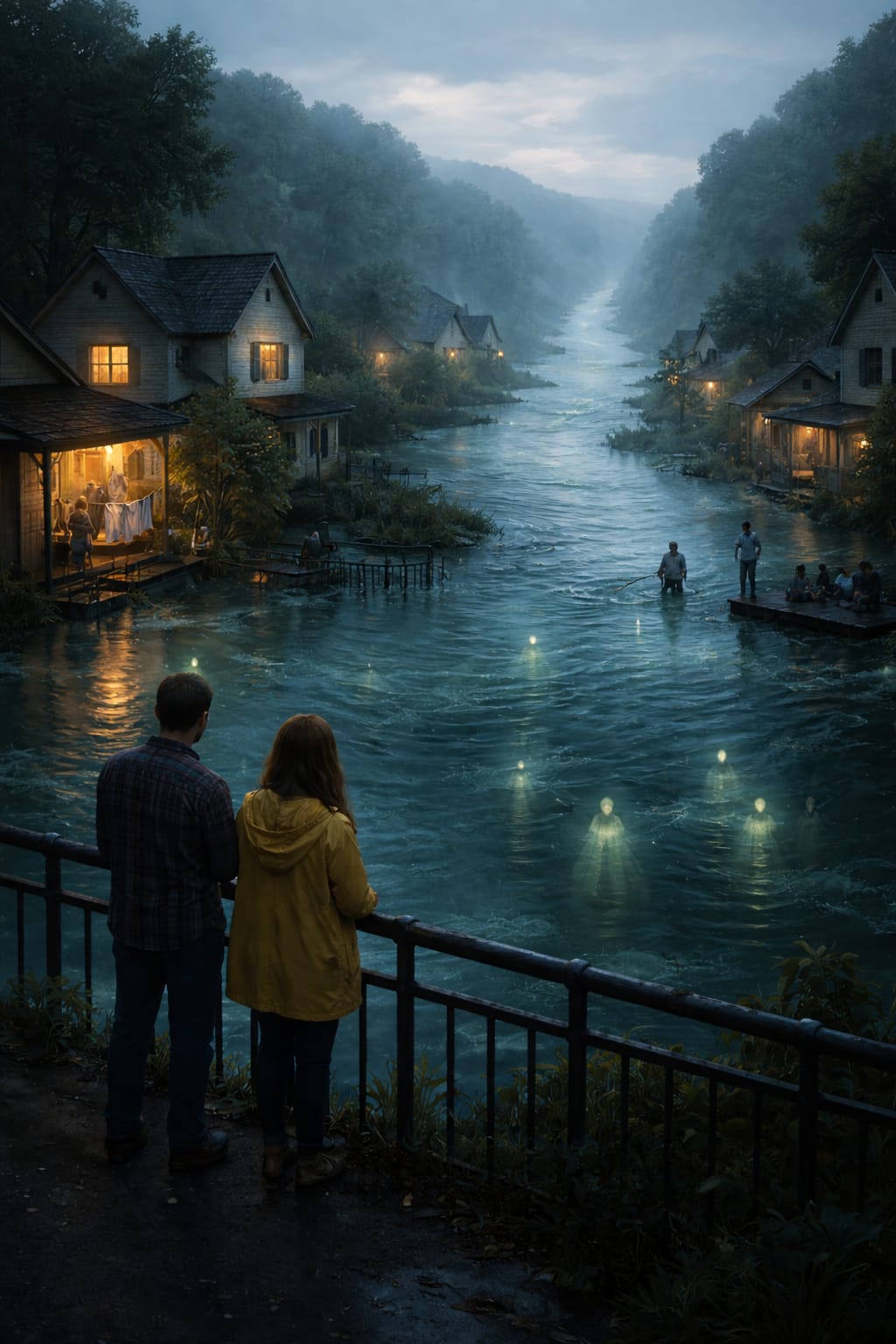
They said instead that the town was “cleverly engineered,” or that the water simply “knew where it needed to go.” Children were taught in school that Bellmere sat on a rare but perfectly respectable incline that confused outsiders more than locals. On field trip days, Mrs. Carrow would line the class up along the iron railing and point toward the water climbing, slow and patient, toward the distant hills.
“Gravity is funny here,” she would say, tapping the rail with her ring. “Remember that.”
No one asked why.
In the mornings, the river looked like a long sheet of glass being gently pulled backward. Leaves did not drift downstream; they slid in a neat procession toward the narrow throat of the valley, where the water disappeared into a tunnel that had no visible opening. It was not a drain, exactly. More like a mouth.
People built their houses facing it.
The Thomases lived closest. Their back porch hovered maybe ten feet from the bank, a cheerful wraparound with white railings and a pair of rocking chairs that had never rocked. The chairs always pointed the same way, toward the river, as if waiting for something to happen that never did.
Every Tuesday, Mrs. Thomas hung out laundry.
The shirts floated.
They did not billow. They did not catch wind. They simply lifted, as if an invisible hand were holding them up from beneath. The cloth hovered two, sometimes three feet above the line, sleeves drooping like the arms of someone half-asleep. Neighbors would pause in their walks, glance over, and call out pleasant things.
“Looks breezy today, Linda!”
“Good drying weather!”
Mrs. Thomas would smile and pin down another sock, though the pins never stayed where she placed them. They slid toward the river and hung there, suspended, trembling slightly.
At night, when the town slept, the river grew louder. It wasn’t rushing, exactly. It was breathing. A slow, wet inhale that seemed to come from under every floorboard. Windows rattled. Picture frames tilted, just enough to be noticed and then righted in the morning.
No one kept a clock that worked properly.
Clocks ran backward, then forward, then stopped altogether. The school had removed them from classrooms years ago. Instead, bells rang when someone remembered to ring them. Sometimes lessons lasted hours. Sometimes they ended abruptly after twenty minutes.
“Time is fluid here,” Principal Hale liked to say, chuckling to himself as if he had made a clever joke.
People nodded.
They did not mention how the river carried old newspapers upstream, headlines still legible: BELLERE BRIDGE COLLAPSES — 1978. MAYOR RESIGNS — 1984. FIRE AT MILL — 1992. The papers arrived whole, dry, and perfectly preserved, as if they had been waiting somewhere dark to return.
Fishermen came anyway.
They stood in waders along the bank, casting lines not into the river but above it, as if the fish swam in the air. Occasionally, a silver body would break the surface—not up, but sideways—slipping through the water’s skin like a door opening.
No one reeled in their lines.
They waited. The fish always came to them.
Mr. Calder, who ran the general store, kept a jar of river water on his counter. He claimed it was good for headaches. Customers would take a small sip, wince at the salt, and thank him.
“Bracing,” they said.
The water never evaporated.
Once, a tourist from out of town wandered in, sunburned and loud, asking why the river flowed the wrong way. Mr. Calder had stared at him for a long moment, then laughed.
“Wrong way from where?” he asked.
The man had opened his mouth to answer, then closed it. He left without buying anything.
After that, the town agreed, wordlessly, that no more tourists were needed.
The bridge was the strangest part.
It arched over the river like any other bridge, wooden planks worn smooth by decades of feet. But if you stood in the middle and looked down, you could see—very faintly—the reflection of another bridge beneath the water, upside down, perfectly aligned.
Sometimes people crossed both.
You could step off the bridge and feel yourself descending, not falling, but settling into the water as if it were a staircase made of light. Your reflection would take your place above, walking where you had been. From the bank, no one could tell the difference.
The first time it happened, years ago, a little girl named Mara had stepped off during a game of tag. She had not screamed. She had simply disappeared into the river as neatly as if she had stepped through a doorway.
Her friends had waited on the bridge, breathless, expecting her to resurface.
She never did.
Mrs. Carrow had told the class that Mara had moved away. “Her family needed to be closer to the mountains,” she said, pointing upstream. “She’s very happy there.”
Everyone accepted this.
On Sundays, the church bells rang in reverse order, lowest note first, climbing slowly into something thin and sharp that made teeth ache. Inside, Reverend Pike spoke about patience.
“The river reminds us that we do not always understand the direction of things,” he said, folding his hands. “But we trust that direction exists.”
The congregation murmured amen.
Outside, the river rose another inch.
By late summer, basements filled with water that felt heavier than water. It pressed against legs like something alive. People installed pumps that hummed all night, pushing the river back toward itself.
The pumps failed.
Instead of panicking, neighbors helped neighbors move furniture to higher floors. Rugs were rolled. Photo albums placed carefully on stair landings. Children learned to sleep with their feet tucked up, so the dark, cold wet would not curl around their toes.
The water smelled faintly of iron and flowers.
Mrs. Thomas’s laundry line had long since been abandoned. Her shirts hovered now in the living room, drifting just above the water that covered the first floor. When visitors came, she offered tea and pointed out how the light refracted through the cloth.
“Like being underwater,” she said pleasantly.
The town council met in the high school gym, which remained dry. They debated zoning, garbage collection, and whether the river should be called a river at all.
“It’s still doing what rivers do,” Councilman Breck argued, slapping his palm against a folding chair. “Moving. Circulating. We just happen to be… in its way.”
No one suggested moving.
At dusk, the river reached the foot of the gym steps. Children sat on the bleachers and dangled their legs over the edge, watching the water ripple without touching them. Occasionally, a reflection would rise—of a hand, a face, a familiar silhouette—hovering just beneath the surface.
The reflections smiled.
No one waved back.
Mrs. Carrow gathered her students around her and told them to keep their voices low. “The water listens,” she said, though she did not sound afraid.
That night, the town slept as it always had, in houses half-filled with river, in rooms where pictures floated gently off walls. Dreams came thick and salt-tasting.
In the early hours before dawn, some people woke to the sensation of being lifted.
They felt their bodies grow lighter, as if the river were finally accepting them. They did not fight it. They did not call out. They simply slid from their beds and stepped down into the dark, careful not to splash.
From the shore, those who remained saw lights moving beneath the surface—soft, drifting, upright figures walking along the inverted bridge below.
At breakfast, the town spoke of a “quiet night.”
“Not much noise from the pumps,” Mr. Calder said, stirring his coffee.
“Peaceful,” Mrs. Thomas agreed, wringing out a towel that had not been wet.
They did not mention the empty beds, the shoes neatly lined up by the door, the way the river now lapped against the very edge of the gym floor.
And still the water moved uphill, patient and unwavering, carrying with it everything Bellmere pretended was not already gone.
About the Creator
Lawrence Lease
Alaska born and bred, Washington DC is my home. I'm also a freelance writer. Love politics and history.
Keep reading
More stories from Lawrence Lease and writers in Fiction and other communities.
At 2:14, the Earth Listens
The first time Mara noticed the hour, she assumed it was coincidence. 2:14 a.m. The clock on her bedside table glowed that soft, watery green that feels almost alive in a dark room. She had rolled over half-asleep, arm searching for Elias out of habit, and instead of warm skin she found cold sheets and the faint dip of where his body had been moments before.
By Lawrence Lease12 days ago in Fiction
Love as Consumption
I could feel it in the pit of my stomach. That inevitable crush. I knew as soon as I walked through the door, we’d have words — stern, unproductive words. The atmosphere choked me, the scent of Bolognese burned into the bottom of the pan reminding me why it’s best I do the cooking, and of the air of unfiltered bitterness that had been present for years.
By Paul Stewart4 days ago in Fiction



Comments (1)
So vivid and full of detail! A great story.