
A New World in the Shadows: Uranus Gains a Newly Discovered Moon, S/2025 U1
Space

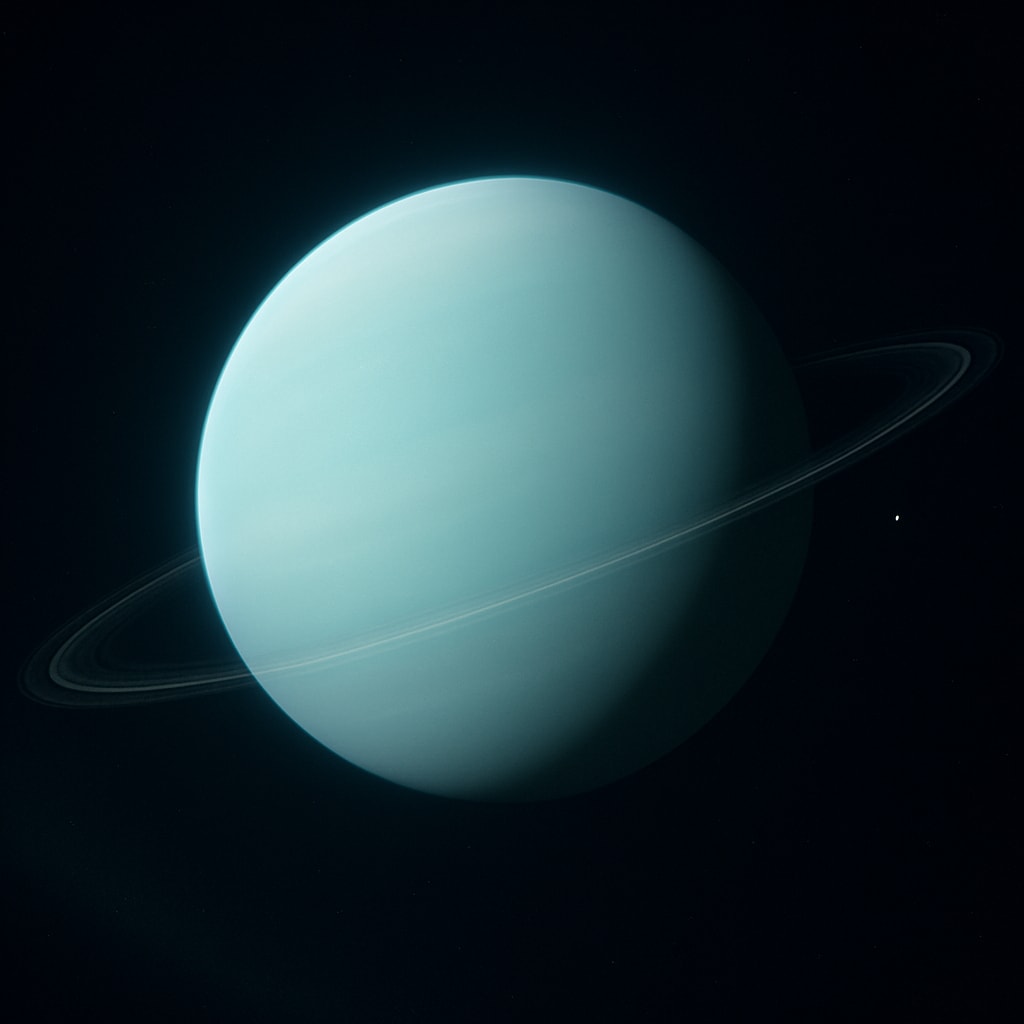
For decades, Uranus seemed like one of the quietest and least explored giants in our Solar System. Its pale-blue disk, distant and dim, concealed only a modest collection of known moons—until now. In 2025, astronomers announced a remarkable discovery: a previously unseen miniature satellite orbiting Uranus. The moon, currently designated S/2025 U1, is tiny, elusive, and scientifically promising. Despite its minuscule size—no more than 8 to 10 kilometers across—it adds an important new piece to the complex and dynamic architecture of Uranus’s moon system.
The discovery was made using the extraordinary capabilities of the James Webb Space Telescope (JWST). This powerful observatory, designed to peer deeper into space than any instrument before it, demonstrated once again that the Solar System still contains secrets hidden in plain sight. The fact that such a small body could remain undetected for so long, even after the Voyager 2 flyby and decades of observations from Hubble, underscores just how faint and challenging this moon is to find.
A Moon Discovered in the Dark
S/2025 U1 was identified on a series of long-exposure infrared images captured on February 2, 2025, by JWST’s NIRCam instrument. The observing sequence consisted of ten extended exposures, each roughly 40 minutes long. These deep, high-resolution frames allowed astronomers to sift through the glow of Uranus, its rings, and its numerous inner moons to detect a point of light moving in a coherent orbital path.
The object’s properties quickly suggested that it was not an asteroid or background body. Its orbit is nearly circular and lies in Uranus’s equatorial plane—like most of the planet’s inner moons. Calculations show that S/2025 U1 orbits at a distance of approximately 56,250 kilometers from the center of Uranus, nestled between the orbits of the moons Ophelia and Bianca. Its orbital period is remarkably short: roughly 9.6 hours per revolution. The moon’s location, deep inside the system of narrow inner rings and shepherd moons, suggests that it may play a role—however subtle—in shaping the structure of those rings.
Why Was It So Hard to See?
The difficulty of detecting S/2025 U1 highlights the challenges of studying the outer Solar System. Several factors contributed to its late discovery:
- 1. It is extremely small. With a diameter estimated at under 10 kilometers, it reflects very little sunlight—far too little for Voyager 2 to detect during its brief 1986 flyby.
- 2. Uranus’s inner region is crowded and bright. Rings, dust, and nearby moons create a visually cluttered environment. A small body can easily blend into the complexity of reflected and scattered light.
- 3. Infrared sensitivity is essential. JWST’s ability to capture long-exposure, high-contrast infrared images is what finally made the moon visible. Earlier telescopes did not combine such sensitivity with the same resolution and stability.
In short, S/2025 U1 was hiding in one of the Solar System’s most difficult observational environments—until the right instrument came along.
Why This Discovery Matters
At first glance, a tiny moon might seem insignificant, but its implications are much broader.
A More Complete Picture of Uranus
With this discovery, Uranus now has 29 known moons. The addition of S/2025 U1 suggests that several more small, faint moons may still exist, undiscovered. This challenges previous assumptions about the completeness of our understanding of Uranus’s satellite system and raises new questions about how many small moons might circle the ice giants.
Insight into Ring Dynamics
The moon’s position is especially intriguing. Uranus’s inner rings are thin, fragile structures, maintained in part by gravitational interactions with small moons known as shepherds. S/2025 U1’s orbit may subtly influence nearby dust streams or help stabilize sections of the ring system. Future observations could reveal whether this moon is indeed shaping ring edges or contributing to the transport of dust and debris.
Clues About the System’s Origin
Tiny moons often originate from collisions, fragmentation, or the slow gravitational sculpting of the planet’s past. Understanding S/2025 U1’s composition, orbit, and potential interactions with nearby bodies could illuminate how the Uranian system evolved—whether from catastrophic impacts or from gradual accretion processes.
Looking Ahead: What Comes Next?
Astronomers expect that this discovery will not be the last. JWST will continue to observe Uranus in the coming years, and each new dataset will likely undergo increasingly refined analysis. Improved computer modeling may reveal other faint, fast-moving points of light—possible additional moons waiting to be confirmed.
There is also growing momentum for a dedicated Uranus Orbiter and Probe mission, often discussed by NASA as a priority for the 2030s. A spacecraft in orbit around Uranus could finally provide definitive, close-range answers about its rings, moons, and atmosphere. If approved, such a mission would transform S/2025 U1 from a faint speck into a fully characterized world.
A Reminder That the Solar System Still Surprises Us
S/2025 U1 may be tiny, but it represents something much larger: the continued capacity of modern astronomy to reveal the unexpected. Even after centuries of exploration, the Solar System remains unfinished in our maps and incomplete in our understanding. With every new discovery—no matter how small—we sharpen our picture of the cosmos and renew our curiosity about what still lies hidden in its shadows.
About the Creator
Keep reading
More stories from Holianyk Ihor and writers in Futurism and other communities.
Euclid Has Found Hidden Giant Threads of the Cosmic Web — And They Are Challenging Our Models of the Universe
For decades, cosmologists have suspected that the Universe is woven together by an enormous and invisible scaffold: a vast network of filaments, bridges, knots, and voids known collectively as the cosmic web. This web is not a poetic metaphor. It is the real, physical structure of the cosmos on the largest scales—hundreds of millions of light-years across—shaped by dark matter, threaded by hot gas, and lit here and there by strings of galaxies.
By Holianyk Ihor3 months ago in Futurism
Smoking Accessories Market Analysis: Product Categories & Revenue Forecast
According to IMARC Group's latest research publication, global smoking accessories market size reached USD 73.8 Billion in 2025. Looking forward, IMARC Group expects the market to reach USD 102.3 Billion by 2034, exhibiting a growth rate of 3.70% during 2026-2034.
By sujeet. imarcgroupabout 16 hours ago in Futurism
Craft Over Catharsis Challenge Winners
Craft Over Catharsis? What the hell does that even mean? The phrase came out of a curation meeting as a genuine question. We had been noticing that many challenge entries, across prompts, naturally gravitate toward trauma, grief, and personal reckoning. That makes sense. Writing is often cathartic. It's one of the ways we process what we've lived through.
By Vocal Curation Teamabout 4 hours ago in Resources




Comments
There are no comments for this story
Be the first to respond and start the conversation.