
Australia Foundry Equipment Market: Metal Casting Technology, Industrial Modernization & Productivity Growth
How infrastructure demand, manufacturing upgrades and automation are shaping Australia’s foundry equipment market
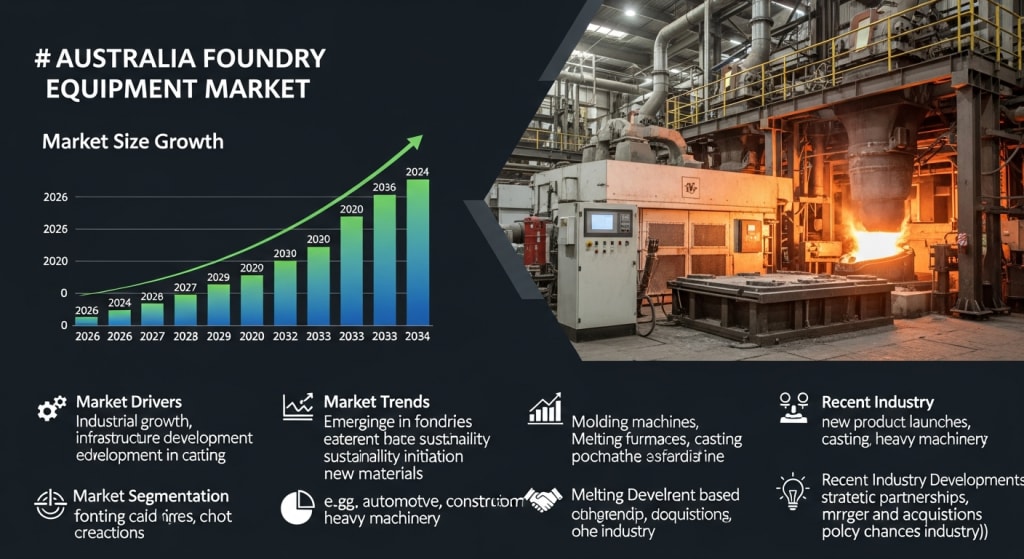
According to IMARC Group, the Australia foundry equipment market was valued at USD 143.59 Million in 2025 and is projected to reach USD 259.08 Million by 2034, growing at a compound annual growth rate (CAGR) of 6.78% during 2026–2034. This sustained growth reflects the increasing modernisation of Australia’s metal casting industry as manufacturers invest in advanced, efficient and automation-ready foundry systems. Foundry equipment plays a foundational role in producing metal components used across infrastructure, automotive, mining, defence, construction machinery and heavy engineering sectors. As Australia upgrades its industrial base and prioritises domestic manufacturing capability, foundry equipment is becoming a strategic enabler of productivity, quality and long-term industrial resilience.
Why Should Smart Buyers and Industrial Decision-Makers Know About the Australia Foundry Equipment Market?
A Growing Market Supporting Core Industrial Sectors
With the market projected to reach USD 259.08 Million by 2034, foundry equipment remains a vital investment category supporting infrastructure, mining, automotive and heavy engineering industries.
Strong ROI Through Productivity and Efficiency Gains
Modern foundry equipment delivers measurable improvements in output, quality and energy efficiency, translating into long-term operational savings and competitive advantage.
Critical Role in Automation and Workforce Safety
Automation-ready equipment reduces reliance on manual labour, improves safety outcomes and supports consistent production in challenging industrial environments.
Alignment with Sustainability and Regulatory Compliance
Energy-efficient and low-emission equipment helps foundries meet environmental regulations while reducing long-term operating risk.
Foundation for Future Manufacturing Capability
Investment in advanced foundry equipment strengthens Australia’s domestic manufacturing base and positions operators to meet future demand for high-quality, locally produced metal components.
Recent Trends & Developments in the Australia Foundry Equipment Market
April 2025:
Australian foundries accelerated investment in automated moulding and pouring systems to improve productivity and address skilled labour shortages. Equipment upgrades focused on consistency and reduced manual handling.
November 2024:
Demand increased for energy-efficient induction furnaces and advanced melting technologies as foundry operators sought to lower operating costs and emissions while maintaining output capacity.
July 2024:
Manufacturers expanded adoption of digital monitoring systems for real-time process control and predictive maintenance, improving equipment uptime and reducing unplanned shutdowns.
The Australia foundry equipment market is evolving into a future-focused industrial segment, driven by infrastructure growth, manufacturing modernisation and the adoption of automation and digital technologies. Supported by strong IMARC growth projections, increasing capital investment and a clear shift toward energy-efficient and smart foundry operations, the market plays a critical role in Australia’s industrial future. For manufacturers, equipment suppliers and investors, foundry equipment represents a strategic opportunity to support productivity, sustainability and long-term industrial resilience.
Australia Foundry Equipment Market Vision 2050
1. Fully Automated and Digitally Connected Foundries
By 2050, Australian foundries are expected to operate as smart manufacturing environments, with fully automated moulding, pouring and finishing systems connected through real-time data platforms.
2. AI-Driven Process Optimisation and Predictive Maintenance
Artificial intelligence will be widely used to optimise casting parameters, predict equipment failures and reduce scrap rates, improving yield and asset utilisation across foundry operations.
3. Low-Carbon and Energy-Efficient Casting Operations
Future foundry equipment will support electrification, alternative fuels and waste-heat recovery, helping operators meet emissions targets and reduce energy intensity.
4. Flexible, Modular Equipment for Customised Production
As demand shifts toward smaller batch sizes and specialised components, modular foundry equipment will allow rapid reconfiguration for different alloys, mould designs and production volumes.
5. Strategic Role in Australia’s Industrial Sovereignty
Foundry equipment will underpin Australia’s ability to produce critical components domestically, supporting national infrastructure, defence manufacturing and supply-chain resilience.
What is the Australia Foundry Equipment Market Key Growth Drivers?
Rising Infrastructure and Industrial Development Demand
Large-scale infrastructure projects across transport, energy, utilities and construction are increasing demand for cast metal components such as pipes, fittings, frames and structural parts. This drives investment in modern foundry equipment capable of delivering high-volume, consistent and high-quality output.
Modernisation of Domestic Manufacturing and Metal Casting Facilities
Australian foundries are upgrading legacy systems to remain competitive against global suppliers. New investments focus on automated moulding lines, advanced melting furnaces and precision finishing equipment to improve throughput and reduce operational inefficiencies.
Growing Adoption of Automation and Smart Foundry Technologies
Automation is transforming foundry operations. Equipment integrated with robotics, programmable logic controllers (PLCs) and digital monitoring systems enables higher productivity, reduced labour dependency and improved workplace safety.
Demand for Energy-Efficient and Low-Emission Equipment
Energy costs and environmental compliance are becoming critical considerations for foundry operators. Modern foundry equipment offers improved thermal efficiency, reduced emissions and better material utilisation, aligning with sustainability and cost-control objectives.
Increasing Focus on Product Quality and Process Consistency
End-use industries such as automotive, defence and mining require tight tolerances and consistent material properties. Advanced foundry equipment supports precise temperature control, uniform moulding and defect reduction, strengthening supplier reliability.
About the Creator
Keep reading
More stories from Shrestha Roy and writers in Futurism and other communities.
Australia Cargo Security Surveillance Market: Supply Chain Protection, Smart Monitoring & Risk Mitigation
According to IMARC Group, the Australia cargo security and surveillance market was valued at USD 87.30 Million in 2025 and is projected to reach USD 212.13 Million by 2034, expanding at a robust compound annual growth rate (CAGR) of 10.37% during 2026–2034. This strong growth highlights the rising importance of cargo protection across Australia’s increasingly complex and high-value supply chains. As the country strengthens its position as a global exporter of commodities, manufactured goods and critical materials, securing cargo across ports, warehouses, road freight corridors and distribution hubs has become a strategic priority. Cargo security surveillance is rapidly evolving from basic monitoring into intelligent, data-driven systems designed to prevent theft, minimise losses and enhance supply chain resilience.
By Shrestha Roy25 days ago in Futurism
Wearable Injectors Market: On-Body Drug Delivery Systems, Smart Devices & Growth Outlook
According to IMARC Group's latest research publication, global wearable injectors market size reached USD 8.67 Billion in 2024. Looking forward, IMARC Group expects the market to reach USD 26.80 Billion by 2033, exhibiting a growth rate (CAGR of 12.69%) during 2025-2033.
By sujeet. imarcgroup3 days ago in Futurism




Comments
There are no comments for this story
Be the first to respond and start the conversation.