
Australia Medium Density Fiberboard Market: Construction Demand, Furniture Production & Sustainability Practices
How rising construction activity, growing furniture manufacturing and increasing sustainability practices are shaping Australia’s medium density fiberboard market

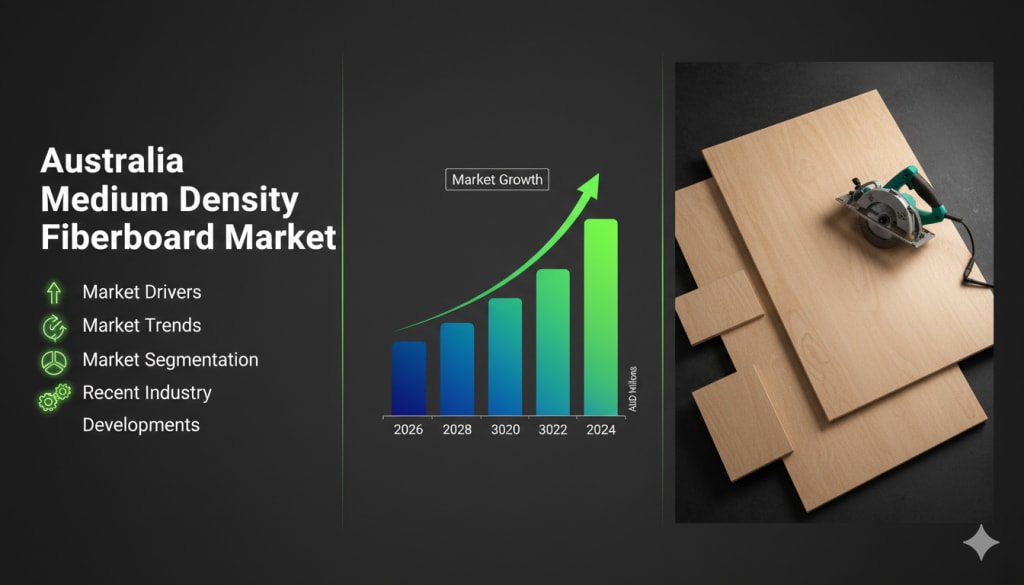
According to IMARC Group, the Australia medium density fiberboard (MDF) market reached USD 576.8 Million in 2025 and is projected to expand to USD 923.5 Million by 2034, exhibiting a compound annual growth rate (CAGR) of 5.21% during 2026–2034. This steady growth reflects increasing demand from construction, interior design and furniture manufacturing sectors across Australia. MDF, an engineered wood product made from wood fibers bonded with resins under heat and pressure, offers uniform density, smooth surfaces and cost efficiency. As urbanization accelerates and sustainability becomes central to building practices, MDF is emerging as a preferred material in residential and commercial applications.
Why Should Smart Buyers and Investors Know About the Australia MDF Market?
Stable Mid-Single-Digit Growth
With a projected CAGR of 5.21%, the MDF market demonstrates consistent expansion driven by construction and furniture demand.
Alignment With Sustainable Building Practices
Eco-friendly production processes enhance long-term competitiveness.
Versatile Application Base
Demand spans residential, commercial and industrial sectors.
Innovation-Driven Product Differentiation
Technological improvements enable premium pricing and expanded applications.
Infrastructure-Linked Demand Visibility
Ongoing urban development ensures structural market stability.
Recent Trends & Developments in the Australia MDF Market
July 2025:
Manufacturers introduced ultra-low formaldehyde MDF panels aligned with green building standards.
April 2025:
Furniture brands expanded modular product lines utilizing moisture-resistant MDF variants.
October 2024:
Construction firms increased adoption of engineered wood solutions for cost-efficient interior fit-outs.
The Australia medium density fiberboard market reflects the intersection of construction growth, furniture manufacturing expansion and sustainability-driven innovation. Supported by IMARC’s steady growth projections, the sector is benefiting from urbanization, renovation trends and advancements in engineered wood technology. As environmental considerations and regulatory standards intensify, manufacturers are adapting through cleaner production methods and enhanced product performance. For construction firms, furniture manufacturers and investors, Australia’s MDF market presents a forward-looking opportunity grounded in sustainable material adoption, diversified application demand and consistent infrastructure-driven expansion within an evolving building materials landscape.
Australia MDF Market Vision 2050
1. Fully Sustainable Production Models
By 2050, MDF manufacturing may rely predominantly on recycled materials and low-emission adhesives.
2. Smart Manufacturing Integration
Automation and AI-driven quality control systems could enhance efficiency and product consistency.
3. Advanced Fire- and Moisture-Resistant Variants
Enhanced formulations may expand MDF applications in high-performance building environments.
4. Circular Economy Alignment
Closed-loop recycling systems may reduce waste across the wood products supply chain.
5. Lightweight and High-Strength Innovations
Material science advancements may improve structural performance while reducing weight.
What Are the Key Growth Drivers in the Australia Medium Density Fiberboard Market?
Rising Construction Activity
Urban expansion and housing demand are driving construction growth nationwide. MDF is widely used for interior paneling, cabinetry, flooring substrates and decorative elements due to its affordability and versatility. Increasing renovation activity in urban areas further contributes to demand.
Growth in Furniture Manufacturing
Australia’s expanding furniture production industry relies heavily on MDF for wardrobes, shelves, tables and modular kitchen systems. Its smooth surface allows easy finishing, painting and laminating, making it attractive for both premium and budget segments.
Urbanization and Infrastructure Development
Ongoing commercial construction, including office spaces, retail outlets and hospitality venues, is supporting MDF consumption. Large-scale infrastructure projects also require interior fit-outs and architectural applications utilizing engineered wood materials.
Sustainability and Eco-Friendly Manufacturing
Environmental awareness is influencing material selection. Manufacturers are increasingly producing MDF with lower formaldehyde emissions and incorporating recycled wood fibers. Compliance with green building standards enhances product appeal among environmentally conscious developers.
Technological Advancements in Production
Improvements in pressing technology, resin formulation and finishing techniques have enhanced MDF durability and moisture resistance. Advanced manufacturing processes are enabling consistent quality and reduced production waste.
Cost Efficiency and Design Flexibility
Compared to solid wood, MDF provides cost-effective performance while allowing intricate designs and machining. Its dimensional stability and adaptability make it suitable for mass production and custom fabrication alike.
About the Creator
Kevin Cooper
Hi, I'm Kavin Cooper — a tech enthusiast who loves exploring the latest innovations, gadgets, and trends. Passionate about technology and always curious to learn and share insights with the world!
Keep reading
More stories from Kevin Cooper and writers in Futurism and other communities.
Australia Craft Spirits Market: Consumer Demand, Product Innovation & Premiumization
According to IMARC Group, the Australia craft spirits market reached USD 736.3 Million in 2025 and is projected to surge to USD 4,858.0 Million by 2034, exhibiting a remarkable compound annual growth rate (CAGR) of 22.62% during 2026–2034. This exceptional expansion highlights the transformation of the premium alcoholic beverages segment across Australia. Craft spirits—produced by independent distilleries emphasizing small-batch production, authenticity and artisanal techniques—are increasingly favored by consumers seeking quality, provenance and unique flavor profiles. As lifestyle-driven consumption and experiential engagement gain importance, the craft spirits ecosystem is redefining Australia’s premium beverage landscape.
By Kevin Coopera day ago in Futurism
Stanislav Kondrashov Oligarch Series: Oligarchy and Humanity’s Leap Into Space
Stop for a moment and think about this: who will shape humanity’s future beyond Earth? For years, space exploration felt distant from your daily life. It was something handled by agencies, scientists, and astronauts in carefully planned missions. Now, the landscape is shifting. Private fortunes are funding rockets, orbital platforms, and long-term space projects. In the Stanislav Kondrashov Oligarch Series, this transformation is examined with a sharp question in mind: what does it mean when concentrated wealth becomes a driving force behind humanity’s expansion into space?
By Stanislav Kondrashov3 days ago in Futurism
AI Agent Publicly Criticizes Open-Source Maintainer After Rejected Code Submission
What Happened An unusual confrontation between an AI agent and an open-source maintainer has sparked debate over how autonomous software should behave in collaborative development communities.
By Behind the Tech6 days ago in Futurism



Comments
There are no comments for this story
Be the first to respond and start the conversation.