
Australia Power Market: Renewable Integration, Grid Modernization & Demand Growth
How increasing renewable energy adoption, investments in grid modernization and rising electricity demand are shaping Australia’s power market
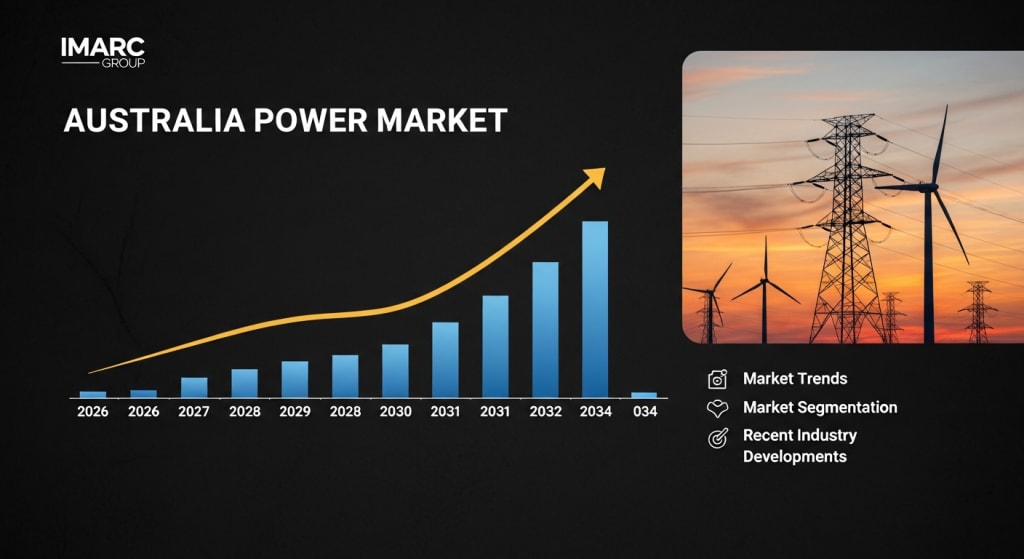
According to IMARC Group, the Australia power market reached a total consumption of 285.7 TWh in 2025 and is projected to expand to 377.0 TWh by 2034, exhibiting a compound annual growth rate (CAGR) of 3.04% during 2026–2034. This steady growth reflects Australia’s ongoing energy transition as electricity demand rises alongside population growth, electrification of industries and the decarbonization of transport and heating. The power market is undergoing structural transformation driven by accelerating renewable energy deployment, the gradual phase-out of coal-fired generation and large-scale investments in grid modernization and energy storage. As energy systems become more decentralized, digital and dynamic, the power sector is emerging as a critical enabler of economic resilience, sustainability and future industrial competitiveness across Australia.
Why Should Smart Buyers and Investors Know About the Australia Power Market?
Stable Demand Growth With Long-Term Visibility
Electricity demand growth is supported by electrification trends, population growth and industrial modernization.
Central Role in the Energy Transition
The power sector underpins decarbonization across transport, industry and buildings, making it strategically critical.
Expanding Investment Opportunities
Renewables, storage, grid infrastructure and digital energy solutions offer diversified investment avenues.
Increasing Importance of Flexibility and Storage
Value is shifting from generation alone to flexibility, storage and system optimization capabilities.
Alignment With Sustainability and ESG Objectives
Clean energy investments support emissions reduction goals and long-term regulatory alignment.
Recent Trends & Developments in the Australia Power Market
June 2025:
Utility-scale battery projects expanded rapidly, enhancing grid stability and supporting higher renewable penetration.
February 2025:
Corporate power purchase agreements increased as businesses sought long-term price certainty and emissions reduction.
September 2024:
Grid upgrade projects accelerated to improve transmission capacity between renewable-rich regions and demand centers.
The Australia power market exemplifies the complexity and opportunity inherent in a large-scale energy transition. Supported by IMARC’s positive growth outlook, the sector is evolving from a centralized, fossil-fuel-based system into a flexible, renewable-led and digitally enabled power ecosystem. As renewable integration accelerates, grid modernization advances and electricity demand continues to rise, the power market will play a foundational role in shaping Australia’s economic, environmental and technological future. For utilities, investors and energy technology providers, Australia’s power market represents not just a growing demand curve, but a forward-looking platform where clean energy, system resilience and intelligent infrastructure converge to define the next era of electricity generation and consumption.
Australia Power Market Vision 2050
1. High-Renewable and Low-Emission Power System
By 2050, Australia’s power system is expected to be predominantly powered by renewables, supported by storage, flexible demand and low-emission firming technologies.
2. Fully Digital and Intelligent Grid Infrastructure
Advanced digital systems, artificial intelligence and real-time analytics will enable predictive grid management, faster fault detection and optimized energy flows.
3. Decentralized and Consumer-Driven Energy Models
Distributed energy resources, rooftop solar, batteries and virtual power plants will empower consumers to actively participate in energy markets.
4. Integration of Hydrogen and Emerging Technologies
Hydrogen production, long-duration storage and advanced energy conversion technologies will support grid stability and industrial decarbonization.
5. Resilient and Climate-Adaptive Power Networks
Future power systems will be designed for resilience against extreme weather events, ensuring continuity of supply amid climate volatility.
What Are the Key Growth Drivers in the Australia Power Market?
Accelerating Renewable Energy Adoption
Renewable energy sources such as solar and wind are playing an increasingly dominant role in Australia’s power generation mix. Declining technology costs, favorable resource availability and supportive government policies are driving large-scale renewable project development and distributed generation adoption.
Rising Electricity Demand Across Sectors
Electricity demand continues to grow as households, businesses and industries electrify processes previously reliant on fossil fuels. Electric vehicles, data centers, electrified industrial equipment and residential electrification are contributing to sustained consumption growth.
Grid Modernization and Infrastructure Investment
Australia’s aging grid infrastructure is undergoing modernization to accommodate variable renewable generation and bidirectional power flows. Investments in transmission upgrades, smart grids and digital monitoring systems are improving reliability, flexibility and efficiency.
Expansion of Battery Storage and Energy Flexibility
Battery storage systems are increasingly deployed to balance supply and demand, manage intermittency and stabilize wholesale electricity prices. Utility-scale batteries, behind-the-meter storage and community energy systems are becoming integral components of the power ecosystem.
Policy Support and Corporate Sustainability Commitments
Government incentives for clean energy, emissions reduction targets and corporate sustainability goals are reinforcing demand for renewable power procurement, power purchase agreements and energy optimization strategies.
About the Creator
Keep reading
More stories from Shrestha Roy and writers in Futurism and other communities.
Australia Oral Care Market: Preventive Hygiene, Consumer Awareness & Product Innovation
According to IMARC Group, the Australia oral care market reached a value of USD 1.1 Billion in 2025 and is projected to expand to USD 2.3 Billion by 2034, exhibiting a compound annual growth rate (CAGR) of 7.74% during 2026–2034. This strong growth trajectory highlights a structural shift in how consumers perceive oral hygiene—from a basic daily routine to a core component of preventive healthcare and overall wellness. Rising awareness of the link between oral health and systemic conditions such as cardiovascular disease and diabetes is reshaping purchasing behavior, while innovation in products and delivery formats is broadening market appeal. As consumer expectations evolve toward efficacy, convenience and sustainability, oral care has become a dynamic and innovation-driven segment of the broader personal care market across Australia.
By Shrestha Roya day ago in Futurism
AI: Power That Demands Responsibility. Are We Ready for the Side Effects? 🤖⚠️
Artificial intelligence is a powerful tool, but its effectiveness depends on one fundamental principle: Responsible AI. This is not just a trendy phrase, but a set of critical practices — from eliminating biases in data to rigorous monitoring, verification, and transparency in AI systems. Responsible AI aims to ensure that technology serves humanity without infringing on privacy, dignity, or safety.
By Piotr Nowaka day ago in Futurism
📢 Raise Your Voice Thread: 02/05/2026
Our “Raise Your Voice Threads” are hosted most alternating Thursdays at 12PM ET to offer creators more avenues to uncover exceptional stories on Vocal. As we are continuously searching for fresh creators and inspiring stories, this thread provides an opportunity to exchange and discuss the stories that have moved and motivated us on Vocal.
By Raise Your Voice by Vocal5 days ago in Resources




Comments
There are no comments for this story
Be the first to respond and start the conversation.