
Australia Power Rental Market: Equipment Demand, Infrastructure Projects & Service Innovation
How increasing demand for temporary power solutions, expanding infrastructure projects and ongoing service innovations are shaping Australia’s power rental market
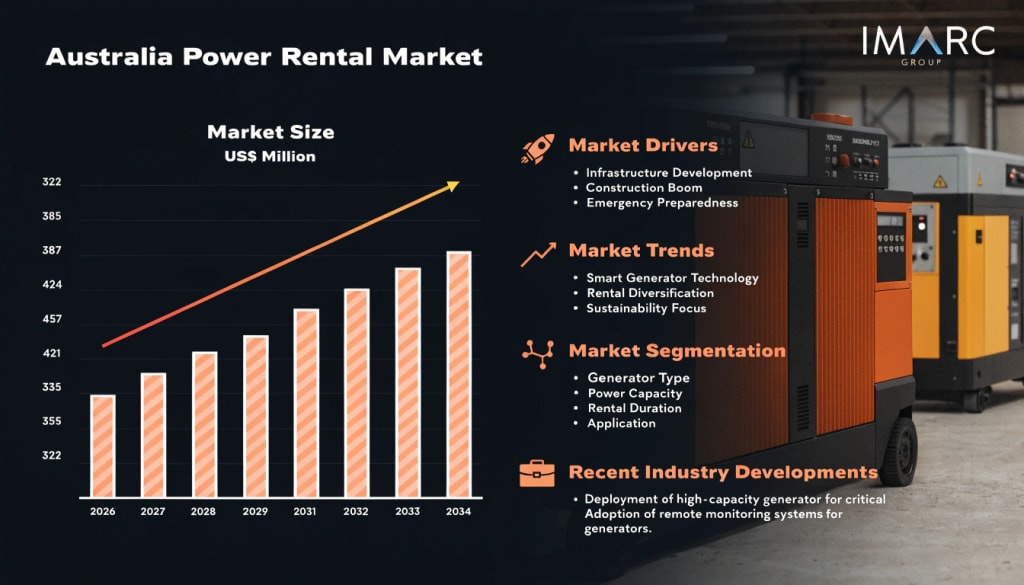
According to IMARC Group, the Australia power rental market reached USD 460.9 Million in 2025 and is projected to grow to USD 771.5 Million by 2034, exhibiting a compound annual growth rate (CAGR) of 5.71% during 2026–2034. This steady expansion reflects rising demand for temporary and backup power solutions across industrial, commercial and event-driven applications in Australia. Power rental services provide generators, load banks and related equipment for short-term or emergency needs, ensuring operational continuity during grid instability, maintenance shutdowns or remote site operations. As aging grid infrastructure, large-scale construction projects and mining expansion intensify, the power rental ecosystem is becoming an essential component of Australia’s energy resilience framework.
Why Should Smart Buyers and Investors Know About the Australia Power Rental Market?
Steady Growth Outlook
With a projected CAGR of 5.71%, the market offers stable expansion tied to infrastructure and industrial activity.
Infrastructure-Linked Demand Visibility
Construction and mining projects provide consistent demand pipelines.
Sustainability Transition Opportunities
Hybrid and renewable rental systems create innovation-driven differentiation.
Capital-Efficient Business Model
Rental services offer recurring revenue and flexible deployment.
Grid Resilience Importance
Rising energy reliability concerns reinforce structural demand for backup power solutions.
Recent Trends & Developments in the Australia Power Rental Market
July 2025:
Rental providers expanded hybrid generator fleets incorporating battery storage systems.
April 2025:
Mining operators adopted modular rental power units to support remote site electrification.
October 2024:
Infrastructure projects increased reliance on temporary power solutions during grid upgrade activities.
The Australia power rental market represents a vital link between infrastructure development, industrial expansion and energy resilience. Backed by IMARC’s steady growth projections, the sector is evolving through hybridization, digital monitoring and service innovation. As grid reliability challenges persist and large-scale projects accelerate, temporary power solutions are becoming indispensable across mining, construction and commercial sectors. For equipment manufacturers, rental service providers and investors, Australia’s power rental market offers a forward-looking opportunity grounded in infrastructure momentum, sustainability transition and the growing need for flexible, reliable energy solutions within an increasingly dynamic power landscape.
Australia Power Rental Market Vision 2050
1. Renewable-Integrated Rental Fleets
By 2050, rental fleets may predominantly consist of hybrid and renewable-powered systems.
2. AI-Driven Energy Optimization
Smart monitoring platforms could dynamically adjust energy output based on demand patterns.
3. Modular and Portable Energy Systems
Compact, plug-and-play units may offer rapid deployment for emergency scenarios.
4. Carbon-Neutral Rental Operations
Providers may transition toward low-emission fuels and carbon offset programs.
5. Integration With Smart Grid Networks
Temporary power systems may integrate seamlessly with national grid management platforms.
What Are the Key Growth Drivers in the Australia Power Rental Market?
Aging Grid Infrastructure and Reliability Concerns
Australia’s electricity network faces periodic strain due to aging infrastructure and extreme weather events. Businesses and institutions increasingly rely on rental generators to safeguard operations against outages and voltage fluctuations.
Expanding Infrastructure and Construction Projects
Large-scale infrastructure development—including transport networks, renewable energy facilities and commercial real estate—requires temporary power supply during construction phases. Rental equipment provides flexibility without long-term capital expenditure.
Growth in Mining and Resource Sectors
Remote mining operations depend heavily on off-grid and temporary power systems. Rental solutions enable scalable energy supply tailored to project duration and operational intensity.
Rising Electrification of Remote Sites
Electrification initiatives in rural and isolated areas are boosting demand for temporary and hybrid power systems. Rental providers offer rapid deployment capabilities to meet these evolving needs.
Increasing Demand from Events and Commercial Applications
Outdoor events, exhibitions and emergency response operations require reliable temporary power infrastructure. Rental services ensure operational continuity during peak usage periods.
Adoption of Hybrid and Renewable Rental Solutions
Stricter emissions regulations and sustainability targets are encouraging integration of hybrid generator systems combining diesel, battery storage and solar components. These solutions reduce fuel consumption and carbon footprint.
Service Innovation and Digital Monitoring
Power rental companies are enhancing service models with remote monitoring, predictive maintenance and flexible leasing contracts. Digital tools improve equipment utilization and reliability.
About the Creator
Keep reading
More stories from Shrestha Roy and writers in Futurism and other communities.
Australia Wealth Management Market: HNWI Growth, Digital Transformation & Regulatory Evolution
According to IMARC Group, the Australia wealth management market reached USD 118.6 Million in 2025 and is projected to expand to USD 222.2 Million by 2034, exhibiting a compound annual growth rate (CAGR) of 7.00% during 2026–2034. This steady growth reflects structural expansion in private wealth, regulatory reform and digital transformation across Australia. Wealth management in Australia spans portfolio advisory, retirement planning, estate structuring, tax optimization and alternative investment management. As the number of high-net-worth individuals (HNWIs) rises and intergenerational wealth transfer accelerates, advisory firms are repositioning themselves with technology-enabled, client-centric service models designed for long-term value preservation and growth.
By Shrestha Royabout 3 hours ago in Futurism
Saudi Arabia Truck Industry Trends Industrial Expansion, Smart Fleet Solutions & Future Opportunities
According to IMARC Group's latest research publication, Saudi Arabia truck market size reached USD 74.7 Billion in 2025. The market is projected to reach USD 136.1 Billion by 2034, exhibiting a growth rate of 6.90% during 2026-2034.
By Faisal Al-Harbi6 days ago in Futurism
Australia Accounting Services Market: Regulatory Demand, Digital Transformation & SME Growth
According to IMARC Group, the Australia accounting services market reached USD 12.2 Billion in 2025 and is projected to expand to USD 21.3 Billion by 2034, exhibiting a compound annual growth rate (CAGR) of 6.24% during 2026–2034. This steady growth reflects the increasing complexity of financial reporting, regulatory compliance and strategic advisory needs across businesses in Australia. Accounting services have evolved far beyond traditional bookkeeping and tax preparation. Today, firms provide data-driven insights, ESG reporting support, cybersecurity advisory and digital financial management solutions. As startups multiply, multinational corporations expand and SMEs scale operations, demand for specialized, technology-enabled accounting services continues to rise.
By Kevin Coopera day ago in Futurism


Comments
There are no comments for this story
Be the first to respond and start the conversation.