
Australia Renewable Energy Market: Capacity Expansion, Policy Support & Technology Integration
How expanding renewable energy capacity, supportive government policies and advancing energy integration technologies are shaping Australia’s renewable energy market
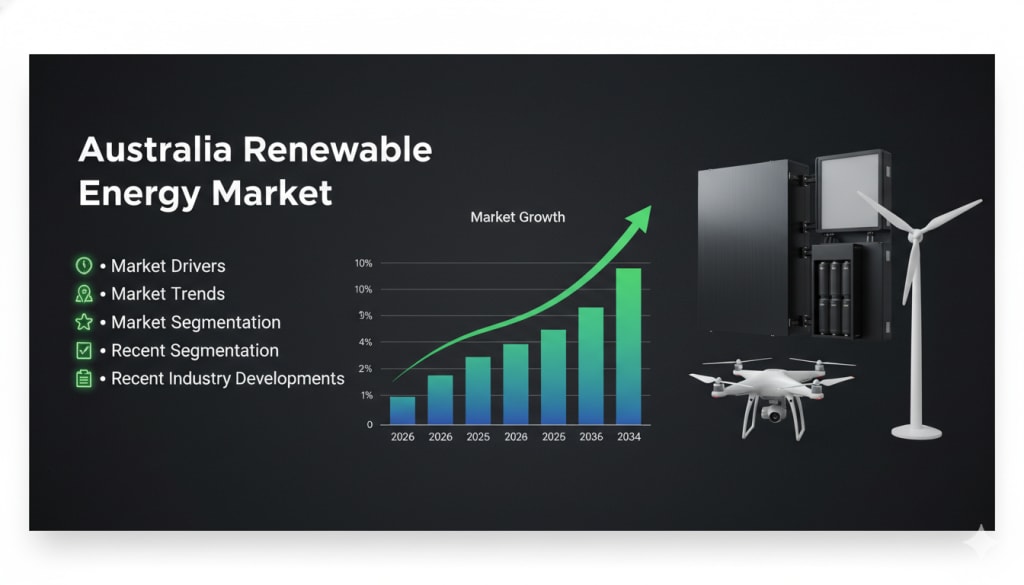
According to IMARC Group, the Australia renewable energy market reached a value of USD 193.3 Billion in 2025 and is projected to surge to USD 722.2 Billion by 2034, exhibiting a robust compound annual growth rate (CAGR) of 15.77% during 2026–2034. This exceptional growth trajectory highlights Australia’s accelerating transition toward a low-carbon economy and the large-scale transformation of its energy infrastructure. Renewable energy is no longer a supplementary power source—it is becoming the structural foundation of the national electricity system. Driven by technological innovation, policy alignment and large-scale investment, renewable generation is reshaping the energy mix and positioning Australia as a global leader in clean energy deployment.
Why Should Smart Buyers and Investors Know About the Australia Renewable Energy Market?
High-Growth Infrastructure Opportunity
With a projected CAGR of 15.77%, renewable energy represents one of the fastest-growing infrastructure segments in Australia.
Long-Term Policy Alignment
National decarbonization targets and regulatory frameworks provide structural support for sustained investment.
Diversified Revenue Streams
Renewable projects benefit from power purchase agreements, government incentives and energy market participation.
ESG and Sustainability Investment Alignment
Renewable energy assets align strongly with ESG-focused portfolios and climate transition strategies.
Integration With Emerging Energy Technologies
Energy storage, hydrogen production and digital grid technologies create cross-sector investment opportunities.
Recent Trends & Developments in the Australia Renewable Energy Market
July 2025:
Large-scale hybrid solar-plus-storage projects were commissioned to enhance grid flexibility and reduce reliance on fossil fuels.
April 2025:
State-level renewable energy auctions attracted significant private capital investment.
October 2024:
Transmission upgrade initiatives advanced to connect renewable energy zones with metropolitan demand hubs.
The Australia renewable energy market exemplifies large-scale structural transformation driven by technology innovation, policy alignment and investment momentum. Supported by IMARC’s strong growth outlook, the sector is transitioning from supplementary generation capacity to the backbone of the national energy system. As renewable penetration deepens, storage technologies advance and grid modernization accelerates, Australia’s clean energy ecosystem will continue to expand in scale and sophistication. For investors, utilities and technology providers, the renewable energy market represents not just rapid capacity growth, but a long-term platform for sustainable infrastructure development and economic resilience in the era of global energy transition.
Australia Renewable Energy Market Vision 2050
1. Predominantly Renewable Energy Mix
By 2050, Australia’s energy system is expected to operate with a high proportion of renewable generation, supported by large-scale storage and flexible demand management.
2. Hydrogen and Green Export Leadership
Green hydrogen production powered by renewable energy may position Australia as a major exporter of clean fuels to global markets.
3. Decentralized and Distributed Generation Models
Residential solar-plus-storage systems and community renewable projects will enhance localized energy independence.
4. Advanced Grid Interconnectivity
Upgraded transmission networks will connect renewable-rich regions with urban demand centers, ensuring efficient power distribution.
5. AI-Driven Energy Optimization
Artificial intelligence will optimize generation forecasting, dispatch management and energy trading platforms.
What Are the Key Growth Drivers in the Australia Renewable Energy Market?
Rapid Expansion of Renewable Capacity
Australia continues to add significant solar and wind capacity across utility-scale and distributed installations. The country’s abundant sunlight and favorable wind conditions make renewable energy economically competitive and geographically scalable. Rooftop solar adoption remains particularly strong in residential and commercial sectors.
Strong Government Policy Support
Federal and state-level renewable energy targets, emissions reduction commitments and clean energy incentives are accelerating deployment. Regulatory frameworks are providing clarity and investment confidence for large-scale renewable projects and infrastructure upgrades.
Technological Advancements in Energy Storage
Energy storage innovations are strengthening renewable integration. Battery systems, long-duration storage solutions and grid-scale projects are helping balance supply variability and improve reliability. Storage integration is enabling higher renewable penetration without compromising grid stability.
Smart Grid and Digital Integration Technologies
Advanced grid technologies—including smart meters, demand-response systems and AI-based forecasting tools—are improving renewable integration efficiency. These systems allow real-time monitoring, load balancing and predictive maintenance, enhancing operational performance.
Corporate Renewable Procurement and ESG Alignment
Corporations are increasingly committing to renewable energy procurement through long-term power purchase agreements (PPAs). ESG-focused investment strategies are directing capital toward renewable infrastructure, strengthening funding pipelines.
Phase-Out of Coal-Fired Generation
The gradual retirement of aging coal plants is accelerating renewable capacity expansion. Replacement capacity increasingly comes from solar, wind and hybrid renewable-storage systems.
About the Creator
Keep reading
More stories from Shrestha Roy and writers in Futurism and other communities.
Australia E-Invoicing Market: Digital Adoption, Regulatory Mandates & Business Efficiency
According to IMARC Group, the Australia e-invoicing market reached a value of USD 512.9 Million in 2025 and is projected to expand significantly to USD 1,854.5 Million by 2034, exhibiting a strong compound annual growth rate (CAGR) of 14.89% during 2026–2034. This rapid growth reflects the accelerating digital transformation of financial processes across businesses in Australia. E-invoicing is moving beyond basic digitization of paper invoices toward fully automated, interoperable systems that streamline accounts payable and receivable operations. Government mandates, regulatory standardization and enterprise-level efficiency goals are collectively reshaping invoicing into a strategic digital infrastructure component. As organizations pursue cost savings, faster payment cycles and error reduction, e-invoicing adoption is becoming integral to modern business operations.
By Shrestha Roy4 days ago in Futurism
Saudi Arabia Footwear Market Insights: Youth Demographics, Lifestyle Shifts & Future Demand
According to IMARC Group's latest research publication, Saudi Arabia footwear market size reached USD 2,426.7 Million in 2025. The market is projected to reach USD 3,339.2 Million by 2034, exhibiting a growth rate (CAGR) of 3.61% during 2026-2034.
By Faisal Al-Harbi7 days ago in Futurism
Australia Chocolate Market: Consumption Trends, Product Innovation & Retail Expansion
According to IMARC Group, the Australia chocolate market reached USD 2.0 Billion in 2025 and is projected to grow to USD 3.2 Billion by 2034, exhibiting a compound annual growth rate (CAGR) of 5.02% during 2026–2034. This steady growth reflects the enduring popularity of chocolate as both an everyday indulgence and a premium gifting product across Australia. The market is evolving beyond traditional mass-market bars toward diversified offerings that include premium dark chocolate, functional variants, artisanal creations and ethically sourced products. As consumer preferences shift and retail channels expand, chocolate manufacturers are balancing indulgence with innovation, health awareness and sustainability considerations.
By Kevin Cooperabout 4 hours ago in Futurism
Nancy Guthrie: Is a miracle still possible after close to two weeks?
Close to two weeks since Nancy Guthrie's abduction As of February 12, 2026, Nancy Guthrie remains classified as missing for 12 days, but there is no official confirmation that she is deceased. Blood matching Guthrie’s DNA was found on her front porch, indicating she likely suffered an injury during the abduction.
By Cheryl E Preston4 days ago in Geeks



Comments
There are no comments for this story
Be the first to respond and start the conversation.