
Before the Shift: Old Life vs 2025
When Yesterday’s World Collided with Tomorrow’s Reality
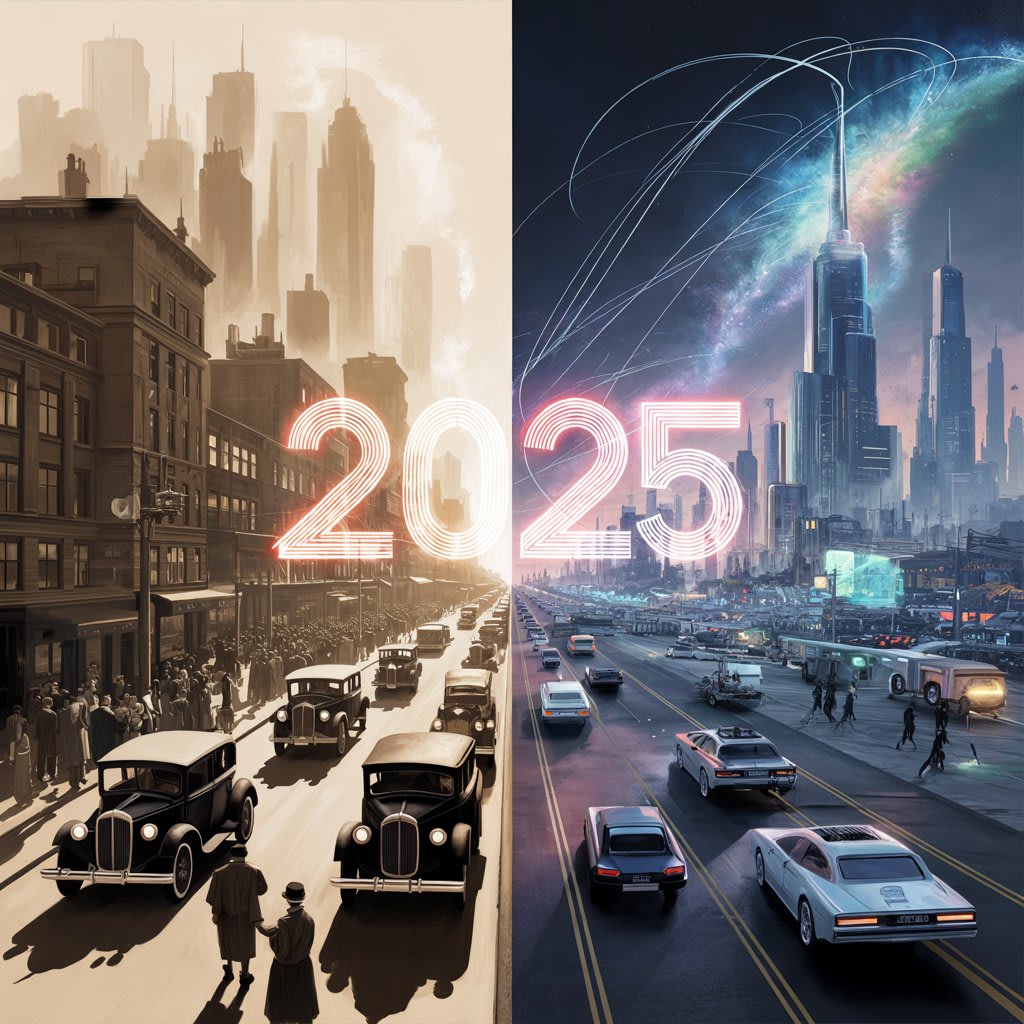
In a quiet town that felt untouched by time, 42-year-old Daniel Reed awoke to the sound of birdsong and the gentle creak of wood. The air smelled of rain and earth. The digital clock on his nightstand was nowhere to be found—because there wasn’t one. A simple analog alarm ticked softly, though he hadn’t wound it in years.
Daniel's life was deliberately unplugged. He ran a small bookshop inherited from his father, never owned a smartphone, and still wrote letters instead of emails. He found peace in silence, in dog-eared pages and black coffee. The world outside was racing forward, but he had chosen to stay behind.
He believed faster didn't mean better.
Part II: The Shift
On the morning of January 1, 2025, everything changed.
Daniel opened his shop as usual, expecting the familiar jingling bell, familiar faces, and the smell of aged paper. Instead, the streets were silent. No foot traffic. No kids on bikes. No sound but a distant hum—like power lines or turbines.
He stepped outside.
Gone were the cobblestone roads and ivy-covered houses. In their place stood gleaming steel buildings, pulsing digital signs, and sky-traffic of autonomous drones. The air buzzed with invisible networks. A billboard blinked to life as he passed:
> "Welcome to **New Society 2025**. Every citizen is connected. Every move, optimized."
Daniel stumbled backward. A sleek humanoid robot rolled up beside him.
> “Citizen Daniel Reed, your biometrics are not synced. Please submit to retinal onboarding.”
“What the hell is going on?” he whispered.
“Worldshift Protocol completed at 04:00 hours. Analog sectors have been absorbed. Resistance to integration is non-compliant.”
---
Part III: Assimilation
He tried to run—back to his shop, back to what was—but it was gone. The bookstore had become a "Virtual Literature Lounge," a sterile glass pod where people sat in VR headsets. No books. Just silence and flickering digital landscapes.
He wandered through the city, watching people interact with holograms and AI assistants, lost in augmented overlays. No eye contact. No conversation. Just infinite scrolling.
At a café, he watched a mother “feed” her baby with a robotic arm while she laughed at something in her retinal display. The baby’s eyes were blank.
A man at the next table noticed Daniel staring.
“You okay, old-timer?” he asked, his voice modulated by vocal-enhancement software.
Daniel replied, “This… none of this is real.”
“It’s better than real,” the man said. “Faster. Cleaner. Efficient. No more forgetting birthdays, no more disease, no more decisions. AI handles it all.”
Daniel shook his head. “What about thinking for yourself?”
The man smiled politely. “That’s inefficient.”
---
Part IV: Ghost in the Code
That night, Daniel wandered into an underground alley where lights flickered and tech didn’t fully reach. There, he met a girl named Zara—17, sharp-eyed, with an old radio slung across her back.
“Let me guess,” she said. “You’re one of the last 'before-the-shift' people.”
“How do you know?”
“I collect analogs,” she said, showing him a pocket watch, a Polaroid camera, and a journal with handwriting.
He smiled for the first time that day.
“I miss real things,” he said.
“So do I,” she whispered. “But you can’t go back. The Shift wiped the old code.”
“Then why are you still here?”
“Because someone has to remember,” she replied.
---
Part V: Resistance or Resilience
Zara took Daniel to a hidden enclave below the city—dozens of people, young and old, rebuilding the world that had been erased. No screens. No noise. Just music played live on instruments, stories told aloud, and firelight flickering on human faces.
They called themselves the “Uncoded.”
“You can live here,” she said. “But the world above—it's watching. Drones come at night. Some of us don’t return.”
He nodded. “Then we don’t hide. We teach.”
In the weeks that followed, Daniel taught children how to write cursive, read maps, and think without algorithms. He showed them what it meant to sit in silence and *feel* the world.
Word spread.
People from the surface began visiting. At first out of curiosity. Then out of hunger for something real. Not filtered. Not optimized.
---
Part VI: A New Balance
By the end of 2025, the city above had begun to change. Slowly.
Digital billboards began displaying poetry. Cafés reintroduced “no-screen hours.” Books—real ones—were placed on shelves again. A few drone delivery companies even went bankrupt as people rediscovered the joy of walking.
And on the edge of the city, a bookstore reopened.
Daniel stood at the door, now older, perhaps wiser, certainly no longer alone.
A boy passed by, staring at his tablet. Then paused. Looked up.
“What’s a bookstore?” the boy asked.
Daniel smiled. “Want to find out?”
The boy nodded.
Inside, the smell of paper, ink, and possibility filled the air.
| THE END
About the Creator
YOUNG MINDSET
BE CREATIVE WITH SMILE
Keep reading
More stories from YOUNG MINDSET and writers in Futurism and other communities.
The Next Breakthrough: Inventing the Future
In the heart of New Avalon, a city where skyscrapers pierced the sky like shards of glass and neon lights painted the night, the future was being invented—not just dreamed about. The world had already seen countless inventions that transformed everyday life: clean energy that powered entire continents, artificial intelligence that managed cities, and medical miracles that extended human life well beyond a century.
By YOUNG MINDSET7 months ago in Futurism
Cocoa Processing Market: Chocolate Demand Growth, Value Addition & Industry Growth Outlook
According to IMARC Group's latest research publication, The global cocoa processing market size reached USD 15.6 Billion in 2025. Looking forward, IMARC Group expects the market to reach USD 16.6 Billion by 2034.
By sujeet. imarcgroupa day ago in Futurism
Saudi Arabia Juvenile Products Market: Rising Birth Rates, Premiumization & Expansion
According to IMARC Group's latest research publication, Saudi Arabia Juvenile Products Market size was valued at USD 240.13 Million in 2025. The market is projected to reach USD 417.21 Million by 2034, exhibiting a growth rate (CAGR) of 6.33% during 2026-2034.
By Jeffrey Wilson6 days ago in Futurism



Comments
There are no comments for this story
Be the first to respond and start the conversation.