
Binary Asteroids: The Cosmic Dance of Twin Worlds
Space

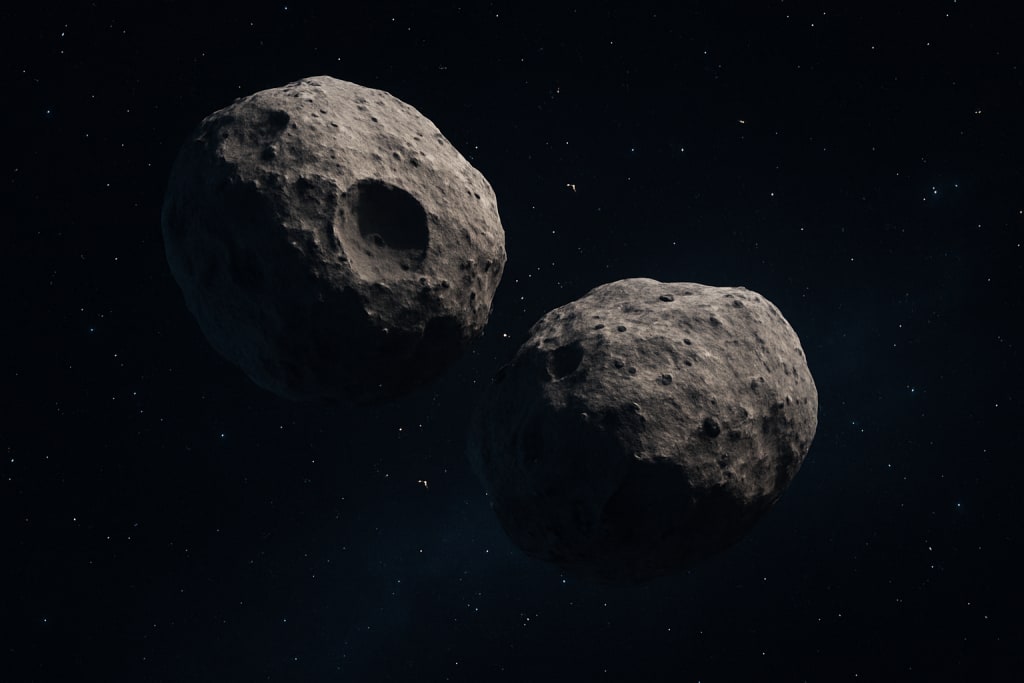
When most people think of an asteroid, they picture a lonely, rugged rock drifting through the solar system—silent, solitary, and self-contained. But space, as it often does, surprises us. Not all asteroids travel alone. Some of them form remarkable partnerships: binary asteroid systems, or what you might call asteroid twins, orbiting around a shared center of mass. These systems behave like miniature versions of binary stars, engaging in an endless gravitational dance that can last billions of years.
Today, astronomers have identified hundreds of such pairs, and every new discovery adds a twist to our understanding of how small bodies evolve in the solar system. Their existence challenges assumptions, sparks new theories, and occasionally becomes the focus of daring space missions.
What Exactly Are Binary Asteroids?
Binary asteroids are two gravitationally bound bodies orbiting a common center of mass. This “center” isn’t always located within one of them—it often lies somewhere in the space between. The two objects might differ greatly in size, or they could be close to twins. Either way, the pair forms a stable system that moves through space as a single unit.
In some rare cases, astronomers have found triple systems, adding even more complexity. But binaries remain the most common and most studied.
How Do Binary Asteroid Systems Form?
The formation of these celestial duos can occur in several ways, each one fascinating in its own right.
1. Rotational Fission: Spinning Until You Split
Many asteroids are not solid rock but “rubble piles”—collections of stones held together by gravity. Over millions of years, sunlight can cause the YORP effect (Yarkovsky–O’Keefe–Radzievskii–Paddack), which slowly increases their rotation rate. As the asteroid spins faster and faster, centrifugal force begins to overcome gravitational cohesion.
Eventually, part of the asteroid detaches, drifting away but remaining bound to its parent. The result: a brand-new binary system.
This mechanism is believed to be one of the most common ways asteroid families are formed.
2. Catastrophic Collisions
Space is not as empty as it appears. Collisions—ranging from minor nudges to catastrophic impacts—happen regularly on cosmic timescales. If a large asteroid is shattered but not completely dispersed, fragments can reassemble into two gravitationally bound objects.
This is how many irregular binaries likely came into existence.
3. Tidal Forces from Close Planetary Flybys
Sometimes an asteroid’s orbit brings it dangerously close to a planet, especially Earth or Mars. As it passes by, tidal forces can distort the body or even tear part of it away. The stripped material may settle into orbit around the main asteroid, forming a companion.
This scenario is relatively rare but supported by simulations and observational evidence.
Different Types of Binary Asteroids
Not all binary systems look the same. In fact, they vary dramatically, from mismatched rock pairs to nearly symmetrical twins.
🔹 Big Primary, Tiny Moonlet
The most common structure is a large main body with a much smaller companion—essentially an asteroid with its own miniature moon.
Example: Asteroid (243) Ida and its tiny moon Dactyl, discovered by the Galileo spacecraft in 1993.
🔹 Twin or Near-Twin Asteroids
Two asteroids of similar size orbit a midpoint located between them. They almost appear to be waltzing partners, moving in graceful, synchronized loops.
🔹 Contact Binaries: Two That Became One
Sometimes the dance becomes so tight that the partners touch and merge, creating a distinctive peanut-like or snowman-shaped object.
Famous example: Arrokoth (formerly known as 2014 MU69)—the distant Kuiper Belt object visited by NASA’s New Horizons mission in 2019. Its two lobes were once separate bodies that gently fused.
Why Binary Asteroids Are Scientifically Important
Binary systems are not just cosmic curiosities; they are invaluable tools for planetary scientists.
They Reveal Internal Structure
The motion of binary partners allows astronomers to calculate mass, density, and cohesion—properties that are almost impossible to measure from a single distant rock.
They Help Us Understand Solar System Formation
Studying these systems offers clues about the chaotic early days of the solar system, when small bodies collided, split, and reassembled repeatedly.
They Are Crucial for Planetary Defense
In 2022, NASA’s DART spacecraft struck Dimorphos, the small companion in the Didymos–Dimorphos binary system. For the first time in history, humans intentionally altered the orbit of a celestial body. The success of this mission proves that asteroid deflection is possible—and binary systems serve as excellent test beds.
They Improve Models of Orbital Evolution
Because binaries respond so sensitively to radiation pressure, tidal forces, and mutual gravitational effects, they help refine long-term predictions of asteroid motion—essential for identifying potential threats to Earth.
A Future Full of Discoveries
With next-generation telescopes like the Vera Rubin Observatory and upcoming missions such as NASA’s Janus binary-asteroid mission, our understanding of these cosmic pairs is poised to expand dramatically. We may soon discover thousands more, each with its own story of formation, evolution, and survival.
Binary asteroids show us that even small, rocky objects can form complex and beautiful systems. They dance, they break apart, they reunite, they evolve—and through them, we learn a little more about our own place in the solar system.
About the Creator
Keep reading
More stories from Holianyk Ihor and writers in Futurism and other communities.
Earth’s Mysterious “Third Radiation Belt”: What NASA’s Van Allen Probes Really Discovered
When NASA launched the twin Van Allen Probes in 2012, scientists expected to study something familiar — the two well-known belts of charged particles surrounding Earth, first discovered in 1958. These “Van Allen radiation belts” had been mapped, modeled, and largely understood.
By Holianyk Ihor3 months ago in Futurism
A breakthrough in optics enables quantum computers to read data more quickly.
A novel method for simultaneously capturing light from numerous individual atoms has been developed by researchers, enabling the reading of their quantum information in tandem rather than one at a time.
By Francis Damiabout 12 hours ago in Futurism
Australia Wearables Market: Smart Gadgets, Consumer Tech & the Future of Connected Living
According to IMARC Group, the Australia wearables market reached a value of USD 3.0 Billion in 2025 and is projected to expand significantly to USD 10.0 Billion by 2034, exhibiting a strong compound annual growth rate (CAGR) of 14.16% during 2026–2034. This rapid expansion reflects the growing integration of wearable technology into everyday life, as consumers increasingly rely on smart devices to monitor health, enhance safety and stay connected. Wearables have evolved from basic fitness trackers into multifunctional personal technology platforms, combining advanced sensors, connectivity and design-driven appeal. As healthcare awareness, aging demographics and digital lifestyles converge, wearable devices are becoming essential tools for preventive health management and personalized data insights across Australia.
By Shrestha Roy5 days ago in Futurism


Comments
There are no comments for this story
Be the first to respond and start the conversation.