
China Launches First Satellites to Build World's First Orbital Supercomputer
With the launch of 12 advanced satellites, China begins constructing the world’s first space-based supercomputer, aiming to revolutionize real-time data processing and assert dominance in the new era of orbital technology.

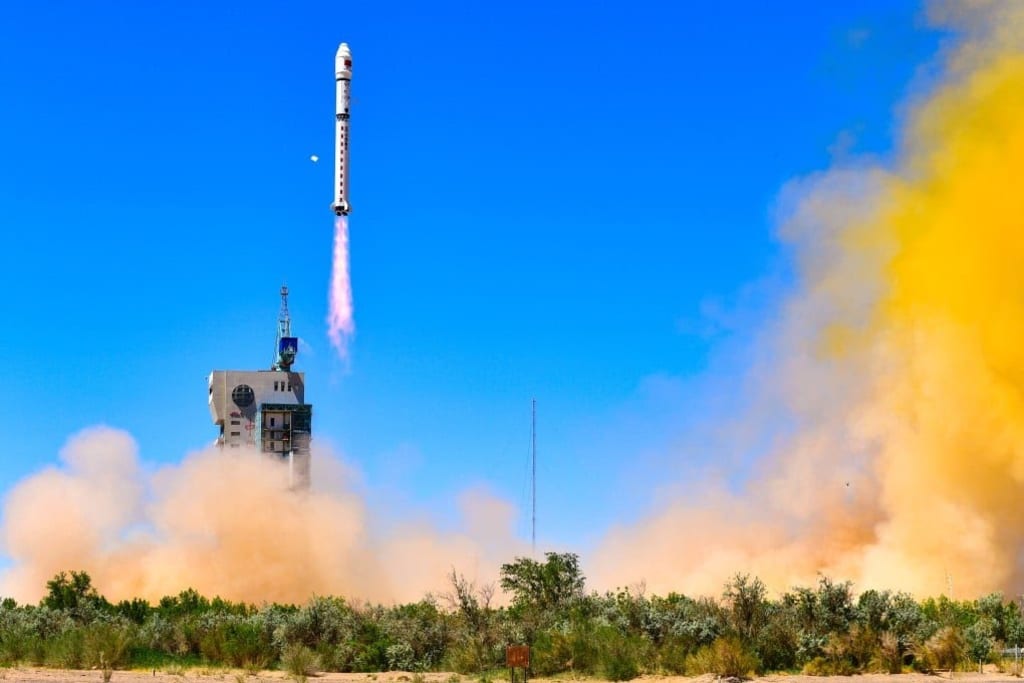
China Launches First Satellites to Build World's First Orbital Supercomputer
With the launch of 12 advanced satellites, China begins constructing the world’s first space-based supercomputer, aiming to revolutionize real-time data processing and assert dominance in the new era of orbital technology.
In a groundbreaking move that could redefine space-based computing, China has successfully launched the first 12 satellites of its ambitious "Three-Body Computing Constellation." This initiative aims to establish the world's first supercomputer in orbit, marking a significant leap in the nation's technological capabilities.
A New Era of Space Computing
The launch took place on May 14 from the Jiuquan Satellite Launch Center in northwest China, utilizing a Long March 2D rocket. The satellites, developed by ADA Space in collaboration with Zhejiang Lab, represent the initial phase of a planned 2,800-satellite network designed to perform real-time data processing directly in space.
Unlike traditional satellites that primarily focus on data collection and transmission, these new satellites are equipped with advanced processors and artificial intelligence capabilities. This allows them to analyze vast amounts of data in orbit, significantly reducing the need to send information back to Earth for processing.
The Three-Body Computing Constellation
Named after the renowned science fiction novel "The Three-Body Problem," the constellation is envisioned as a massive, space-based computing network. Once fully operational, it is expected to rival the processing power of the most advanced ground-based supercomputers.
The primary advantage of this system lies in its ability to process data in real-time, directly in space. This capability is particularly beneficial for applications requiring immediate analysis, such as disaster monitoring, environmental studies, and defense operations.
Strategic Implications
The development of an orbital supercomputer has significant strategic implications. By processing data in space, China can achieve faster decision-making capabilities in various domains, including military and intelligence operations. This advancement could provide a competitive edge in the rapidly evolving landscape of space technology.
Moreover, the project underscores China's commitment to becoming a global leader in space exploration and technology. It aligns with the nation's broader goals of enhancing its space infrastructure and expanding its influence in the domain.
Global Reactions and Concerns
While the launch has been hailed as a technological milestone, it has also raised concerns among other space-faring nations. The United States, in particular, has expressed apprehension over the potential military applications of such advanced space-based systems.
General B. Chance Saltzman, U.S. Chief of Space Operations, recently highlighted the growing capabilities of China's satellite networks, referring to them as a "kill web" that poses significant challenges to U.S. space assets.
The rapid advancement of China's space technology, including the development of an orbital supercomputer, is seen as part of a broader strategy to assert dominance in space and counterbalance U.S. influence.
Looking Ahead
The successful deployment of the initial satellites marks just the beginning of China's ambitious plan. The full realization of the Three-Body Computing Constellation will require the launch and integration of thousands more satellites, a process expected to unfold over the coming years.
As the project progresses, it will be closely watched by the international community, both for its technological innovations and its implications for global security dynamics. The development of an orbital supercomputer not only represents a significant scientific achievement but also signals a new chapter in the strategic utilization of space.
Conclusion
China's launch of the first satellites for its orbital supercomputer project signifies a bold step into the future of space technology. By bringing advanced computing capabilities into orbit, the nation is poised to transform how data is processed and utilized in space, with far-reaching implications for science, industry, and national security.
Thanks for Read:
About the Creator
Adnan Rasheed
Author & Creator | Writing News , Science Fiction, and Worldwide Update| Digital Product Designer | Sharing life-changing strategies for success.
Keep reading
More stories from Adnan Rasheed and writers in Futurism and other communities.
China Shares Moon Samples with the World—But NASA is Left Out
China Shares Moon Samples with the World—But NASA is Left Out In a groundbreaking move that underscores its growing ambitions in space exploration, China has begun sharing moon rock samples with international researchers. These samples, brought back by China's Chang’e missions, offer rare and valuable insight into the moon’s composition—especially from regions never before explored. However, one major space power remains conspicuously absent from this collaboration: NASA.
By Adnan Rasheed9 months ago in Futurism
Australia Wealth Management Market: HNWI Growth, Digital Transformation & Regulatory Reform
According to IMARC Group, the Australia wealth management market reached a value of USD 118.6 Million in 2025 and is expected to expand to USD 222.2 Million by 2034, registering a compound annual growth rate (CAGR) of 7.00% during 2026–2034. This steady growth reflects the increasing complexity of personal wealth structures, rising numbers of high-net-worth individuals (HNWIs) and a fundamental transformation in how financial advisory services are delivered. Wealth management in Australia is moving beyond traditional portfolio management toward holistic, technology-enabled financial planning that integrates investments, retirement strategies, tax efficiency and intergenerational wealth transfer. Supported by a mature superannuation system, strong economic fundamentals and regulatory modernization, the sector is emerging as a key pillar of long-term financial resilience across Australia.
By Shrestha Roy5 days ago in Futurism
Australia Energy Storage Market: Renewable Integration, Grid Resilience & Technology Advancements
According to IMARC Group, the Australia energy storage market reached a capacity of 4.72 GW in 2025 and is projected to expand significantly to 19.81 GW by 2034, exhibiting a strong compound annual growth rate (CAGR) of 17.28% during 2026–2034. This rapid expansion underscores the central role of energy storage in Australia’s accelerating clean energy transition. As renewable energy penetration increases and coal-fired generation is progressively phased out, storage systems are becoming indispensable for balancing supply and demand. From utility-scale battery projects to distributed residential systems, energy storage is emerging as a foundational infrastructure layer supporting grid stability, renewable integration and energy security across Australia.
By Shrestha Roy4 days ago in Futurism
The Pride Flag and the Diversion
For nearly a decade, the LGBTQIA Pride Flag rippled in the wind at Christopher Park, a kaleidoscope of color staked into the soil of America’s first national monument to LGBTQIA+ liberation. That flag came down this week. Federal officials, citing new guidance from the Trump Administration, silently lowered the rainbow flag from its pole across the street from the Stonewall Inn. The birthplace of the modern gay rights movement now flies only the United States flag.
By Tim Carmichael4 days ago in Pride




Comments
There are no comments for this story
Be the first to respond and start the conversation.