
Cosmic Spin Masters: The Stars That Rotate So Fast They Flatten Themselves
Space

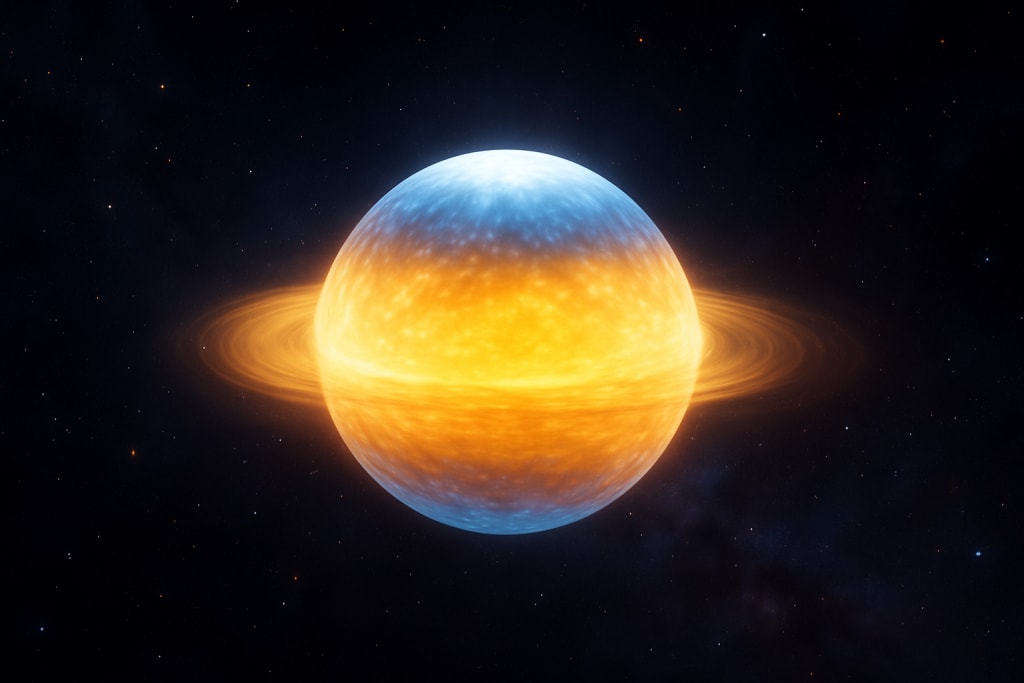
When most of us picture a star, we imagine a flawless glowing sphere—something smooth, round, and uniform. But the universe, as usual, loves to surprise us. Some stars defy this classic picture entirely. They spin so rapidly that their shape becomes distorted, stretched, and dramatically flattened. These celestial whirlers are some of the most intriguing objects astronomers have ever observed, and they challenge our understanding of what a star can be.
Why Do Some Stars Become Flattened?
The idea is simple, but the physics is breathtaking. A star is an enormous sphere of gas held together by gravity. But once it starts spinning, another force enters the picture: centrifugal force. The faster a star rotates, the more strongly its equatorial regions try to push outward.
Imagine a figure skater pulling in their arms to spin faster. Now imagine the opposite—stretching the arms outward to slow down. A rapidly rotating star acts like the skater who never pulls their arms back in. The outer layers near the equator are flung outward, while the poles remain tightly pulled inward by gravity.
The result is a shape called an oblate spheroid: flattened at the poles and swollen around the middle. Some of these stars are so distorted that comparing them to a “sphere” feels wrong—they look more like cosmic frisbees or fiery, glowing pancakes.
Meet the Champions of Fast Rotation
Several well-known stars are spinning so fast that their shapes are wildly distorted. Take Altair, a bright star in the constellation Aquila. Altair rotates once every 8.9 hours. For comparison, our Sun rotates once every 27 days. Because of that extreme speed, Altair’s equatorial diameter is about 25% larger than its polar diameter. If stars had fitness competitions, Altair would win “most ripped core” by a mile.
But Altair isn’t even the most extreme case.
The star Achernar, in the constellation Eridanus, is one of the most distorted stars ever directly imaged. Achernar spins so fast that its equatorial radius is more than 50% larger than its radius at the poles. If you could place it next to a perfectly spherical star, the difference would be shocking—Achernar looks genuinely stretched, like someone grabbed it at the poles and squeezed.
Then there are the famous Be stars, a class of rapidly rotating hot blue stars. Many of them spin at more than 300 km/s, which is fast enough to fling material into space. This creates surrounding disks of gas, giving these stars a distinctive halo-like appearance. Their namesake “B-e” stands for “B-type stars with emission lines,” a direct result of the hot gas they shed.
Some Be stars rotate at 99% of their critical velocity—the point at which a star would literally begin tearing itself apart. They’re cosmic daredevils living on the edge of stability.
How Do We Know What Shape a Star Really Has?
For centuries, astronomers could only guess at the shapes of distant stars based on their brightness and spectra. Stars were simply too far away to resolve directly—even through the largest telescopes, they still appeared as points of light.
That changed with the development of interferometry, a technique that combines multiple telescope signals into a single ultra-high-resolution image. This method allowed astronomers to “see” the surface of stars for the first time, revealing their true shapes.
Using interferometry, scientists discovered something even more surprising: rapidly spinning stars aren’t just stretched—they also experience gravity darkening. This means their poles, where gravity is strongest, are hotter and brighter, while their equators appear cooler and dimmer. Instead of a uniformly glowing sphere, these stars have dramatic temperature gradients that give them a unique, uneven glow.
What Happens If a Star Spins Even Faster?
If a star approaches its critical rotational speed, the centrifugal force at the equator becomes so strong that gravity can no longer hold the outer layers in place. When that happens, the star begins losing mass into space. Some stars shed gas into a vast disk, while others eject material in bursts or flares.
Over time, this mass loss acts like a braking system. As the star ejects material, it also sheds angular momentum, allowing it to slow down and stabilize.
In some rare cases—especially in binary systems—rapid rotation can lead to dramatic cosmic events, including stellar mergers or the creation of unusual stars like blue stragglers, which appear younger and hotter than they should be.
A Universe Full of Unexpected Shapes
Rapidly rotating stars remind us that the universe is far stranger and more diverse than our everyday intuition suggests. Even something as “simple” as the shape of a star can defy expectations. These cosmic spin masters reveal a hidden side of stellar physics, one where extreme speed reshapes not only the star’s body but also its temperature, brightness, and evolution.
As telescope technology continues to improve, we’ll likely discover even more bizarre and beautiful stars—objects that stretch our imagination just as much as they stretch themselves.
About the Creator
Keep reading
More stories from Holianyk Ihor and writers in Futurism and other communities.
Cosmic Bridges: The Hidden Gravitational Highways Linking Galaxies
When we look up at the night sky, galaxies appear as isolated islands scattered through an endless, silent ocean. But modern astrophysics paints a very different picture. Rather than drifting alone, galaxies are woven into a vast interconnected structure held together by invisible forces. This structure is threaded with what scientists sometimes call “cosmic bridges” — gravitational channels that link galaxies across unimaginable distances.
By Holianyk Ihor3 months ago in Futurism
Mars Isn’t Plan B: Why Earth Stays More Livable — No Matter What
For decades, we’ve been sold a sleek, silver-lined dream: if things go south on Earth, we’ll simply pack our bags and move to the Red Planet. From billionaire-funded rocket launches to Hollywood blockbusters, the narrative is clear—Mars is humanity’s "Plan B." It’s our cosmic lifeboat in the event of climate collapse, nuclear war, or resource depletion.
By Adil Ali Khan5 days ago in Futurism
Aniline Market: Rubber Processing Chemicals, Tire Manufacturing & Growth Outlook
According to IMARC Group's latest research publication, global aniline market size reached 10.9 Million Tons in 2025. Looking forward, IMARC Group expects the market to reach 16.3 Million Tons by 2034, exhibiting a growth rate (CAGR) of 4.43% during 2026-2034.
By sujeet. imarcgroup4 days ago in Futurism
The Pride Flag and the Diversion
For nearly a decade, the LGBTQIA Pride Flag rippled in the wind at Christopher Park, a kaleidoscope of color staked into the soil of America’s first national monument to LGBTQIA+ liberation. That flag came down this week. Federal officials, citing new guidance from the Trump Administration, silently lowered the rainbow flag from its pole across the street from the Stonewall Inn. The birthplace of the modern gay rights movement now flies only the United States flag.
By Tim Carmichael4 days ago in Pride



Comments
There are no comments for this story
Be the first to respond and start the conversation.