
Digital Twin Market Size to Hit USD 223.6 Billion by 2034 | Driven by Recent Advancements in IoT, AI, and ML Technologies
Driven by recent advancements in the Internet of Things (IoT), artificial intelligence (AI), and machine learning (ML) technologies

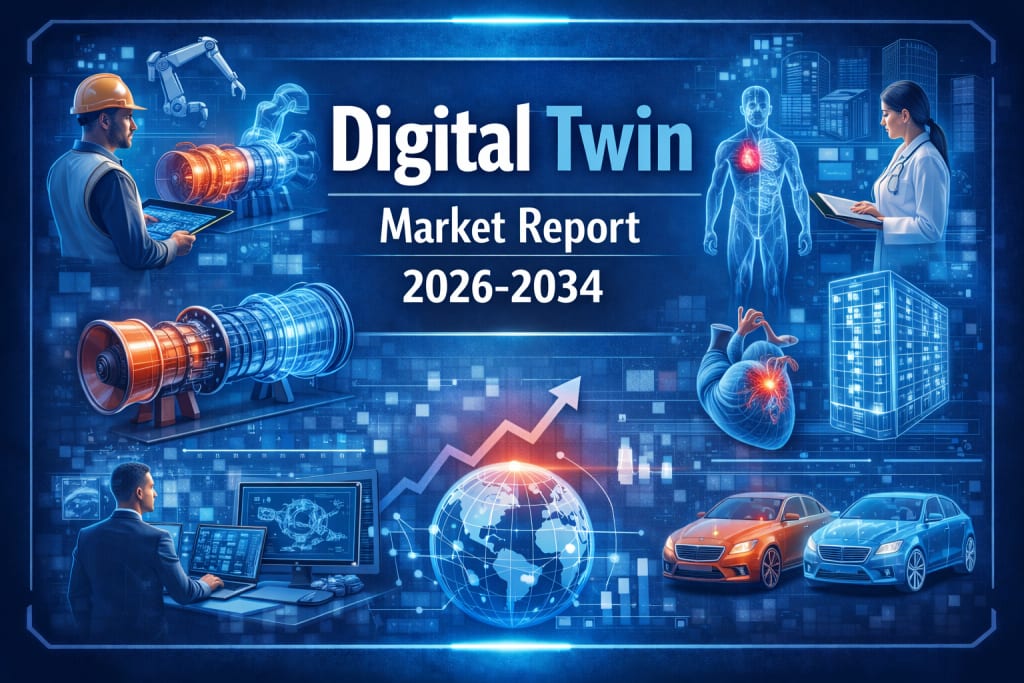
Industry 4.0 and Smart Manufacturing Driving Global Digital Twin Adoption
The global digital twin market is driven by the increase in adoption of Industry 4.0 and smart manufacturing solutions, owing to the need for improved operational and production efficiency and competitive advantage and increasing awareness regarding the benefits of digital transformation and rapid adoption of smart manufacturing solutions among industrial facilities across the globe.
Digital twin technology has entered the Industry 4.0 effort, enabling the simulation of individual physical objects, production lines and entire factories in software, optimizing manufacturing, reducing machine downtime, improving quality, and speeding new product introduction into production. Digital twins contrast with former manufacturing models based on reactive maintenance and limited visibility over the state of the manufacturing process. Digital twins enable data-driven, dynamic decision-making using real-time monitoring data from operational assets and predictive analytics. The effectiveness of digital twin solutions and the power of simulation tools and data-driven insights are driving global demand.
The potential to improve operational productivity, reduce costs, minimize unplanned downtime, and drive continuous improvement efforts continues to drive industrial adoption. As a result, manufacturing organizations as well as automotive, aerospace, heavy machinery and industrial equipment manufacturers deploy holistic digital twin strategies to improve throughput and profitability. Additionally, industry education campaigns regarding the benefits of digital transformation initiatives and competitive advantages of smart manufacturing have further contributed to market growth. The use of digital twin technology in a variety of forms from product twins, to system twins as well as process twins is applicable for different industrial use cases. This end-to-end approach to industrial digitalization, along with the growing maturity of solutions, and the institutionalization of Industry 4.0 practices, stimulates worldwide demand for digital twin solutions.
The global digital twin market size was valued at USD 29.3 Billion in 2025. Looking forward, IMARC Group estimates the market to reach USD 223.6 Billion by 2034, exhibiting a CAGR of 25.33% from 2026-2034. North America currently dominates the market, holding a market share of over 34.6% in 2025.
IoT and IIoT Integration Enabling Real-Time Data for Digital Twins
The second main driver for the digital twin market is the growing adoption of the Internet of Things (IoT) and Industrial Internet of Things (IIoT), providing data infrastructure for digital twin applications. As the number of devices and sensors connected to the Internet of Things (IoT) increases across manufacturing facilities, commercial buildings, civil infrastructure, and consumer products, more and more operational data is collected in real-time for digital twins via IoT sensors attached to physical assets to continuously monitor their temperature, vibration, pressure, speed, etc. The data is then fed into digital twin platforms for analysis and visualization, creating a decently accurate and synchronized digital counterpart of the physical asset.
Falling costs for IoT sensors and advancements in wireless technology have enabled common implementation of sensors and digital twins across industries. Advanced sensor technologies such as MEMS, smart and edge computing sensors and environmental monitoring systems will push forward real-time data capture and allow a finer granularity of data to be used to build digital twins. 5G networks will improve connectivity reliability and low-latency communications to enable use cases that require real-time synchronization between physical assets and digital twins. In addition to connectivity, product innovation is also eased through the integration of edge computing with devices to develop smart sensors that can pre-process data locally, reducing bandwidth demands and latency.
The rise of IoT platforms with standard APIs and data management capabilities solves many of the problems of implementing a large-scale digital twin. Cloud IoT offerings from major technology companies allow enterprises to scale to millions of connected devices, making it easy to deploy digital twins at scale. The growth of industrial communication protocols and standardization efforts improves interoperability between sensor technology and digital twins. Along with the enlarged global infrastructure and capabilities of the Internet of Things (IoT), the result is a long-term market opportunity now that improved connectivity and more data is a persistent mission in industrialization and smart infrastructure.
Artificial Intelligence and Machine Learning Enhancing Predictive and Prescriptive Capabilities
The digital twin market is largely influenced by artificial intelligence (AI) and machine learning (ML) technologies. Both technologies strongly increase the analytics value proposition for digital twins. As a result of the use of AI and ML algorithms, digital twins can become more than a static virtual image of a physical asset. They can develop into clever, self-learning systems, capable of autonomously analyzing, predicting, and optimizing the performance of a physical asset, and generating recommendations for the optimal operational parameters based on historical operational data patterns and anomalies. Thus, over time, AI-based digital twins are moving from simple visualization tools to predictive and prescriptive analytics which provide actionable insights to the decision makers. In these applications deep learning methods can detect complex patterns in high-dimensional sensor data that are indicative of degradation or a drop in performance often not detectable by conventional monitoring approaches.
Reinforcement learning techniques allow a digital twin to explore control policy space by digitally experimenting with millions of scenarios before implementing a control policy on a physical system. Natural language processing allows operators to directly communicate with digital twin systems using conversational interfaces. Computer vision helps digital twins analyze images, videos and other data acquired from cameras and inspection devices, improving situational awareness. Increasingly advanced generative AI is being applied to help digital twins suggest optimization processes, simulate the future, and develop probabilistic forecasts that contribute to planned planning and decision-making.
When combined with AI/ML, digital twins enable predictive maintenance solutions that minimize unplanned interruptions, lengthen equipment life, and optimize the maintenance schedule based on equipment condition. Real-time optimization of a complex system in energy distribution, manufacturing, and logistics applications is achieved by varying system parameters in order to maximize some measure of utility, subject to a predefined set of constraints. This adds basic clever analytics functionality, resulting in an active market growth opportunity for data-driven optimization of systems through the use of artificial intelligence-powered digital twins of those systems.
Digital Twin Market Share by Region 2026 | Regional Analysis:
North America
- United States
- Canada
Asia Pacific
- China
- Japan
- India
- South Korea
- Australia
- Indonesia
- Others
Europe
- Germany
- France
- United Kingdom
- Italy
- Spain
- Russia
- Others
Latin America
- Brazil
- Mexico
- Others
Middle East and Africa
North America accounted for the largest market share of over 34.6%.
About the Creator
Keep reading
More stories from Frank Morgan and writers in Futurism and other communities.
Type 2 Diabetes - Treatment Trends, Market Size (USD 45.9 Billion), Epidemiology Forecast to 2035
Rising Prevalence of Type 2 Diabetes Driving Market Growth The type 2 diabetes market in 2025 is one of the most active sectors of the entire healthcare market. Type 2 diabetes is characterized by the failure to produce sufficient insulin and/or inadequate use of insulin. Insulin is a naturally occurring hormone used to control the level of sugar in the blood. Long-term high blood sugar levels can damage organs and cause conditions such as heart disease, kidney failure, nerve damage, and vision problems. As a result, type 2 diabetes has become a focus for patients, providers, and policymakers.
By Frank Morgan4 days ago in Futurism
Bottled Water Market Trends: Eco-Friendly Bottles, Smart Labeling & Industry Outlook to 2034
Growing health awareness, concerns about water contamination, and the shift away from sugary beverages are fueling the bottled water market, complemented by convenience factors, premiumization trends, and eco-friendly packaging innovations. According to IMARC Group's latest data, the global bottled water market size was valued at USD 288.8 Billion in 2025. Looking forward, IMARC Group estimates the market to reach USD 498.4 Billion by 2034, exhibiting a CAGR of 6.06% from 2026-2034.
By Andrew Sullivanabout 5 hours ago in Futurism
Virtual Reality Market Analysis: Industrial Training, Automation & Forecast to 2033
Rising demand for immersive experiences across gaming, healthcare, and enterprise training, combined with improvements in headset hardware and the spread of 5G connectivity, is pushing virtual reality adoption to new levels. According to IMARC Group's latest data, the global virtual reality market size was valued at USD 15.9 Billion in 2024. Looking forward, IMARC Group estimates the market to reach USD 89.5 Billion by 2033, exhibiting a CAGR of 21.1% from 2025-2033. North America currently dominates the market.
By Suhaira Yusuf11 minutes ago in Futurism
Nancy Guthrie: Is a miracle still possible after close to two weeks?
Close to two weeks since Nancy Guthrie's abduction As of February 12, 2026, Nancy Guthrie remains classified as missing for 12 days, but there is no official confirmation that she is deceased. Blood matching Guthrie’s DNA was found on her front porch, indicating she likely suffered an injury during the abduction.
By Cheryl E Preston5 days ago in Geeks



Comments
There are no comments for this story
Be the first to respond and start the conversation.