
Fermenters Market Trends: Sustainable Manufacturing, Energy Optimization & Industry Outlook to 2033
How sustainability goals, energy optimization, and waste reduction strategies are reshaping fermenter design, driving adoption of resource-efficient, modular, and continuous bioprocessing technologies.

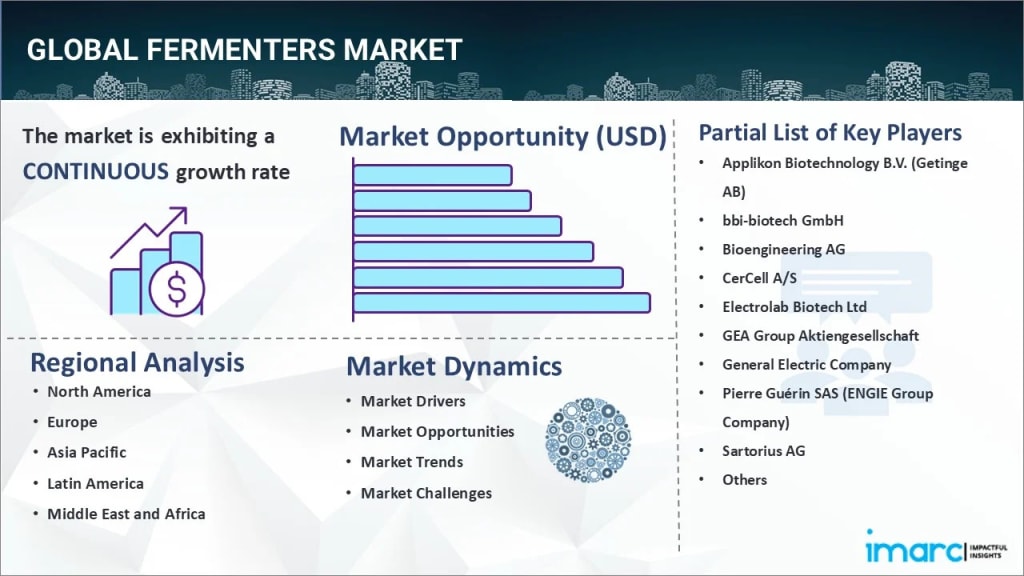
The rapid evolution of the biopharmaceutical and food technology sectors is reshaping the industrial landscape, with advanced fermentation systems at the forefront of this transformation. According to IMARC Group’s latest data, the global fermenters market size reached USD 1.8 Billion in 2024. Looking forward, IMARC Group expects the market to reach USD 2.9 Billion by 2033, exhibiting a growth rate (CAGR) of 5.47% during 2025-2033.
Modern fermentation technology has evolved far beyond traditional brewing, now serving as the backbone for the production of life-saving vaccines, sustainable biofuels, and innovative animal-free proteins. As industries pivot toward eco-friendly manufacturing, the demand for high-precision, automated, and stainless-steel fermenters is surging. Businesses are increasingly adopting these systems to optimize yields and ensure consistency, moving away from manual processes to meet the rigorous quality standards of the global pharmaceutical and specialty food markets.
Fermenters Market Growth Drivers:
- Accelerating Biopharmaceutical Production and Vaccine Demand
The global healthcare sector is increasingly reliant on fermentation for the manufacturing of biologics, monoclonal antibodies, and vaccines. Following the global push for enhanced pandemic preparedness, pharmaceutical companies have scaled up their bioreactor and fermenter capacities significantly. Statistics indicate that global vaccine demand has seen a sharp increase, requiring sophisticated stainless-steel fermenters that offer sterile environments and precise temperature control. This industrial shift is backed by substantial healthcare spending, which is projected to grow by over 5% annually in major economies like the United States, further cementing the role of fermenters in modern medicine.
- Revolution in Alternative Proteins and Functional Foods
A major shift in consumer dietary habits toward plant-based and lab-grown proteins is fueling a new wave of industrial fermentation. Precision fermentation allows for the creation of dairy and meat alternatives that mimic traditional textures without the environmental footprint of livestock. In 2024, the number of companies specializing in fermentation-enabled proteins grew by approximately 16%, highlighting a massive transition in food tech. These facilities require specialized fermenter tanks to cultivate microorganisms that produce whey, casein, and other essential nutrients, catering to a global audience that increasingly views "fermented" as a hallmark of health and sustainability.
- Technological Shift Toward Automation and Single-Use Systems
Industrial operators are prioritizing efficiency through the integration of AI-driven automation and real-time monitoring within fermentation processes. Automated fermenters allow for continuous nutrient feeding and pH balancing, which drastically reduces human error and operational downtime. Furthermore, the rise of "Single-Use Technology" (SUT) is gaining traction, particularly in the pharmaceutical sector, as it minimizes the risk of cross-contamination and reduces the heavy water and energy costs associated with cleaning traditional tanks. This move toward digitalized and modular fermentation setups is enabling startups to scale their production quickly while maintaining the high-purity standards required for global distribution.
Fermenters Market Trends:
- Strategic Focus on Sustainability and the "Bio-Economy"
Governments and corporations are viewing fermentation as a critical tool for achieving net-zero goals. By using microbes to convert organic waste into high-value chemicals or fuels, the industry is supporting a circular economy. Recent policy shifts, such as the U.S. Executive Order on Advancing Biotechnology, have directed billions toward "bio-manufacturing" infrastructure. This trend is mirrored in the private sector, where brands are replacing traditional chemical synthesis with microbial fermentation to produce biodegradable plastics and specialty ingredients. Industry data suggests that sustainability now influences over 40% of procurement decisions for large-scale industrial equipment, driving demand for energy-efficient fermenter designs.
- The Rise of Craft Culture and Micro-Brewery Expansion
The "craft" movement has moved beyond beer into functional beverages like kombucha, kefir, and probiotic juices. This has created a vibrant niche for small-to-medium-sized fermenters that offer flexibility and artisanal control. In the United States alone, the craft beer industry accounts for nearly 13% of the national beer market, supported by over 9,000 active breweries. This expansion is now spreading to the Asia-Pacific region, where urban populations in India and China are showing a strong preference for premium, locally fermented drinks. Consequently, manufacturers are launching modular, plug-and-play fermenter kits tailored for these smaller, high-growth beverage enterprises.
- Integration of Artificial Intelligence in Strain Optimization
A cutting-edge trend in the market is the use of AI to design "super-strains" of microbes that work more efficiently within the fermenter. By using digital twins to simulate fermentation environments, companies can predict how a batch will perform before it even begins. This reduces the time-to-market for new products, from enzymes to specialty food ingredients. Large players like Nestlé and PepsiCo are increasingly engaging in partnerships with biotech startups to utilize these AI-optimized processes. This data-driven approach is transforming fermenters from simple storage tanks into "smart reactors" that can self-adjust to maximize output.
Recent News and Developments in the Fermenters Market:
- November 2025: The U.S. government introduced bipartisan legislation to establish the National Biopharmaceutical Manufacturing Center of Excellence, a move designed to bolster domestic biotech infrastructure and incentivize the installation of advanced fermentation suites for health security.
- August 2024: The Government of India approved the BioE3 Policy, which targets a USD 300 Billion bio-economy by 2030. The policy focuses on setting up "Bio-Enabler" centers equipped with high-tech fermentation and downstream processing units to support over 250 startups.
- February 2024: 21st.Bio, in partnership with Novozymes, launched a new precision fermentation technology platform. This platform is designed to help ingredient manufacturers scale up the production of animal-free dairy proteins, bridging the gap between lab-scale innovation and industrial-scale manufacturing.
- January 2024: ABB unveiled a new process automation solution specifically for the "cold block" stage of brewing. This technology optimizes the fermentation and maturation stages, enhancing energy efficiency and quality control for large-scale beverage producers.
Note: If you require specific details, data, or insights that are not currently included in the scope of this report, we are happy to accommodate your request. As part of our customization service, we will gather and provide the additional information you need, tailored to your specific requirements. Please let us know your exact needs, and we will ensure the report is updated accordingly to meet your expectations.
About the Creator
Andrew Sullivan
Hello, I’m Andrew Sullivan. I have over 9+ years of experience as a market research specialist.
Keep reading
More stories from Andrew Sullivan and writers in Futurism and other communities.
Automotive Blind Spot Detection System Market Trends: AI Integration, Sensor Innovation & Forecast to 2034
Rising safety concerns, stringent government regulations, and the increasing adoption of Advanced Driver Assistance Systems (ADAS) are driving the demand for automotive blind spot detection systems. This growth is further supported by ongoing technological advancements in radar and sensor fusion, as well as a significant shift in consumer preference toward vehicles equipped with proactive safety features. According to IMARC Group’s latest data, the global automotive blind spot detection system market size reached USD 6.72 Billion in 2025. Looking forward, IMARC Group estimates the market to reach USD 15.57 Billion by 2034, exhibiting a CAGR of 9.79% from 2026-2034.
By Andrew Sullivanabout 8 hours ago in Futurism
Saudi Arabia Wood Pellets Market: Renewable Energy Shift, Biomass Demand & Growth Outlook
Saudi Arabia's wood pellets sector is quietly gaining ground, supported by an ambitious national push to diversify the energy mix, cut carbon emissions, and reduce industrial dependence on fossil fuels. From power plants co-firing biomass to commercial heating facilities shifting away from conventional fuels, wood pellets are finding their footing as a practical, scalable renewable option. According to IMARC Group's latest data, the Saudi Arabia wood pellets market size was valued at USD 0.13 Billion in 2024. Looking forward, IMARC Group estimates the market to reach USD 0.21 Billion by 2033, exhibiting a CAGR of 5.70% from 2025-2033.
By Kishan Kumar7 days ago in Futurism
AGI: Between Divine Creation and the Shadow of Skynet🤔🤖
We are living in times that future historians will likely describe as the "Era of the Great Transition." The development of Artificial Intelligence has ceased to be a mere curiosity for programmers and has become the driving force of a new reality. 🌍 Our daily lives are filled with Generative AI that creates photorealistic images on demand, writes application code, or edits videos. We use algorithms to optimize logistics and AI agents that perform tasks within their narrow specializations with incredible precision. 🎯 However, all of this is just a prelude. The real challenge that the whole world is waiting for—and simultaneously dreading—is called AGI.
By Piotr Nowak6 days ago in Futurism




Comments
There are no comments for this story
Be the first to respond and start the conversation.