
From Pocket AI Labs to Mixed Reality Gaming: How New Devices Are Redefining Personal Computing
AI Supercomputers in Your Pocket, AR Glasses on Your Face, and Robots in Motion — The Future of Tech Is Closer Than You Think

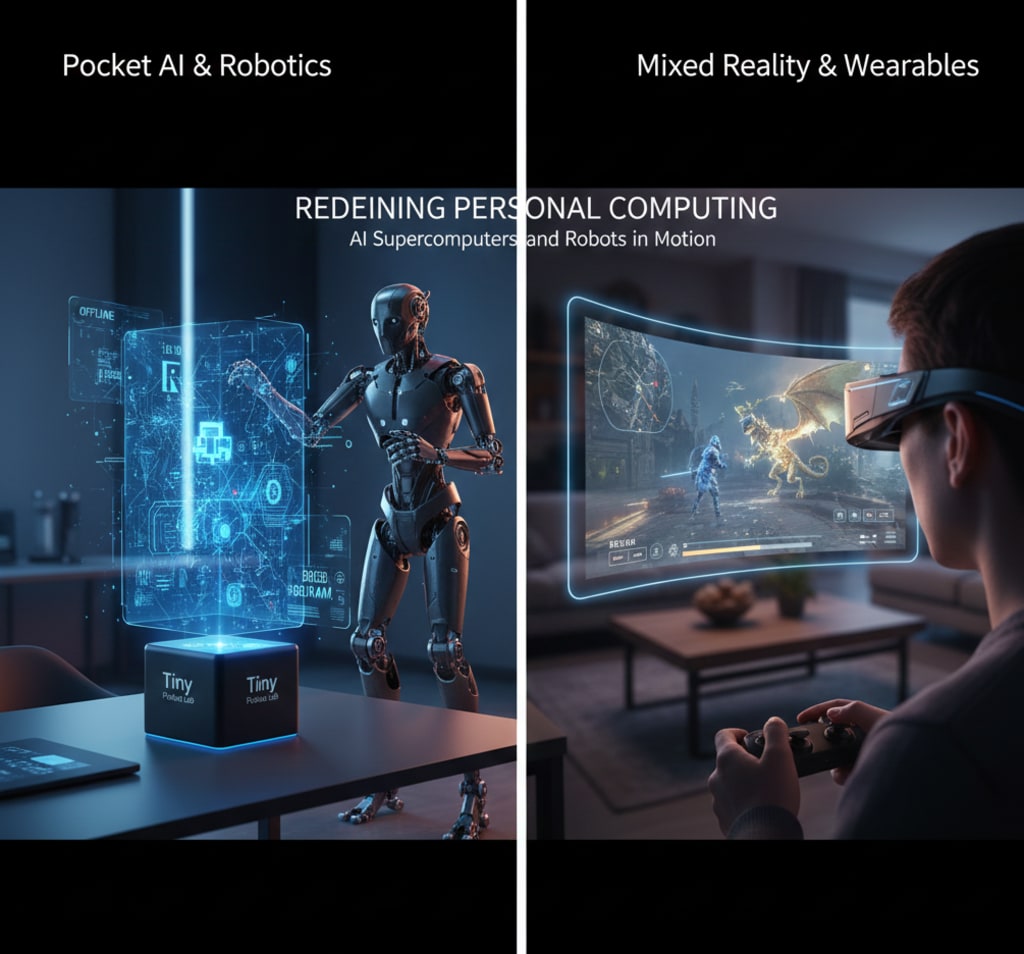
The world of technology is undergoing a powerful transformation. Instead of relying solely on massive data centers and traditional desktop machines, computing is becoming more personal, immersive, and localized.
Recent product showcases have highlighted this shift clearly. From the Tiiny AI Pocket Lab, a portable offline AI device, to Xreal’s augmented reality smart glasses, Boston Dynamics’ Atlas robot, and Intel’s Core Ultra Series 3 processors, these innovations reveal how the future of computing is moving directly into our hands — and even onto our faces.
Together, these technologies point to a larger trend: powerful computing tools are becoming smaller, smarter, and more integrated into daily life.
Let’s explore what this shift means.
________________________________________
The Rise of Pocket AI: Tiiny AI Pocket Lab
One of the most attention-grabbing innovations is the Tiiny AI Pocket Lab — a compact, offline artificial intelligence device described as a portable AI “supercomputer.”
Unlike many AI platforms that rely heavily on cloud infrastructure, this device is designed to run AI models locally, without internet connectivity.
Key Specifications
• Up to 80GB of RAM
• 1TB solid-state drive (SSD)
• Fully offline functionality
• Portable form factor
These specifications are impressive for a device small enough to fit in a bag — or even a large pocket.
Why Offline AI Matters
In an era where most AI tools rely on cloud servers, local processing offers significant advantages:
✔ Enhanced Privacy – Sensitive data stays on the device
✔ Reduced Cloud Costs – No ongoing server fees
✔ Faster Response Times – No internet latency
✔ Functionality in Remote Areas – Useful in fieldwork or unstable connectivity
For developers, researchers, and cybersecurity professionals, this approach could be game-changing.
________________________________________
Limitations of Pocket AI Devices
However, portable AI labs face practical challenges:
• Heat management in compact hardware
• High production costs
• Limited appeal for non-technical users
• Power consumption concerns
While cloud AI remains more convenient for everyday users, devices like the Tiiny AI Pocket Lab represent a growing demand for edge computing and local AI processing.
This shift suggests that the future of AI may not be exclusively cloud-based.
________________________________________
Augmented Reality Smart Glasses: Mixed Reality Gaming Goes Mainstream
While pocket AI brings computing inward, Xreal’s AR smart glasses push computing outward — into the user’s field of vision.
These lightweight augmented reality glasses recently gained attention for showcasing immersive gaming experiences, including mixed reality gameplay for titles like Elden Ring.
Instead of sitting in front of a monitor, users see large virtual screens projected into their real-world environment.
________________________________________
Features of Xreal’s AR Smart Glasses
• High-resolution virtual display projection
• Low-latency tracking
• Compatibility with PCs, consoles, and smartphones
• Lightweight and wearable design
• Mixed reality functionality
Unlike traditional VR headsets, AR glasses allow users to remain aware of their surroundings while engaging with digital content.
This reduces motion discomfort and increases practicality for daily use.
________________________________________
The Benefits of Mixed Reality Technology
Augmented reality glasses offer several advantages:
🎮 Immersive gaming without bulky headsets
📺 Large virtual screens without physical monitors
💼 Productivity use cases for remote work
🎥 Enhanced media consumption experiences
Beyond entertainment, AR smart glasses may support collaboration, design visualization, and digital overlays in professional environments.
________________________________________
Barriers to AR Adoption
Despite excitement, AR glasses still face hurdles:
• Battery life limitations
• Comfort for long-term wear
• High pricing
• Limited AR-optimized content
For widespread adoption, developers must build stronger software ecosystems that fully leverage mixed reality capabilities.
________________________________________
Robotics Progress: Boston Dynamics’ Atlas
While AI and AR reshape personal computing, robotics continues to redefine physical automation.
Boston Dynamics’ Atlas robot has demonstrated advanced mobility, balance, and object manipulation — showcasing how machine learning integrates with robotics.
Recent demonstrations highlight:
• Improved dynamic movement
• Enhanced adaptability
• More precise object handling
• Increased autonomous operation
Atlas is not a consumer product. It is primarily intended for research and industrial use. However, its development signals the rapid progress of intelligent robotics systems.
________________________________________
Why Atlas Represents a Broader Shift
Robots like Atlas could eventually assist in:
• Disaster response
• Construction sites
• Hazardous environments
• Industrial automation
Rather than replacing humans entirely, the goal may be collaboration — robots handling high-risk or repetitive tasks while humans focus on oversight and complex decision-making.
Still, challenges remain:
• High production and maintenance costs
• Regulatory frameworks
• Ethical concerns
• Long-term reliability
Robotics continues to evolve, but mass deployment will require careful implementation.
________________________________________
Intel Core Ultra Series 3: The AI-Powered Processor Era
Another key development shaping personal computing is Intel’s Core Ultra Series 3 processors.
These new chips are designed for:
• AI acceleration
• Gaming performance
• Energy efficiency
• Integrated AI processing units
Unlike older processors, these chips include dedicated AI engines capable of handling tasks like:
• Voice recognition
• Image processing
• Local AI inference
• Background AI enhancements
This reflects a broader trend toward AI-native hardware architecture.
________________________________________
Why AI-Integrated Chips Matter
By embedding AI acceleration directly into processors, manufacturers can:
⚡ Improve performance efficiency
🔋 Reduce power consumption
📉 Decrease reliance on cloud AI
💻 Enable smarter laptops and compact devices
This aligns closely with the rise of pocket AI devices and AR systems — computing is becoming smarter at the hardware level.
________________________________________
What Connects These Innovations?
Although these technologies differ in purpose, they share a common theme:
Computing is becoming more localized, immersive, and personalized.
Instead of centralized systems controlling everything from distant data centers, users now have:
• Portable AI supercomputers
• Wearable AR displays
• Intelligent robotics systems
• AI-accelerated processors
The shift is clear — advanced capabilities are moving closer to the user.
This transformation reflects the growth of:
• Edge computing
• Mixed reality environments
• Local AI processing
• Smart hardware ecosystems
________________________________________
Challenges in the New Personal Computing Era
While innovation is accelerating, adoption faces real obstacles:
• High initial costs
• Technical complexity
• Software ecosystem readiness
• Consumer education gaps
• Privacy and ethical considerations
Mass-market success will depend on affordability, user-friendliness, and developer support.
________________________________________
The Future of Personal and Immersive Computing
Looking ahead, we may see:
• More compact AI hardware
• Lightweight AR glasses with extended battery life
• Smarter AI-integrated processors
• Collaborative robotics in industry
• Seamless interaction between digital and physical spaces
The traditional concept of “personal computing” — a desktop or laptop on a desk — is evolving into something more dynamic and integrated.
Devices are no longer just tools; they are becoming intelligent companions that adapt to users’ environments and workflows.
________________________________________
Final Thoughts
From the Tiiny AI Pocket Lab to AR smart glasses, advanced robotics, and AI-powered processors, today’s technology landscape reveals a fundamental transformation.
The focus is shifting from centralized cloud dependence to localized intelligence and immersive interaction.
While challenges around cost, adoption, and ecosystem development remain, these innovations highlight a powerful trend: computing is becoming more personal, portable, and deeply integrated into everyday life.
As hardware and AI continue to merge, the boundaries between physical and digital worlds will likely grow thinner — reshaping how we work, play, and connect with technology.
About the Creator
Adil Ali Khan
I’m a passionate writer who loves exploring trending news topics, sharing insights, and keeping readers updated on what’s happening around the world.
Keep reading
More stories from Adil Ali Khan and writers in Futurism and other communities.
AI Video Tools: How Text and Images Are Becoming Full-Fledged Videos in Minutes
Artificial intelligence is no longer limited to chatbots and automation systems. One of the fastest-growing areas of innovation is AI video generation — tools that transform simple text prompts or static images into complete videos with visuals, animation, music, and even voiceovers.
By Adil Ali Khana day ago in Futurism
Saudi Arabia Agritech Market: Smart Farming, Water Efficiency & Growth Outlook
According to IMARC Group's latest research publication, Saudi Arabia agritech market size reached USD 274.0 Million in 2025. The market is projected to reach USD 667.1 Million by 2034, exhibiting a growth rate of 10.39% during 2026-2034.
By Faisal Al-Harbi2 days ago in Futurism
Specialty Food Ingredients Market Outlook: Clean Label Innovation & Future Demand
According to IMARC Group's latest research publication, the global specialty food ingredients market size reached USD 85 Billion in 2024. Looking forward, IMARC Group expects the market to reach USD 126 Billion by 2033, exhibiting a growth rate (CAGR) of 4.5% during 2025-2033.
By sujeet. imarcgroup4 days ago in Futurism




Comments
There are no comments for this story
Be the first to respond and start the conversation.