
Health Insurance Market Trends: Preventive Care Incentives, Wellness Programs & Industry Forecast to 2034
Examining how rising healthcare costs, changing reimbursement models, and preventive care incentives are influencing policy design, premium structures, and insurer profitability strategies.

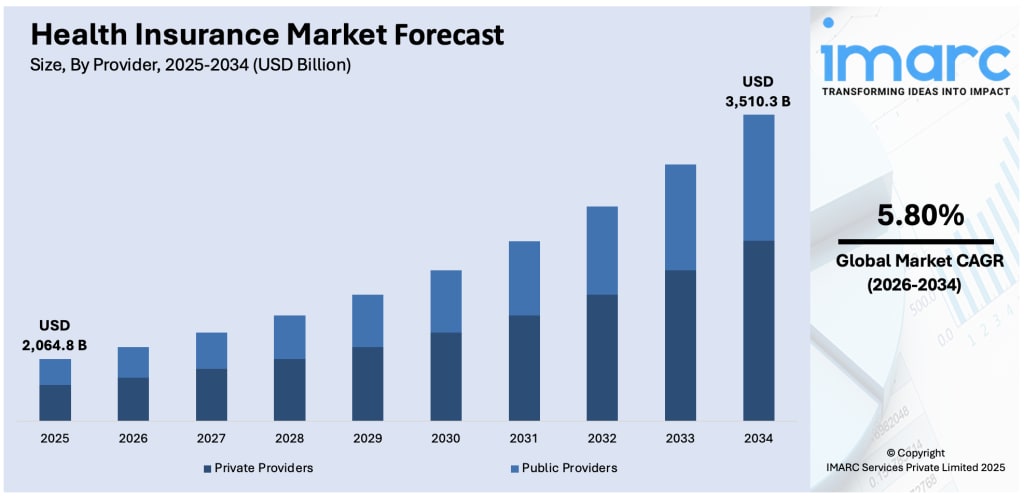
Rising healthcare costs, a growing geriatric population, and the increasing prevalence of chronic diseases are driving global health insurance demand, supported by digital transformation, value-based care models, and supportive government policies. According to IMARC Group’s latest data, the global health insurance market size was valued at USD 2,064.8 Billion in 2025. Looking forward, IMARC Group estimates the market to reach USD 3,510.3 Billion by 2034, exhibiting a CAGR of 5.80% from 2026-2034.
Health insurance has evolved into a cornerstone of global financial and physical well-being, now representing a massive industry valued at over USD 2 trillion. This sector is characterized by a significant shift toward private provider dominance and a growing preference for medical insurance plans, which currently account for over 51% of the market share. Consumers are increasingly prioritizing long-term security, with life-time coverage options leading the industry. The landscape is also being reshaped by the integration of telehealth services and AI-driven underwriting, as insurers strive to offer more personalized, transparent, and accessible coverage to a diverse global demographic.
Health Insurance Market Growth Drivers:
- Rising Burden of Chronic Diseases and Aging Populations
The global surge in chronic conditions, such as diabetes and cardiovascular diseases, necessitates consistent medical intervention and long-term financial protection. This demand is further intensified by a rapidly aging global society; recent statistics indicate that by 2030, one in six people worldwide will be aged 60 or older. As the geriatric population is projected to reach 2.1 billion by 2050, the need for comprehensive health coverage becomes critical. Consequently, insurers are expanding portfolios to include specialized geriatric care and chronic disease management, catering to a demographic that now holds a 57.5% market share.
- Escalating Healthcare Expenditures and Medical Inflation
Continuous increases in medical costs are forcing individuals and employers to seek robust insurance shields. In the United States alone, healthcare spending climbed by 7.5% in 2023, reaching a staggering USD 4.8 trillion. This inflationary environment, driven by high-cost specialty drugs and advanced surgical procedures, makes out-of-pocket payments unsustainable for most households. Market data reveals that medical insurance remains the dominant plan type, capturing over half of the industry value, as consumers rely on these policies to mitigate the financial impact of hospital stays, which can easily exceed USD 20,000 for a single major event.
Grab Your Free "Health Insurance Market" Market Intelligence Sample
- Expansion of Digital Health and Telemedicine Integration
Technological advancements are revolutionizing how insurance is consumed and delivered. The post-pandemic era has seen a permanent shift toward virtual care, with the telemedicine sector growing at double-digit rates. Insurers are now integrating 24/7 digital consultations into standard plans to improve patient outcomes and reduce administrative overhead. This digital evolution is supported by the adoption of AI and big data, which streamline claims processing and enhance risk assessment accuracy. By offering more convenient, tech-enabled touchpoints, providers are attracting a younger, tech-savvy workforce that demands seamless, on-the-go access to healthcare services through mobile platforms.
Health Insurance Market Trends:
- Shift Toward Value-Based Care and Outcome-Focused Models
The industry is moving away from traditional fee-for-service models toward value-based care, where providers are incentivized based on patient health outcomes rather than the volume of services. This trend aims to curb rising costs while improving the quality of care. For example, in 2024, new platforms were launched to enhance connectivity between payors and providers, ensuring more efficient contract resolutions. By focusing on preventive measures and effective chronic disease management, insurers are reducing the frequency of expensive emergency interventions. This systemic shift is becoming a standard in developed markets, aligning financial incentives with long-term wellness goals.
- Hyper-Personalization and Modular Policy Design
Modern consumers are moving away from "one-size-fits-all" plans in favor of highly customizable coverage. To meet this demand, leading insurers are introducing flexible "riders" or add-ons that cover specific needs such as mental health support, maternity care, and cancer-specific treatments. Recent developments show brands launching "super-star" retail policies that allow users to pick and choose features based on their specific lifestyle or medical history. This trend of premiumization and customization is particularly strong in North America and Europe, where affluent consumers are willing to pay higher premiums for plans that offer mineral-rich wellness benefits or exclusive specialist networks.
- Regulatory Reforms and Mandatory Insurance Mandates
Government interventions are playing a pivotal role in market expansion, particularly in emerging economies. In regions like the GCC, countries such as Saudi Arabia and the UAE have introduced mandatory health insurance for residents and tourists, shifting the burden from the state to the private sector. Similarly, in the U.S., the extension of federal subsidies has historically kept millions of people enrolled in marketplace plans. These regulatory frameworks not only increase insurance penetration but also foster a more competitive environment. Currently, private health insurance providers dominate the global landscape by tailoring products to meet these evolving legal requirements and diverse consumer needs.
Recent News and Developments in Health Insurance Market
- December 2024: Star Health introduced "SUPER STAR," a long-term retail insurance policy featuring highly customizable covers to address the growing consumer demand for personalized and flexible health plans.
- February 2025: Narayana Health officially entered the insurance sector with a new product specifically targeted at the working class, aiming to enhance healthcare affordability for middle- and lower-income households.
- October 2024: TATA AIG General Insurance launched five innovative health insurance riders—including Mental Wellbeing and OPD Care—to provide broader coverage and cater to evolving consumer preferences for holistic health management.
- April 2024: Arbital Health launched its Value-Based Care Adjudication Platform to streamline connectivity among employers, payors, and providers, facilitating more efficient healthcare contract resolutions and outcome-tracking.
Note: If you require specific details, data, or insights that are not currently included in the scope of this report, we are happy to accommodate your request. As part of our customization service, we will gather and provide the additional information you need, tailored to your specific requirements. Please let us know your exact needs, and we will ensure the report is updated accordingly to meet your expectations.
About the Creator
Andrew Sullivan
Hello, I’m Andrew Sullivan. I have over 9+ years of experience as a market research specialist.
Keep reading
More stories from Andrew Sullivan and writers in Futurism and other communities.
Fertilizer Market Forecast: Eco-Friendly Formulations, Regulatory Support & Industry Outlook to 2034
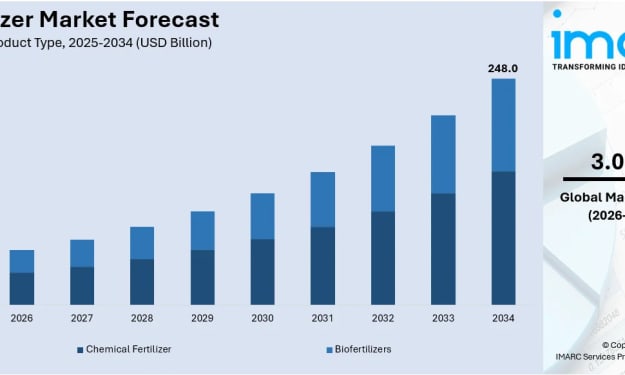
Rising demand for food security, shrinking arable land, and the adoption of high-yield crop varieties are fueling the global fertilizer market. These trends are further supported by government subsidies, advancements in precision farming, and the rapid expansion of the organic and bio-based fertilizer sectors. According to IMARC Group’s latest data, the global fertilizer market size reached USD 187.9 Billion in 2025. Looking forward, IMARC Group estimates the market to reach USD 248.0 Billion by 2034, exhibiting a CAGR of 3.04% during 2026-2034.
By Andrew Sullivanabout 14 hours ago in Futurism
Australia Hair Care Market: Consumer Trends, Product Innovation & Retail Expansion
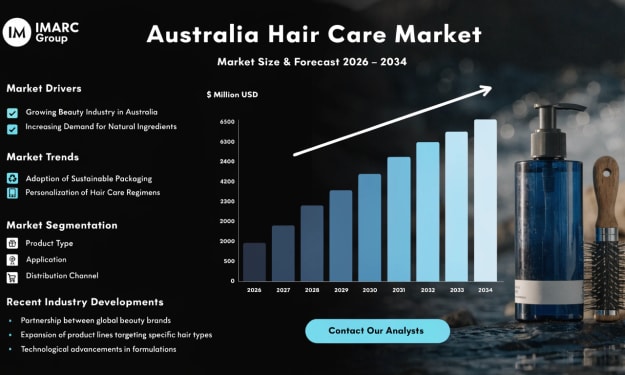
According to IMARC Group, the Australia hair care market was valued at USD 1.36 Billion in 2025 and is projected to reach USD 2.03 Billion by 2034, exhibiting a compound annual growth rate (CAGR) of 4.51% during 2026–2034. This steady expansion reflects shifting consumer grooming preferences, increasing premiumization and expanding omnichannel retail networks across Australia. Hair care products—ranging from shampoos and conditioners to styling solutions, treatments and hair colorants—are increasingly positioned as wellness-oriented and sustainability-driven offerings. As consumers prioritize scalp health, ingredient transparency and eco-conscious packaging, the Australian hair care industry is undergoing meaningful transformation.
By Kevin Cooper5 days ago in Futurism
The Subtle Market Shifts That Often Signal What Comes Next in Crypto
Most of the time, the crypto market is not as crazy as it seems. Even though daily price changes make a lot of noise, the real story often happens in the background, through changes in how investors act, slow but steady infrastructure growth, and shifting priorities across the ecosystem.
By Muhammad Talha Ahmad5 days ago in Futurism


Comments
There are no comments for this story
Be the first to respond and start the conversation.