
How Attention Economics Influences Europe Digital OOH Advertising Market Strategies
Attention economics is a valuation model that treats human attention as a scarce commodity.

The modern consumer lives in an economy of distraction. Consequently, capturing genuine focus has become the hardest challenge for marketers. While online ads often vanish under the thumb of a scrolling user, one channel is proving resilient. The Europe digital OOH advertising market is not just surviving; it is thriving by leveraging the power of "Attention Economics."
According to the latest industry analysis by IMARC Group, the market size reached US$ 3.26 Billion in 2024. However, this is just the beginning. The shift from counting "impressions" to valuing "attention" is reshaping investment strategies across the continent. Brands are no longer satisfied with potential views. Instead, they demand verified engagement.
This article analyzes how attention economics drives this growth and provides specific data to help you navigate the European landscape.
What Does the Data Say About the Europe DOOH Market Growth?
The market is currently experiencing a robust upward trajectory. This growth is fuelled by rapid urbanization and the digitization of public infrastructure.
IMARC Group forecasts that the market will reach a staggering US$ 8.22 Billion by 2033. This represents a strong Compound Annual Growth Rate (CAGR) of 10.28% during the 2025-2033 forecast period.
Why is this growth happening now?
- Infrastructure: Countries like Germany, which currently holds the largest market share, are heavily investing in smart city projects.
- Format Dominance: Digital Billboards represent the largest market segment. Their large format and high brightness naturally command higher visual fixation than smaller static posters.
- Technological Integration: The ease of deploying dynamic content allows brands to update messages in real-time, keeping the visuals fresh and engaging.
What Exactly Is Attention Economics in the Context of DOOH?
Attention economics is a valuation model that treats human attention as a scarce commodity.
In traditional media planning, advertisers buy "Reach" or "Impressions" (the number of people who could see the ad). However, attention economics asks a deeper question: How many people actually looked?
For the European DOOH sector, this means a pivot from quantity to quality. An impression is merely an opportunity. In contrast, attention is the outcome. Therefore, strategies are shifting toward high-impact formats that maximize "eyes-on-screen" time. This shift protects budgets from being wasted on low-quality inventory where ads play to empty rooms or distracted audiences.
How Does DOOH Compete with Online Advertising for User Attention?
DOOH outperforms online formats by offering an unskippable, high-impact experience.
In the digital realm, users actively avoid ads. They install blockers or skip videos after five seconds. Conversely, Digital Out-of-Home ads exist in the physical world where "skipping" is impossible. To understand this disparity, we can look at comparative data.
Comparison: Premium DOOH vs. Online Formats
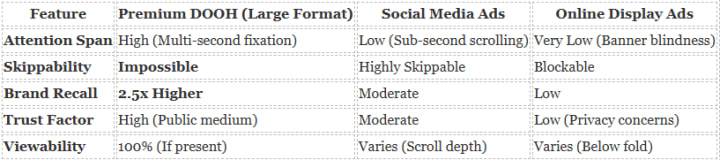
The data indicates that while online ads offer granular targeting, DOOH offers superior impact. Consequently, European advertisers are reallocating budgets to DOOH to build long-term brand equity.
Which Market Segments Are Driving the Highest Attention Levels?
Certain environments naturally foster higher engagement. IMARC Group segmentation data reveals that the Retail sector is the leading end-use segment.
Why does Retail lead? Consumers in retail environments possess a "buy" mindset. Therefore, their cognitive load is primed for product information.
- Outdoor vs. Indoor: While Outdoor applications hold the largest market share due to highway billboards, Indoor applications (in malls and airports) offer higher "Dwell Time."
- Transportation: This segment is also critical. Commuters waiting for trains or buses are a captive audience. They actively seek distraction, making them highly receptive to digital displays.
How Are Programmatic Strategies Enhancing Viewer Engagement?
Programmatic DOOH (pDOOH) is the technological engine behind the attention revolution.
pDOOH allows advertisers to buy inventory automatically based on specific data triggers. This ensures contextual relevance. For example, a coffee brand can bid for ad slots on digital billboards in London only when the temperature drops below 10°C.
Benefits of pDOOH strategies include:
- Relevance: Ads match the viewer’s current reality (weather, time, traffic).
- Efficiency: Budgets are not wasted on empty locations.
- Agility: Campaigns can be paused or optimized instantly based on attention metrics.
By utilizing these tools, brands ensure their creative work aligns with the moment. This relevance naturally boosts the "Attention Per Mille" (APM), rendering the ad more effective than a generic, static loop.
What Metrics Should European Brands Use to Measure Attention?
Advertisers must move beyond simple "footfall" counters. To truly leverage attention economics, you need advanced measurement protocols.
Here are the best practices for measuring success in 2025:
- Attention Per Mille (APM): This metric tracks the cost per 1,000 seconds of attention, rather than just impressions.
- Dwell Time: Cameras and sensors measure how long a person stands in the viewable zone of a screen.
- Facial Detection (Anonymized): Advanced software counts how many faces turned toward the screen. Note: In Europe, this technology strictly adheres to GDPR standards by processing data locally without storing personal identity.
- Brand Lift Studies: Post-campaign surveys compare brand recall between exposed groups and control groups.
What Does the Future Hold for DOOH Investment?
The future of the Europe digital OOH advertising market is bright and data-driven.
As the IMARC Group report highlights, the jump to a US$ 8.22 Billion valuation by 2033 is not accidental. It is the result of a fundamental shift in media consumption. As online channels become saturated and expensive, the "real world" canvas of DOOH offers a trustworthy alternative.
Key Takeaways for Strategists:
- Follow the Growth: Invest in Germany and the Retail sector.
- Prioritize Attention: Use APM as your primary KPI, not just CPM.
- Embrace Tech: Utilize pDOOH to increase contextual relevance.
In conclusion, attention is the new currency. Brands that understand the economics of attention will capture the market. Those that rely on outdated reach metrics risk fading into the background.
About the Creator
Joey Moore
I'm Joey Moore, a seasoned Research Analyst with 5+ years of experience in market research. Expert in data analysis, strategic planning, and industry insights. Proven track record in delivering actionable reports.
Keep reading
More stories from Joey Moore and writers in Futurism and other communities.
Brazil vs Mexico vs Argentina: Which Country Leads the Latin America AI Market?
The global race for technological dominance is not just happening in Silicon Valley or Beijing; it is rapidly reshaping the economic landscape of Latin America. As businesses shift from experimental pilots to full-scale deployment, the Latin America AI market has become a fierce three-horse race. The primary contenders include Brazil, the undisputed volume leader; Mexico, the industrial manufacturing hub; and Argentina, the region’s resilient talent factory.
By Joey Moore18 days ago in Futurism
Saudi Arabia Data Analytics Market: AI Integration, Cloud Adoption & Growth Outlook
According to IMARC Group's latest research publication, Saudi Arabia data analytics market size reached USD 887.7 Million in 2025. The market is projected to reach USD 7,826.4 Million by 2034, exhibiting a growth rate (CAGR) of 27.36% during 2026-2034.
By Faisal Al-Harbi7 days ago in Futurism
Saudi Arabia Soft Facility Management Market: Integrated Services, Commercial Expansion & Growth Outlook
Saudi Arabia's soft facility management sector is experiencing one of the most dramatic growth phases in the region. The country's ambitious diversification push, monumental infrastructure investments, and a fundamental restructuring of its service economy are creating a perfect storm of opportunity for cleaning, security, catering, and landscaping providers. According to IMARC Group's latest data, the Saudi Arabia soft facility management market size reached USD 354.12 Million in 2024. Looking forward, IMARC Group expects the market to reach USD 821.44 Million by 2033, exhibiting a growth rate (CAGR) of 9.10% during 2025-2033.
By Shubham Sharma about 12 hours ago in Futurism
Nancy Guthrie: Is a miracle still possible after close to two weeks?
Close to two weeks since Nancy Guthrie's abduction As of February 12, 2026, Nancy Guthrie remains classified as missing for 12 days, but there is no official confirmation that she is deceased. Blood matching Guthrie’s DNA was found on her front porch, indicating she likely suffered an injury during the abduction.
By Cheryl E Preston6 days ago in Geeks




Comments
There are no comments for this story
Be the first to respond and start the conversation.