
How Personal Computers Have Evolved in Speed Over the Years 💻⚡
Tracing the Rapid Acceleration of Computing Performance

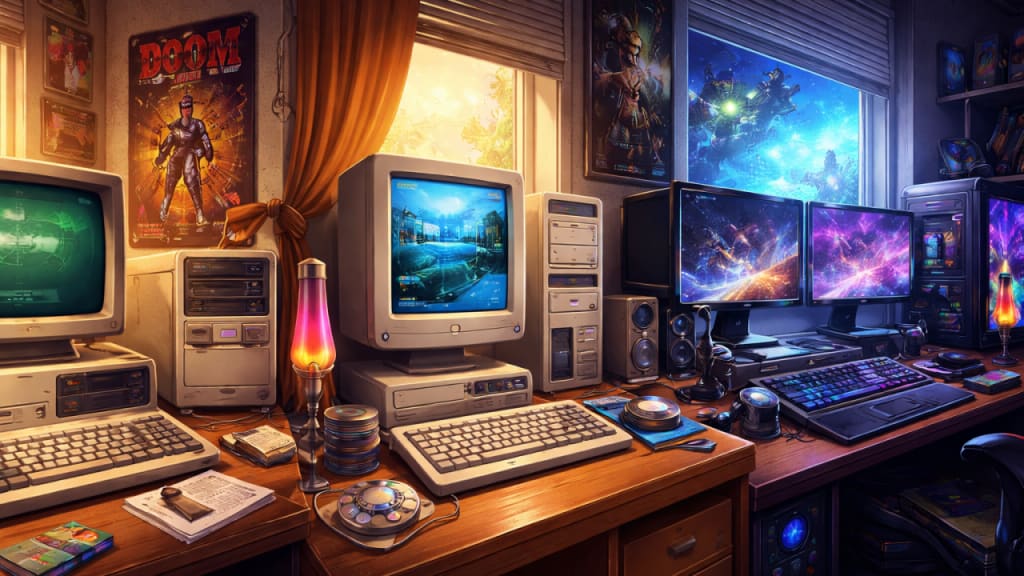
The first personal computers we used long ago are dramatically different in computing power compared to what we have today. In this article, I wanted to take a closer look at how PC specifications evolved over the years. Let’s start with 1985–1989, some time before I was even born.
1985–1989 — The first “home” computer 🏠
The first home computer had an Intel 8086/8088 processor, running at a mind-blowing 4–10 MHz! Wow… unfortunately, not impressive by today’s standards. RAM was minimal: 256 KB–640 KB, and there was no real hard drive — everything ran from 5.25" floppy disks. The operating system? Classic MS-DOS.
How did this machine work? Well, it opened a program from the floppy disk… and that was it. One program at a time, no multitasking, and everything took forever. Nobody yet thought of a computer as a tool for “entertainment” — it was way too early for that. 🎮❌
1992–1995 — Computers enter the home 🏡
The next evolution should be 1992–1995, when PCs really started appearing in households. Why?
First, we finally got GUI — Graphical User Interface. Simply put: the computer started showing windows, icons, and taskbars, and we could use a mouse instead of typing commands into DOS. 🖱️🖥️
Processors were bigger than the old Intel 8086/8088: Intel 386/486, running at 25–66 MHz. RAM grew to 4–8 MB, and programs finally ran from 80–250 MB HDDs. Operating systems: MS-DOS or Windows 3.1.
This “powerful rig” could play simple games and produce sound, and copying files took much less time. 🎵🕹️
1997–1999 — Multimedia and the Internet 🌐
Here’s when things start to get really memorable. Computers stopped being just tools and became something more.
Processors like Pentium I and II ran at 166–400 MHz, which at the time felt like outer space. RAM reached 32–64 MB, and hard drives were 2–6 GB, a space that seemed impossible to fill.
Operating systems like Windows 95 and 98 made computers look “normal.” Windows, icons, mouse, taskbar — everything became intuitive, even for people who had previously feared the keyboard.
The Internet appeared. The modem screamed and disconnected often, but suddenly the world was accessible from your room. MP3 music, early multiplayer games, classic system crashes — “don’t touch it or it will freeze.”
Computers became the center of the household. 🏠💻
2002–2004 — Computers as a standard ✅
By the early 2000s, PCs were commonplace.
Processors like Pentium 4 or Athlon XP ran at 1.5–2.5 GHz, RAM grew to 256–512 MB, and hard drives reached 40–120 GB. Operating system? The legendary Windows XP — stable, predictable, and loved by millions. ❤️
Computers could now run multiple programs at once. 3D games were no longer a novelty, and rendering graphics or video, though still slow, became achievable for an average user.
At this point, a “fast computer” really mattered — because a slow one started to annoy you. 😅
2007–2009 — Multicore hits the scene 🔥
Processors like Core 2 Duo and Athlon X2 appeared. Two cores sounded unnecessary… until they started working. RAM grew to 2–4 GB, hard drives to 250–500 GB, and dedicated graphics cards became standard, not luxury.
The computer could handle multiple things at once: browser, music, messenger, game in the background. Systems like Windows Vista and 7 showed that comfort isn’t just about raw power, but also how it’s used.
For the first time, we felt the computer was keeping up with us. 🏃♂️💨
2012–2014 — SSD changes everything 🚀
A real turning point.
Processors like Intel i5/i7, 8 GB RAM, and — most importantly — SSD drives. The system booted in seconds. Programs opened instantly. You start wondering: why wasn’t it like this from the beginning? 🤯
No more counting megahertz or gigahertz. What matters now is responsiveness. Computers finally stopped being a bottleneck.
2017–2019 — Power for everyone ⚡
Ryzen CPUs, newer i7s, 16 GB RAM, NVMe drives, GTX/RTX graphics cards.
Real-time video editing, no lag, no waiting. The computer simply does what you want — quickly. ⏱️💻
Increasingly, the problem isn’t the computer, but the human sitting in front of it. 😅
2023–Today — Computers faster than our decisions ⚡🤯
Modern personal PCs have 10+ cores, 32 GB RAM, ultra-fast drives, and GPUs capable of running AI models locally.
Waiting practically doesn’t exist. Operations are counted in fractions of a second.
Looking back, it’s fascinating: computers have accelerated exponentially over decades, while we humans… not necessarily. 🤔
Conclusion 📝
To simplify my observations, let’s focus only on processors. In the early years, CPU performance jumped 6–7x between “generations”, whereas since 2007 the growth has become more cyclical, around 2–3x.
Looking at all this, it’s hard to imagine what computers we’ll have in our homes on a daily basis… 50 years from now. 🤯💭
What do you think?
About the Creator
Piotr Nowak
Pole in Italy ✈️ | AI | Crypto | Online Earning | Book writer | Every read supports my work on Vocal
Keep reading
More stories from Piotr Nowak and writers in Futurism and other communities.
How AI Became My Personal Teacher🤖📚
Today, I want to share a practical example of using AI in learning and work, based on my own experience. Recently, I took a qualification exam to apply for a job. The material was extensive, complex, and entirely in English. Although English itself isn’t a problem for me, the sheer volume of information was overwhelming. After reading the entire course, I felt like I was “hearing bells but not knowing in which church they are ringing.” I recognized terms and concepts, but I struggled to connect them into one coherent picture. There were definitions, frameworks, processes, and detailed explanations — all important, yet difficult to organize in my head.
By Piotr Nowakabout 19 hours ago in Futurism
Climbing Gym Market Outlook: Indoor Fitness Growth and Expansion Opportunities
According to IMARC Group's latest research publication, The global climbing gym market size was valued at USD 3.51 Billion in 2024. Looking forward, IMARC Group estimates the market to reach USD 8.56 Billion by 2033, exhibiting a CAGR of 9.60% from 2025-2033.
By James Whitmanabout 6 hours ago in Futurism
The Clockmaker’s Apprentice
In the heart of the old city, between narrow streets and bustling marketplaces, there was a small shop where time seemed to move differently. The sign read Marcellus & Sons: Clockmakers, but to most passersby, it appeared to be little more than a curiosity. Intricate gears spun behind glass, pendulums swung with mesmerizing rhythm, and the faint ticking of countless clocks created a symphony of precision and patience.
By Sudais Zakwan7 days ago in Futurism
The Lesions of Devotion
Every day I set myself down on the freshly cut lawn and strip myself bare. I take my guitar and finger the frets and pick at the strings, listening for dissonance. My life is dissonance. I twist the tuning pegs until each string sounds bright. Then I kneel, calves pointing behind me, kneecaps facing forward. All exposed to the breeze. I close my eyes and play the melody.
By Paul Stewart5 days ago in Fiction



Comments (1)
We have come a long way, but I admit I still miss my Commodore 64 & 128 & the amiga we had with the floppy desk.