
Humans Age Faster at Two Sharp Peaks, Study Reveals — A Major Breakthrough in Understanding the Aging Process
Scientists reveal that aging is not a steady process but occurs in two accelerated phases that reshape how we understand the human lifespan.

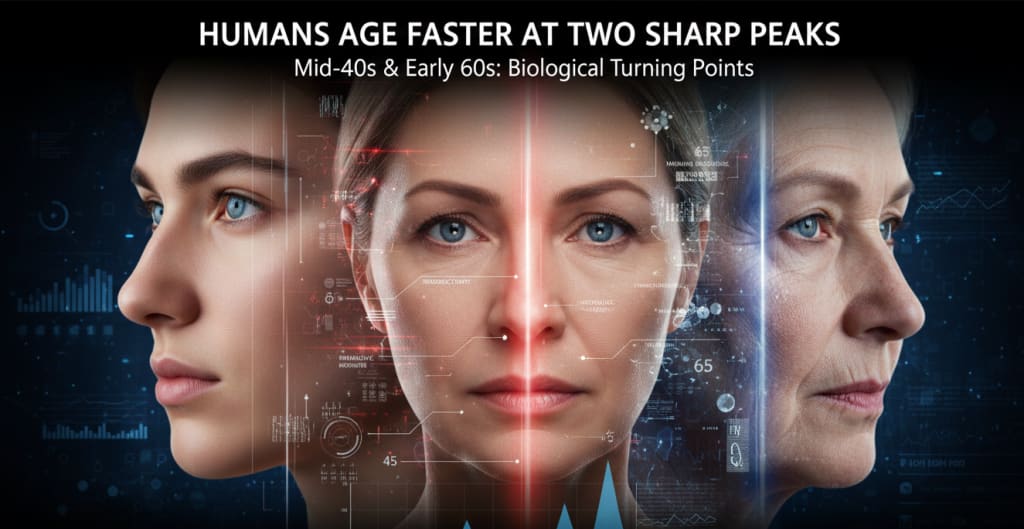
For generations, we’ve believed that aging is a slow, steady process — a gradual accumulation of wrinkles, gray hairs, and subtle changes over decades. But new scientific research is challenging that long-held assumption. According to a groundbreaking study, human aging does not happen at a constant pace. Instead, it accelerates dramatically at two specific stages of life.
These “sharp peaks” in aging occur around the mid-40s and again in the early 60s. Rather than declining gradually year by year, our bodies appear to undergo sudden biological shifts during these periods — reshaping how we understand longevity, disease prevention, and healthy living.
This discovery could fundamentally change modern medicine and the future of human health.
________________________________________
Rethinking How Humans Age
For decades, scientists viewed aging as a linear process — a slow and predictable biological decline. However, researchers analyzing thousands of biological markers uncovered something surprising. Instead of steady deterioration, they observed sudden molecular changes at two key life stages.
These changes were not minor. In fact, nearly 80% of the biological markers studied — including proteins, metabolites, and microbiome patterns — shifted significantly during these windows.
The result? Aging appears to “jump forward” twice during adulthood.
The first acceleration happens around the mid-40s.
The second surge occurs in the early 60s.
This means aging is less like a gently sloping hill and more like climbing two steep mountains.
________________________________________
What Happens During the First Aging Peak (Mid-40s)?
Many people report that their 40s feel different — unexplained fatigue, slower recovery after workouts, or unexpected weight gain. Science now suggests these experiences are not just lifestyle-related. They may reflect a biological turning point.
During this first aging peak, researchers observed:
• Slower metabolism
• Hormonal fluctuations
• Reduced muscle repair and recovery
• Early cardiovascular stress markers
• Changes in lipid and glucose processing
These molecular shifts may explain why midlife often feels like a transition phase. The body’s systems begin operating differently, and resilience may decline more quickly than before.
Importantly, this phase does not mean sudden illness. Instead, it marks the beginning of increased vulnerability — making preventive healthcare especially critical during this time.
________________________________________
The Second Aging Surge (Early 60s)
The second biological acceleration, occurring in the early 60s, tends to be even more profound.
This stage is associated with:
• Weakened immune response
• Increased systemic inflammation
• Declining kidney and liver efficiency
• Greater susceptibility to chronic diseases
• Slower tissue repair
These changes help explain why risks for heart disease, diabetes, and neurodegenerative conditions rise sharply after age 60.
The body’s repair systems lose efficiency, inflammation becomes more persistent, and recovery from illness takes longer. Rather than a slow slide into old age, this phase resembles a significant physiological recalibration.
________________________________________
Why This Discovery Changes Everything About Aging
Understanding that aging accelerates at predictable biological milestones opens powerful new opportunities in healthcare.
Instead of treating aging as an uncontrollable decline, doctors and researchers can now focus on strategic intervention during these critical windows.
This could mean:
• Earlier cardiovascular screenings in the 40s
• Precision nutrition plans tailored to midlife metabolism
• Strength training programs to preserve muscle mass
• Anti-inflammatory therapies timed to biological changes
• Personalized longevity strategies based on molecular data
In short, aging may become something we manage more intelligently rather than simply endure.
________________________________________
Biological Age vs. Chronological Age
One of the most important insights from this research is the distinction between chronological age and biological age.
Two individuals may both be 45 years old, but their bodies could be aging at different rates depending on genetics, stress levels, diet, exercise habits, and environmental exposures.
Biological age measures cellular health, inflammation, and metabolic function — not just the number of birthdays celebrated.
This shift in thinking moves healthcare toward personalized longevity, where interventions are based on how the body is functioning internally rather than simply age on paper.
________________________________________
Can Lifestyle Slow These Aging Peaks?
The study makes one thing clear: while biological aging accelerates at certain points, lifestyle choices still matter — perhaps more than ever.
Research consistently shows that the following habits can reduce the severity of age-related changes:
• Regular strength and cardiovascular exercise
• Balanced, nutrient-dense diets
• Quality sleep
• Stress reduction practices
• Avoiding smoking and excessive alcohol
• Maintaining strong social connections
These habits may not stop the aging peaks entirely, but they can soften their impact and improve overall healthspan — the years of life spent in good health.
In other words, while aging has biological rhythms, our daily decisions influence how those rhythms play out.
________________________________________
A New Era of Preventive Medicine
This research could shift public health priorities worldwide. Instead of focusing primarily on late-life disease management, healthcare systems may begin targeting midlife as a key prevention phase.
Imagine large-scale health programs designed specifically for people in their 40s — before major disease risks skyrocket.
By acting early, societies could reduce healthcare costs, lower chronic disease rates, and extend productive, independent living years.
The science of aging is increasingly focusing not just on extending lifespan, but on extending vitality.
________________________________________
Psychological and Social Implications
The concept of two sharp aging peaks also resonates emotionally. Many people describe feeling a sudden “shift” in their 40s or 60s — physically, mentally, or energetically.
Previously, these experiences were often dismissed as stress, burnout, or simply “getting older.”
Now, biology provides validation.
Understanding that these transitions are natural biological phases may reduce fear and stigma around aging. Instead of seeing midlife changes as decline, they can be viewed as signals to adapt — to adjust habits, priorities, and healthcare strategies.
Aging becomes less mysterious and more manageable.
________________________________________
What This Means for the Future of Longevity Research
Scientists are now exploring whether medications, dietary interventions, or gene-targeted therapies could reduce the intensity of these accelerated aging periods.
While immortality remains science fiction, the realistic goal is clear: extend healthspan.
By identifying the molecular triggers behind these two aging surges, researchers may one day develop treatments that stabilize metabolic and immune systems during these vulnerable phases.
The future of aging research is shifting from reactive treatment to proactive optimization.
________________________________________
A Powerful Shift in Perspective
Perhaps the most transformative takeaway is philosophical.
Aging is not a smooth, predictable march forward. It is dynamic. It has rhythms. It has biological turning points.
Recognizing these hidden patterns empowers individuals to prepare rather than panic.
Your 40s and 60s are not simply numbers — they may represent strategic checkpoints in your body’s timeline.
With scientific insight guiding lifestyle and medical decisions, aging can become less about decline and more about adaptation.
________________________________________
The Bottom Line
The discovery that humans age faster at two sharp peaks challenges everything we thought we knew about the aging process. Instead of a steady slope, life appears marked by powerful biological surges that reshape our health trajectory.
But this knowledge is not alarming — it is empowering.
By understanding when aging accelerates, we gain the opportunity to intervene, optimize, and protect our long-term well-being.
Aging is inevitable. But how we navigate its peaks may define the quality of the years ahead.
And for the first time, science is giving us a clearer map.
About the Creator
Adil Ali Khan
I’m a passionate writer who loves exploring trending news topics, sharing insights, and keeping readers updated on what’s happening around the world.
Keep reading
More stories from Adil Ali Khan and writers in Futurism and other communities.
NASA’s SpaceX Crew-12 Docks at the International Space Station: Four Astronauts Begin Critical 8-Month Mission
The crew members of NASA’s SpaceX Crew-12 mission successfully docked Saturday afternoon after launching before dawn Friday from Cape Canaveral. Their arrival restores the space station’s staffing levels and begins an ambitious eight-month research mission focused on deep-space exploration and advancing food production technologies in orbit.
By Adil Ali Khanabout 15 hours ago in Futurism
Unexpected Properties of Dark Matter Revealed in 2026
For decades, dark matter has remained one of the most persistent enigmas in modern astrophysics. Invisible to telescopes and undetectable through direct electromagnetic interaction, it nonetheless shapes the Universe on the largest scales. Galaxies rotate faster than their visible mass allows, galaxy clusters remain gravitationally bound, and the cosmic web itself depends on an unseen framework. Until recently, dark matter was largely treated as a silent, passive component—cold, inert, and interacting only through gravity. However, research published and analyzed in 2026 significantly challenged this simplified view.
By Holianyk Ihor5 days ago in Futurism
Saudi Arabia Construction Market: Mega Projects, Vision 2030 & Growth Outlook
According to IMARC Group's latest research publication, Saudi Arabia construction market size was valued at USD 101.4 Billion in 2025. The market is projected to reach USD 138.4 Billion by 2034, exhibiting a growth rate of 3.52% during 2026-2034.
By Faisal Al-Harbi3 days ago in Futurism
The Tango Connection
I suppose I've become a writer so I wouldn't bore everyone to death telling them my stories. Reading them is reading. Not the same. There's rhythm. And timing and, most importantly, drama and suspense. Unless you have tremendous magnetism and an undeniable stage presence, there's no way you can engage an audience the way you can by writing your story. That's my opinion.
By Rene Volpi a day ago in Beat



Comments
There are no comments for this story
Be the first to respond and start the conversation.