
Location Analytics Market Outlook: Data-Driven Decision Making and Growth Opportunities
The location analytics market is witnessing rapid growth, driven by increasing demand for geographic data insights across retail, transportation, healthcare, telecom, and smart city applications.

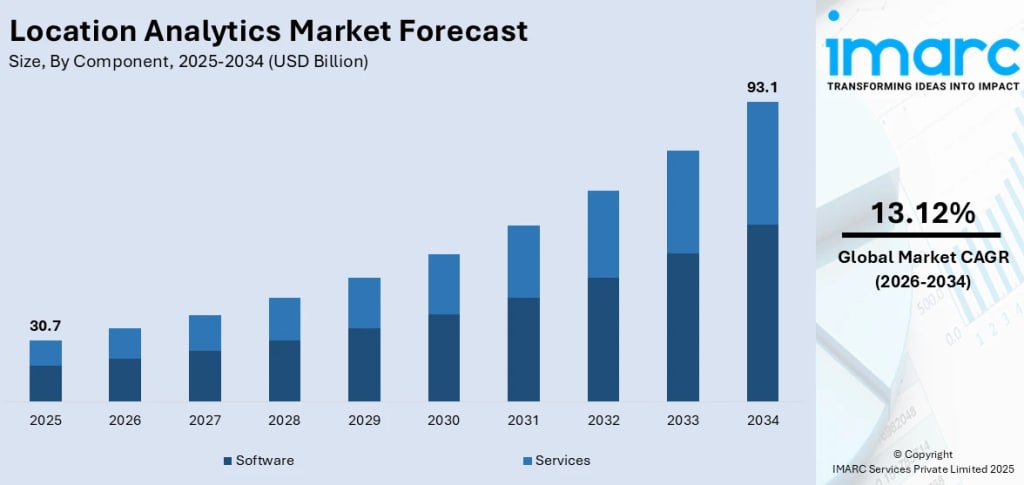
According to IMARC Group's latest research publication, The global location analytics market size reached USD 30.7 Billion in 2025. Looking forward, IMARC Group expects the market to reach USD 93.1 Billion by 2034, exhibiting a growth rate (CAGR) of 13.12% during 2026-2034.
How AI is Reshaping the Future of Location Analytics Market
- AI-Powered Predictive Analytics for Retail Site Selection: AI models analyze customer demographics, traffic patterns, and competitor locations to recommend optimal store sites. Retailers using these tools report site selection success rates improving from approximately 60% to over 85%, helping chains expand strategically while minimizing investment risks.
- Real-Time Fleet Management with Intelligent Route Optimization: AI integrates traffic data, weather patterns, and delivery priorities to dynamically adjust routes for logistics fleets. Transportation companies implementing these systems achieve fuel cost reductions near 18% and on-time delivery improvements of around 25%, while minimizing carbon emissions across operations.
- Automated Geofencing for Personalized Customer Engagement: AI-driven geofencing triggers personalized promotions when customers enter specific zones around stores or competitor locations. Retail brands using location-triggered marketing see engagement rates increase by approximately 40% and conversion rates improve by around 30% compared to traditional advertising approaches.
Location Analytics Industry Overview:
India's smart city mission represents a major catalyst for location analytics adoption across urban infrastructure. The government sanctioned 12 new smart industrial cities through the National Industrial Corridor Development Programme with USD 3.41 billion investment. These projects leverage location intelligence for traffic optimization, waste management, emergency response coordination, and utility planning. Cities like Pune and Ahmedabad are implementing geospatial platforms that analyze real-time data from thousands of sensors to improve citizen services, reduce congestion, and enhance public safety across metropolitan areas.
Location Analytics Market Trends & Drivers:
The explosion of connected devices and IoT sensors across industries is fundamentally reshaping how organizations collect and use location data. Over 70% of large enterprises now integrate location intelligence into business workflows, with retailers using geospatial tools to analyze foot traffic and optimize store layouts. Transportation companies track vehicle fleets in real-time to reduce fuel costs by approximately 18% while improving delivery punctuality. Healthcare facilities monitor patient flow and medical equipment locations to enhance emergency response times. The proliferation of smartphones generating billions of location data points daily enables businesses to understand movement patterns, predict demand fluctuations, and personalize customer experiences at unprecedented scale and precision.
Cloud platforms are transforming location analytics by making advanced geospatial capabilities accessible to organizations of all sizes without massive infrastructure investments. Cloud-based solutions allow companies to process massive location datasets quickly while integrating seamlessly with existing business systems. Enterprises deploying cloud location analytics achieve approximately 61% better platform scalability and support 43% more concurrent users without performance issues. The shift to cloud architectures reduces implementation timelines from months to weeks while lowering total costs by around 40%. Real-time data processing capabilities enable instant insights for time-sensitive decisions, whether optimizing delivery routes during traffic disruptions or adjusting store staffing based on predicted customer arrivals throughout the day.
Governments worldwide are investing billions in smart city initiatives that rely heavily on location analytics for urban planning and public service delivery. Smart city projects use geospatial data to manage traffic flows, reducing congestion by approximately 25% in pilot implementations. Emergency services utilize location intelligence to optimize ambulance routing, cutting average response times by around 30% in cities like Singapore. Urban planners analyze movement patterns to design better public transportation networks and position services where residents need them most. Environmental monitoring systems track air quality and noise levels across neighborhoods to inform policy decisions. These initiatives demonstrate how location analytics transforms cities into more livable, efficient, and responsive environments that adapt to citizens' evolving needs.
Leading Companies Operating in the Global Location Analytics Industry:
- Cisco Spaces
- Esri
- Galigeo
- GeoMoby
- Google LLC
- HERE Technologies
- INRIX, Inc
- Lepton Software
- Precisely
- SAP SE
- SAS Institute Inc.
- TomTom International BV
Location Analytics Market Report Segmentation:
By Component:
- Software
- Services
Software represents the largest segment as businesses depend on robust tools for data visualization, mapping, and predictive modeling to convert location data into actionable insights.
By Deployment Mode:
- On-premises
- Cloud-based
Cloud-based deployment dominates the market due to its scalability, reduced initial expenses, and remote accessibility without significant infrastructure investments.
By Location Type:
- Indoor
- Outdoor
Outdoor accounts for the largest share because businesses utilize it to monitor assets, oversee fleets, and analyze movement trends in public areas.
By Application:
- Remote Monitoring
- Sales and Marketing Optimization
- Asset Management
- Risk Management
- Facility Management
- Others
Based on application, the market includes remote monitoring for real-time tracking, sales and marketing optimization using location data for targeting, asset management for resource tracking, risk management analyzing threats, facility management improving operations, and other specialized applications.
By End Use Industry:
- BFSI
- Healthcare
- Hospitality
- Government
- Transport and Logistic
- IT and Telecom
- Retail and Consumer Goods
- Media and Entertainment
- Others
Retail and consumer goods represent the largest segment as brands rely on location data to comprehend shopper behavior, select store locations, and strategize promotions.
Regional Insights:
- North America (United States, Canada)
- Asia Pacific (China, Japan, India, South Korea, Australia, Indonesia, Others)
- Europe (Germany, France, United Kingdom, Italy, Spain, Russia, Others)
- Latin America (Brazil, Mexico, Others)
- Middle East and Africa
North America leads the market because of robust technological infrastructure, significant investment in innovation, and the existence of top analytics firms.
Recent News and Developments in Location Analytics Market
- June 2025: dataplor announced USD 20.5 million Series B funding led by F-Prime to scale global location intelligence solutions. The funding expands POI coverage to over 350 million locations across 250+ countries and enhances mobility data products. dataplor's privacy-first approach enables enterprises worldwide to access comprehensive location data for strategic decision-making and market analysis.
- January 2025: TomTom International partnered with Esri to integrate global mapping and real-time traffic data into ArcGIS platform. This collaboration provides governments and enterprises with advanced location analytics supporting infrastructure planning, traffic management, and retail site selection. The integration combines TomTom's dynamic traffic intelligence with Esri's geospatial platform for comprehensive urban and commercial insights.
- October 2024: CoreLogic launched Araya, an AI-powered property and location intelligence platform integrating detailed property, market, and risk data. Araya combines vast datasets with predictive models supporting real estate and facility decision-making. Key features include climate risk analytics, property valuations, and growth indicators helping organizations strategize expansions and investments with enhanced accuracy.
- September 2024: Smartvel acquired AVUXI, a provider of location-based content for the travel industry. The integration of AVUXI's TopPlace platform with Smartvel's AI tools enhances destination insights and expands product offerings. This acquisition strengthens market position in location-based travel solutions, providing enriched geospatial intelligence for hospitality and tourism sectors globally.
- February 2024: Kalibrate launched Location Intelligence (KLI) 2.0 featuring modern UI and enhanced analytics tools. The platform integrated features from TAS, Trailblazer, and SiteIntel for streamlined operations. KLI 2.0 empowers retail decision-makers with custom models, real-time data synchronization, and competitive mobile insights for optimal site selection and network planning.
Note: If you require specific details, data, or insights that are not currently included in the scope of this report, we are happy to accommodate your request. As part of our customization service, we will gather and provide the additional information you need, tailored to your specific requirements. Please let us know your exact needs, and we will ensure the report is updated accordingly to meet your expectations.
About the Creator
Michael Richard
Michael Richard is a Market Research Expert specializing in market intelligence, competitive analysis, and data-driven insights. He helps organizations understand trends and emerging opportunities through in-depth research.
Keep reading
More stories from Michael Richard and writers in Futurism and other communities.
On-Board Charger Market Outlook: Electric Vehicle Adoption and Charging Infrastructure Growth Opportunities
According to IMARC Group's latest research publication, The global on-board charger market size was valued at USD 8.8 Billion in 2025. Looking forward, IMARC Group estimates the market to reach USD 31.4 Billion by 2034, exhibiting a CAGR of 15.13% from 2026-2034.
By Michael Richarda day ago in Futurism
Australia Wallpaper Market: Interior Design Trends, Construction Activity & Product Innovation
According to IMARC Group, the Australia wallpaper market was valued at USD 47.51 Million in 2025 and is projected to reach USD 62.80 Million by 2034, growing at a compound annual growth rate (CAGR) of 3.15% during 2026–2034. While relatively niche compared to broader construction materials, wallpaper is gaining renewed relevance in the evolving interior décor landscape across Australia. Once considered a traditional decorative solution, wallpaper is now re-emerging as a design-forward alternative to paint, supported by advancements in digital printing, texture innovation and eco-friendly materials. As construction activity remains steady and consumers increasingly invest in personalized living spaces, wallpaper is carving out a distinctive role in residential and commercial interior design.
By Shrestha Roy2 days ago in Futurism
Why Data Transparency Matters More Than Price Talk in Crypto Markets?
As cryptocurrency markets continue to evolve, access to reliable data has become one of the most important factors shaping informed participation. While price movements often attract the most attention, deeper insights into blockchain activity, governance, and network behavior are increasingly central to understanding how these ecosystems function.
By Muhammad Irfan Afzal2 days ago in Futurism
The Cave Part 6
If you have ever heard a tale about yourself that you cannot remember and doubtless think is made up, you will know how I felt when Tharkin related all that the eagle had seen of me before my memories were scattered. Of far distances and traveling companions that I did not recall, camping out under the stars and making our way to the mountains with deliberate purpose. The great bird had lost contact with my party once we entered the forests, and the seven other members were not seen again by him or his brethren since.
By Jamye Sharp3 days ago in Chapters




Comments
There are no comments for this story
Be the first to respond and start the conversation.