
Middle East Cloud Storage Market: Digital Transformation, Data Localization & Growth Outlook
How rapid digital transformation, government cloud initiatives, and rising enterprise data volumes are accelerating growth in the Middle East cloud storage market.


According to IMARC Group's latest research publication, Middle East cloud storage market size reached USD 6,101.5 Million in 2025. Looking forward, IMARC Group expects the market to reach USD 23,981.3 Million by 2034, exhibiting a growth rate (CAGR) of 16.43% during 2026-2034.
How AI is Reshaping the Future of Middle East Cloud Storage Market
- Massive government investments in AI infrastructure are boosting demand for scalable cloud storage solutions across the region.
- Companies like Microsoft and G42 are expanding data centers with hundreds of megawatts to support AI workloads and secure cloud storage needs.
- Saudi Arabia's HUMAIN initiative partners with global players to build advanced AI data centers that rely heavily on robust cloud storage systems.
Middle East Cloud Storage Market Trends & Drivers:
The Middle East cloud storage market is experiencing robust expansion driven by extensive government-led digital transformation initiatives across the region. National visions such as Saudi Vision 2030 and the UAE's digital economy strategies prioritize cloud adoption to diversify economies beyond oil dependency, fostering widespread migration from traditional on-premises infrastructure to scalable cloud solutions. These programs encourage public and private sectors to embrace cloud storage for enhanced operational efficiency, supporting smart city projects, e-government services, and digitized public administration. As regulatory frameworks promote data localization and sovereign cloud environments, organizations increasingly rely on regional cloud storage to comply with emerging data residency requirements while benefiting from improved accessibility and reduced infrastructure management burdens. This policy momentum accelerates enterprise-level uptake and stimulates investments in localized data centers.
Rapid surge in data generation from digitalization, IoT proliferation, and expanding online services fuels strong demand for flexible cloud storage options in the Middle East. Businesses across sectors like finance, healthcare, retail, and government face exponential growth in unstructured data volumes, necessitating reliable, on-demand storage that supports seamless scalability without heavy upfront capital commitments. The shift toward hybrid and multi-cloud architectures allows organizations to optimize performance, ensure redundancy, and integrate advanced analytics capabilities. Furthermore, rising remote and hybrid work models amplify the need for accessible, secure file sharing and collaboration tools hosted in the cloud, enabling workforce productivity regardless of location. These dynamics position cloud storage as an essential enabler for innovation and competitiveness in a digitally evolving regional landscape.
Increasing emphasis on artificial intelligence, big data analytics, and emerging technologies propels the adoption of advanced cloud storage solutions throughout the Middle East. As enterprises integrate AI-driven applications and machine learning workloads, the requirement for high-performance, low-latency storage becomes critical to handle massive datasets efficiently. Investments by global hyperscalers in regional infrastructure, combined with 5G rollout and edge computing developments, enhance cloud storage capabilities for real-time processing and reduced latency. Organizations leverage these advancements to support predictive insights, personalized services, and automation initiatives. The convergence of these technologies drives a strategic pivot toward cloud-native storage architectures that offer elasticity, security features, and cost-effective management for future-proofing digital operations in the region.
Middle East Cloud Storage Industry Segmentation:
The report has segmented the market into the following categories:
Component Insights:
- Solution
- Services
Deployment Type Insights:
- Private
- Public
- Hybrid
User Type Insights:
- Large Enterprises
- Small and Medium Enterprises
Industry Vertical Insights:
- BFSI
- Government and Public Sector
- Healthcare
- IT and Telecom
- Retail
- Manufacturing
- Media and Entertainment
- Others
Country Insights:
- Saudi Arabia
- Turkey
- Israel
- United Arab Emirates
- Iran
- Iraq
- Qatar
- Kuwait
- Oman
- Jordan
- Bahrain
- Others
Competitive Landscape:
The competitive landscape of the industry has also been examined along with the profiles of the key players.
Recent News and Developments in Middle East Cloud Storage Market
- February 2026: Microsoft confirms the launch of its Saudi Arabia East cloud region in Q4 2026, enabling local workloads with enhanced data residency, low latency, and support for AI-driven applications across government and enterprise sectors.
- February 2026: The UAE solidifies its position as a data center hub with live capacity exceeding 376 MW from 2025 expansions, driven by hyperscale AI investments including a 200 MW Microsoft-G42 data center project set to come online by end of 2026.
- February 2026: Edge data center deployments accelerate across the Middle East, valued at USD 5.4 billion, fueled by low-latency demands from IoT, 5G collaborations, and smart city initiatives requiring localized cloud storage processing for faster data handling.
Note: If you require specific details, data, or insights that are not currently included in the scope of this report, we are happy to accommodate your request. As part of our customization service, we will gather and provide the additional information you need, tailored to your specific requirements. Please let us know your exact needs, and we will ensure the report is updated accordingly to meet your expectations.
About the Creator
Fatimah
Market research writer at IMARC Group, turning data into engaging stories. Passionate about trends, insights & real-world impact. Join me on Vocal!
Why Online Grocery Shopping Is Expanding Across Latin America?
Shopping habits are changing across Latin America as people are more connected to the internet and looking for more convenient shopping options․ One of the biggest changes is online grocery shopping․ While originally experienced in-store, the same process is increasingly becoming possible through mobile apps and websites․
By deepanshu Thakurabout 11 hours ago in Futurism
Bottled Water Market Trends: Eco-Friendly Bottles, Smart Labeling & Industry Outlook to 2034
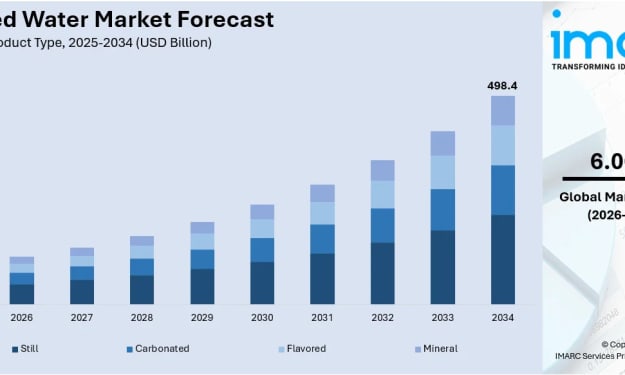
Growing health awareness, concerns about water contamination, and the shift away from sugary beverages are fueling the bottled water market, complemented by convenience factors, premiumization trends, and eco-friendly packaging innovations. According to IMARC Group's latest data, the global bottled water market size was valued at USD 288.8 Billion in 2025. Looking forward, IMARC Group estimates the market to reach USD 498.4 Billion by 2034, exhibiting a CAGR of 6.06% from 2026-2034.
By Andrew Sullivan7 days ago in Futurism
Goodbye, Mr. Duvall
It is turning out to be an interesting year. I was in the middle of teaching a class when a pop-up appeared on the screen announcing the death of Mr. Robert Seldon Duvall (yes, that was his full name). I was in the middle of a discussion on the obsession we have with winning when it comes to sports (the Winter Olympics was a theme), and I felt as though things were coming full circle. We had already lost Gene Hackman last year, and along with that titan, it feels though one particular golden age has closed off to be replaced by...?
By Kendall Defoe 7 days ago in Geeks



Comments
There are no comments for this story
Be the first to respond and start the conversation.