
Retinal Surgery Device Market Trends: Next-Gen Vitrectomy Systems, Smart Visualization & Industry Outlook to 2033
How microincision techniques, enhanced fluidics control, and illumination innovations are redefining surgical efficiency, reducing complications, and shaping next-generation device development strategies.


The rising global burden of vision-related disorders, particularly among the aging population and those with chronic conditions like diabetes, is significantly accelerating the demand for advanced retinal surgical solutions. Enhanced by the shift toward minimally invasive techniques and significant investments in healthcare infrastructure, the market is witnessing a surge in the adoption of high-precision equipment designed to improve patient outcomes and recovery times. According to IMARC Group’s latest data, the global retinal surgery devices market size was valued at USD 2.2 Billion in 2024. Looking forward, IMARC Group estimates the market to reach USD 3.9 Billion by 2033, exhibiting a CAGR of 6.3% during 2025-2033.
The retinal surgery device sector has evolved into a critical multi-billion-dollar medical technology field, driven by a growing urgency to address complex ocular conditions such as diabetic retinopathy, retinal detachment, and age-related macular degeneration. Market growth is further propelled by the rapid integration of digital visualization systems and micro-incision vitrectomy surgery (MIVS), which allow for greater surgical accuracy and reduced trauma. Public health initiatives and improved reimbursement frameworks in emerging economies are making these sophisticated treatments more accessible.
Explore the “Retinal Surgery Device Market” – Download Free Sample Report!
Retinal Surgery Device Market Growth Drivers:
- Escalating Global Prevalence of Diabetic Retinopathy
The sharp rise in diabetes cases worldwide is a primary catalyst for surgical intervention, as diabetic retinopathy remains a leading cause of vision loss. Statistics from the International Diabetes Federation indicate that over 530 million adults are currently living with diabetes, a figure expected to climb significantly in the coming decades. Within this population, roughly one in three individuals develops some form of retinopathy. This high disease burden necessitates the use of vitrectomy machines and laser photocoagulation tools to manage complications. Healthcare providers are increasingly focusing on early surgical intervention to prevent total blindness, fueling the demand for reliable, high-performance retinal devices.
- Rapid Adoption of Minimally Invasive Vitrectomy Surgery (MIVS)
The transition from traditional large-gauge surgery to micro-incision techniques has revolutionized the field, making procedures faster and safer for patients. Modern surgeons are increasingly utilizing 25-gauge and 27-gauge instruments, which require smaller incisions that often do not need sutures. This shift reduces post-operative inflammation and allows for quicker visual recovery, making surgery more attractive to patients who previously feared long downtimes. With smaller-gauge tools accounting for a substantial portion of new instrument sales, manufacturers are focusing heavily on refining the fluidics and cutting speeds of these devices to ensure they can handle even the most complex retinal detachments with extreme precision.
- Expanding Geriatric Population and Age-Related Vision Loss
As life expectancy increases globally, the segment of the population most susceptible to age-related macular degeneration and retinal tears is growing at an unprecedented rate. Data suggests that the prevalence of retinal issues increases dramatically for individuals over the age of 75, often necessitating specialized surgical care. Governments in regions like the Asia-Pacific and North America are responding with increased healthcare spending to manage this demographic shift. This "silver tsunami" is creating a consistent need for diagnostic and surgical equipment that can cater to the specific physiological needs of elderly patients, who often require less traumatic procedures and more frequent monitoring to maintain their quality of life.
Retinal Surgery Device Market Trends:
- Integration of 3D Visualization and Robotic Assistance
Digital transformation is reaching the operating room through high-definition 3D visualization systems that replace traditional microscope eyepieces. These systems provide surgeons with enhanced depth perception and a wider field of view, which is vital when working on the delicate micron-thick layers of the retina. Furthermore, the development of robotic-assisted platforms is gaining momentum, offering stabilized hand movements and sub-micron precision that human hands alone cannot achieve. These technological leaps are not just about luxury; they are becoming essential for highly intricate maneuvers like subretinal injections and membrane peeling, where even a slight tremor can have a major impact on surgical success.
- Favorable Reimbursement Policies and Government Support
Recent updates to healthcare policies are significantly lowering the financial barriers to retinal surgery. For instance, the Centers for Medicare and Medicaid Services (CMS) in the United States recently announced reimbursement rate increases for vitrectomy and other ophthalmic surgeries in ambulatory surgery centers (ASCs). Such moves encourage the migration of retinal procedures to cost-effective outpatient settings, boosting the volume of surgeries performed. Similarly, India’s National Program for Control of Blindness has expanded its focus to include diabetic retinopathy screening and treatment, providing the necessary institutional support for rural populations to access modern surgical devices and laser therapies that were previously unavailable.
- Growth of Office-Based Retinal Procedures and Portability
There is a notable trend toward performing minor retinal interventions, such as certain laser treatments and intravitreal injections, in an office-based setting rather than a full hospital operating theater. This shift is driving the development of more compact, portable, and versatile retinal laser equipment. Manufacturers are designing devices that occupy a smaller footprint while maintaining high-power output and precision. This trend enhances efficiency for clinicians and offers convenience for patients, particularly in urban areas where time-sensitive care is a priority. The move toward portability is also facilitating better access in developing regions where full-scale surgical suites are not always feasible in every clinic.
Recent News and Developments in Retinal Surgery Device Market:
- November 2025: The Centers for Medicare & Medicaid Services (CMS) finalized its 2026 payment rule, authorizing a significant 3.3% increase in payment rates for ophthalmic surgeries, with specific higher-than-average increases for complex retinal procedures to ensure adequate provider compensation.
- August 2024: Leading ophthalmic player Alcon continued to expand its digital surgical ecosystem, focusing on the integration of advanced fluidics and high-speed cutters in its latest vitrectomy platforms to enhance surgical control and safety.
- March 2024: Clinical guidelines from major ophthalmology associations emphasized the use of 27-gauge instruments as a standard for reducing patient discomfort, prompting a surge in the procurement of small-gauge vitrectomy packs across North American hospitals.
- January 2024: New research into subthreshold micropulse laser (SMPL) technology gained traction, offering a "tissue-sparing" alternative for treating macular edema and positioning retinal laser equipment as a complementary tool to pharmaceutical therapies.
Note: If you require specific details, data, or insights that are not currently included in the scope of this report, we are happy to accommodate your request. As part of our customization service, we will gather and provide the additional information you need, tailored to your specific requirements. Please let us know your exact needs, and we will ensure the report is updated accordingly to meet your expectations.
About the Creator
Andrew Sullivan
Hello, I’m Andrew Sullivan. I have over 9+ years of experience as a market research specialist.
Keep reading
More stories from Andrew Sullivan and writers in Futurism and other communities.
Power Electronics Market Overview: Grid Modernization, Digital Power Control & Forecast to 2034
Rapid electrification across industries and the surging adoption of renewable energy are propelling the demand for sophisticated power electronics, which are essential for efficient energy conversion, grid stability, and motor control. According to IMARC Group’s latest data, the global power electronics market size was valued at USD 34.6 Billion in 2025. Looking forward, IMARC Group estimates the market to reach USD 53.1 Billion by 2034, exhibiting a CAGR of 4.87% from 2026-2034.
By Andrew Sullivanabout 2 hours ago in Futurism
Australia Air Freight Market: Trade Flows, Logistics Capacity & Digitalization
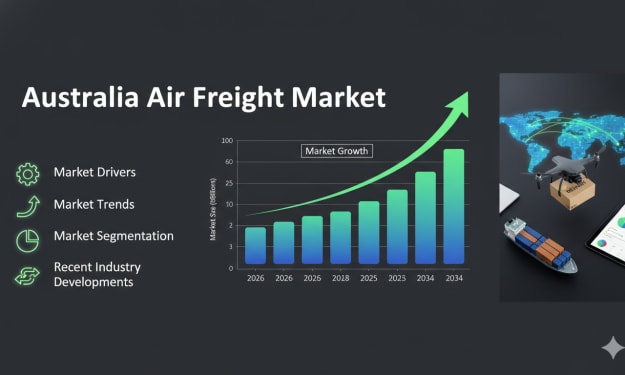
According to IMARC Group, the Australia air freight market was valued at USD 2.0 Billion in 2025 and is projected to reach USD 3.7 Billion by 2034, exhibiting a compound annual growth rate (CAGR) of 7.12% during 2026–2034. This strong expansion reflects the increasing importance of speed, reliability and global connectivity within the trade ecosystem of Australia. As international commerce intensifies and e-commerce accelerates, air freight has become a strategic logistics solution for high-value, time-sensitive and perishable goods. Infrastructure modernization, technological innovation and sustainability initiatives are further strengthening the competitiveness and resilience of Australia’s air cargo sector.
By Shrestha Roy4 days ago in Futurism
Alternative Data Market: Big Data Sources, Real-Time Analytics & Market Forecast
According to IMARC Group's latest research publication, global alternative data market size reached USD 8,889.1 Million in 2025. Looking forward, IMARC Group expects the market to reach USD 1,81,103.5 Million by 2034, exhibiting a growth rate (CAGR) of 35.18% during 2026-2034.
By sujeet. imarcgroup4 days ago in Futurism



Comments
There are no comments for this story
Be the first to respond and start the conversation.