
Sea Bass & Sea Bream Market Outlook: Retail Penetration, Value Chain Developments & Industry Forecast to 2034
How retail expansion, private label seafood offerings, and e-commerce penetration are redefining consumer access to fresh and frozen sea bass and sea bream products.

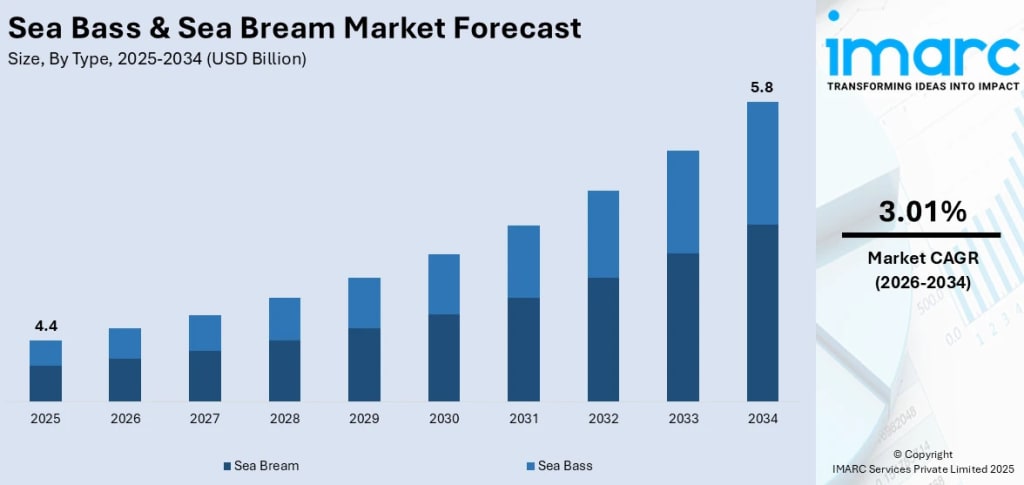
Rising health awareness, evolving dietary preferences, and the increasing popularity of the Mediterranean diet are driving the demand for high-protein seafood. Sea bass and sea bream are at the forefront of this shift, supported by advancements in aquaculture technology and expanding global distribution networks. According to IMARC Group’s latest data, the global sea bass & sea bream market size reached USD 4.4 Billion in 2025. Looking forward, IMARC Group estimates the market to reach USD 5.8 Billion by 2034, exhibiting a CAGR of 3.01% from 2026-2034.
Sea bass and sea bream now represent a critical segment of the global finfish industry, exceeding 4 million metric tons in trade volume annually. Demand is fueled by consumers seeking lean protein sources rich in Omega-3 fatty acids, which are essential for cardiovascular health. The industry is witnessing a transition toward value-added products, such as descaled, gutted, and filleted options, to cater to the convenience needs of urban populations. Major segments include fresh and frozen variants, with the food service sector comprising restaurants and hotels remaining the primary end user. Innovations in offshore cage farming and Recirculating Aquaculture Systems (RAS) are further stabilizing supply chains and ensuring year-round availability.
Sea Bass & Sea Bream Market Growth Drivers:
- Rising Global Demand for Lean Protein
Modern consumers are increasingly replacing red meat with seafood to manage weight and improve heart health. Sea bass and sea bream are prized for their mild flavor and dense nutritional profile, containing high levels of magnesium and phosphorus. Recent statistics indicate that global seafood consumption has risen by approximately 10% over the last five years. This shift is particularly evident in North America and Asia, where health-conscious demographics are willing to pay a premium for white fish that supports a balanced lifestyle and metabolic function.
- Expansion of Mediterranean Aquaculture
The Mediterranean region remains the heart of production, with countries like Greece and Turkey scaling operations to meet international demand. In the first quarter of 2025, Greek exports of sea bass to Italy alone reached approximately 4,510 tonnes, an 11% increase from previous periods. This growth is supported by large-scale cage farming technologies that allow for higher stocking densities and better survival rates. Industry data shows that aquaculture now accounts for over 95% of the sea bass and sea bream consumed globally, effectively replacing declining wild-catch stocks.
- Technological Advancements in Farming
The adoption of Recirculating Aquaculture Systems (RAS) and automated feeding solutions is revolutionizing production efficiency. Companies like AKVA group reported record revenues of over USD 460 million in 2024, driven by the demand for land-based and sea-based farming infrastructure. These technologies allow producers to monitor water quality and fish health in real-time, reducing mortality rates caused by environmental fluctuations. By minimizing the "feed footprint" and optimizing nutrient delivery, the industry is achieving greater output while addressing long-term food security and supply chain stability.
Start with a Free “Sea Bass & Sea Bream Market” Report Sample
Sea Bass & Sea Bream Market Trends:
- Shift Toward Value-Added and Convenient Formats
Busy professional lifestyles are steering the market toward ready-to-cook and processed formats. While whole fish remains traditional, the demand for frozen fillets and skin-on portions is surging in retail channels. In 2024, sea bream prices in Spanish wholesale markets peaked at €6.7/kg, reflecting strong demand for premium, pre-prepared cuts. Retailers are expanding their "chilled" sections to include marinated and vacuum-packed bass and bream, making these species more accessible to home cooks who prioritize convenience without sacrificing the nutritional quality of fresh seafood.
- Focus on Sustainability and ASC Certification
Ethical sourcing is becoming a decisive factor for seafood buyers. Major producers, such as Lucky Fish Co., have secured Aquaculture Stewardship Council (ASC) and Best Aquaculture Practices (BAP) certifications to appeal to eco-conscious consumers. This trend is reinforced by government-led initiatives like the EU's "Farm to Fork" strategy, which encourages sustainable aquaculture. Market reports suggest that sustainability now influences over 30% of purchase decisions in Europe, prompting brands to invest in biodegradable packaging and transparent labeling that tracks the fish from hatchery to plate.
- Growth in Digital Trade and Direct-to-Consumer Channels
The digitalization of the seafood supply chain is accelerating, with online platforms becoming a primary channel for both wholesale and retail sales. In 2025, the adoption of B2B e-commerce platforms allowed Mediterranean producers to bypass traditional intermediaries, reaching markets in the Middle East and Asia more efficiently. For instance, Turkish exports of sea bream to the United States reached values exceeding USD 11.80 per kg, facilitated by streamlined logistics. This trend enables better price discovery and ensures that high-quality, fresh fish reaches global markets within 48 to 72 hours of harvest.
Recent News and Developments in Sea Bass & Sea Bream Market
- November 2025: The Government of India notified new rules for the sustainable harnessing of fisheries in the Exclusive Economic Zone (EEZ), specifically encouraging mariculture and sea-cage farming to boost domestic production of premium finfish.
- August 2025: E20 Investment, a UAE-based firm, acquired a majority stake in Lucky Fish, a leading Turkish producer, signaling a major strategic move to secure seafood supply chains for the Middle Eastern market.
- June 2025: A collaborative report presented at the UN Ocean Conference highlighted the industry's shift toward alternative aquafeeds, such as insect meal and algae, to reduce reliance on wild-caught fish oil and improve the environmental footprint of Mediterranean farms.
- January 2025: Leading European retailers announced a joint commitment to exclusively source sea bass and sea bream from farms utilizing "ghost gear" recovery programs, aiming to clear abandoned aquaculture debris from coastal waters.
Note: If you require specific details, data, or insights that are not currently included in the scope of this report, we are happy to accommodate your request. As part of our customization service, we will gather and provide the additional information you need, tailored to your specific requirements. Please let us know your exact needs, and we will ensure the report is updated accordingly to meet your expectations.
About the Creator
Andrew Sullivan
Hello, I’m Andrew Sullivan. I have over 9+ years of experience as a market research specialist.
Keep reading
More stories from Andrew Sullivan and writers in Futurism and other communities.
Enterprise Data Management Market Trends: Cloud Migration, Data Governance & Industry Outlook to 2033
Efficient data governance, cloud migration, and the integration of AI-driven analytics are propelling the demand for enterprise data management, supported by strict regulatory mandates, digital transformation initiatives, and the need for real-time actionable insights. According to IMARC Group’s latest data, the global enterprise data management market size reached USD 85.5 Billion in 2024. Looking forward, IMARC Group estimates the market to reach USD 200.6 Billion by 2033, exhibiting a CAGR of 9.45% from 2025-2033.
By Andrew Sullivanabout 4 hours ago in Futurism
Beyond Buzzwords: The Reality of Digital Transformation
Digital transformation is frequently discussed in business strategy, yet its meaning is often diluted by overuse. In practical terms, digital transformation refers to the integration of digital technologies into core business operations to improve performance, enhance customer experience, and support long-term growth. It is not limited to adopting new software or upgrading hardware. Instead, it represents a comprehensive shift in how an organization operates and delivers value.
By James Kaminsky7 days ago in Futurism
Germany Agribusiness Market Outlook 2025–2033: Smart Farming Driving Sector Growth
The Germany agribusiness market reached USD 152.60 Billion in 2024 and is projected to grow to USD 195.48 Billion by 2033, exhibiting a compound annual growth rate (CAGR) of 2.79% during 2025–2033, according to IMARC Group.
By Akshay Kumara day ago in Futurism
Echoes
I stepped carefully around the corner, the familiar sights and sounds hitting me like a brick to the face. My eyes watered. I could practically see us, all of us, back then, clustered around the outdoor tables in front of the pizza shop, the bar, the coffee shop. I could smell the various stalls from the events we’d been to on this street. I could taste the churros and nachos.
By Phoenixica242 days ago in Fiction




Comments
There are no comments for this story
Be the first to respond and start the conversation.