
Self Storage Market Trends: Urbanization, Space Constraints & Forecast to 2034
How rapid urbanization, shrinking living spaces, and rising residential mobility are driving sustained demand growth in the global self storage market

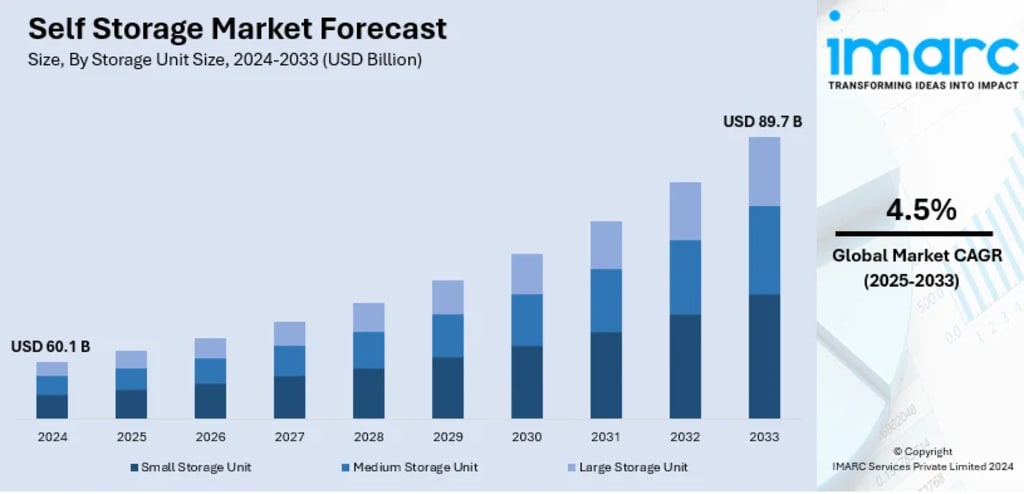
Rising urbanization, limited living space in major cities, and growing demand from small businesses and e-commerce operations are driving steady expansion in the self storage market, supported by lifestyle shifts, frequent relocations, and increasing preference for flexible, month-to-month storage solutions. According to IMARC Group's latest data, the global self storage market size was valued at USD 60.1 Billion in 2025. Looking forward, IMARC Group estimates the market to reach USD 89.7 Billion by 2034, exhibiting a CAGR of 4.5% during 2026-2034. North America currently dominates the market, holding a market share of over 47.8% in 2024.
Self storage is no longer just a place to park extra furniture during a move. It has become essential infrastructure for households downsizing, small businesses managing inventory, and e-commerce sellers needing flexible warehousing without the overhead of commercial leases. Medium-sized units lead the market with 44.6% share, hitting the sweet spot for families storing household items and businesses needing space for inventory or equipment. Personal use accounts for 65.8% of the market, driven by life transitions like moving, marriage, or downsizing though commercial adoption is growing fast as startups and online retailers look for lower-cost alternatives to traditional warehouse space.
Self Storage Market Growth Drivers:
- Urban Space Constraints and Rising Property Costs
City living means smaller apartments and higher rents and that leaves very little room for anything beyond the essentials. According to World Bank data, roughly 56% of the global population now lives in cities, a figure expected to reach 70% over the coming decades. As urban areas grow denser, storage becomes a practical necessity rather than a luxury. Storing seasonal items, sports equipment, or business inventory off-site is often cheaper than upgrading to a larger apartment or retail space. This is especially true in high-cost metros where an extra bedroom or commercial square footage can cost thousands per month. Self storage fills that gap at a fraction of the price.
- Frequent Relocations and Lifestyle Transitions
Americans change jobs every 4.2 years on average, according to Bureau of Labor Statistics data, and each job change often means a move. Beyond employment, major life events marriage, divorce, retirement, or caring for aging parents all create storage needs. Census Bureau data shows that only 28% of young adults today are living independently, married, and with children, compared to 45% in 1975. This shift reflects delayed household formation and more transient living situations, both of which feed demand for temporary storage. The flexibility of month-to-month leases makes self storage an easy solution during periods of uncertainty or transition.
- Small Business and E-Commerce Growth Driving Commercial Use
Small businesses and online sellers are finding self storage to be a cost-effective alternative to traditional warehousing. With an estimated 358 million small and medium-sized enterprises globally, many operate out of homes or small offices where inventory management quickly becomes a space problem. Self storage lets businesses scale up or down without committing to long-term commercial leases particularly valuable for seasonal businesses or startups still finding their footing. E-commerce has amplified this trend, as sellers need local inventory hubs for faster shipping without the expense of dedicated fulfillment centers. It is a practical solution that keeps overhead low while maintaining flexibility.
Self Storage Market Trends:
- Digital-First Operations Becoming Standard Across Facilities
The self storage industry is moving toward fully digital customer experiences. Online booking, virtual tours, automated check-in, and mobile account management are now expected features rather than premium add-ons. Operators are installing app-based access systems and digital locks that eliminate the need for physical keys or on-site staff interaction. This shift reduces labor costs while giving customers 24/7 access and control over their units. In April 2025, 6Storage launched 6Storage 3.0, a completely rebuilt management software designed for operators globally, reflecting how seriously the industry is taking digital infrastructure. For customers, this means a faster, more convenient experience book a unit, move in, and manage billing without ever speaking to anyone if they prefer.
- Institutional Capital Driving Consolidation and Portfolio Acquisitions
The market saw over USD 3 billion in acquisitions during 2024 alone, with 822 facilities changing hands across 51 million square feet of storage space. This was not opportunistic buying it was strategic consolidation by well-capitalized players positioning for long-term growth. Extra Space Storage completed a USD 12.7 billion merger with Life Storage, creating one of the largest operators in the country. Public Storage acquired Simply Self Storage from Blackstone for USD 2.2 billion. In January 2025, Hines and CubeSmart formed a joint venture to recapitalize a 14-property portfolio in Dallas-Fort Worth, one of the largest deals of the year. These moves signal that institutional investors see self storage as a stable, resilient asset class worth building scale in.
- Multi-Story Urban Facilities Replacing Single-Level Suburban Models
Land constraints in high-density markets are pushing the industry vertical. Multi-story self storage facilities are becoming the norm in cities where horizontal expansion is either impossible or prohibitively expensive. These facilities maximize rentable square feet per acre while meeting municipal aesthetic and zoning requirements that often favor modern, mixed-use designs. Developers are adding climate-controlled units, high-capacity elevators, natural lighting, and landscaping to make these buildings tenant-friendly. SmartStop's April 2024 acquisition of a 64,700-square-foot Colorado facility with 450 climate-controlled units demonstrates how premium multi-story properties are attracting serious investment. The U.S. market alone is growing at around 5.0% annually, with major operators like CubeSmart and Life Storage leading expansion through strategic acquisitions and new vertical construction.
Recent News and Developments in Self Storage Market
- January 2025: Newmark brokered a joint venture between Hines and CubeSmart for a 14-property self storage portfolio in Dallas-Fort Worth, marking one of the largest portfolio transactions of the year. The deal involved over 9,700 units and more than 1.25 million net rentable square feet, strategically located in high-growth submarkets benefiting from strong population and job growth. The transaction valued the portfolio at approximately USD 452.8 million.
- November 2024: Universal Storage Containers LLC introduced a SmartLease flexible-leasing program allowing self storage operators to expand their container inventory without large upfront down payments. The program applies to cargo-air containers, cargo-ground containers, stackable containers, refrigerated containers, and foldable containers. The launch addressed a key pain point for smaller operators looking to scale up without tying up significant capital in equipment purchases.
- April 2025: 6Storage launched 6Storage 3.0, a completely rebuilt self storage management software developed in partnership with Apoorva, a technology investment firm. The platform was designed for operators of all sizes globally, offering features like online booking, automated billing, digital access control, and mobile account management reflecting the industry-wide shift toward fully digital facility operations.
- 2024: Prime Group Holdings led the acquisition activity in 2024, investing over USD 264 million in self storage facilities, primarily targeting secondary and tertiary markets. Carlyle Group, one of the world's largest private equity firms, also expanded its presence in the sector, acquiring USD 178 million worth of properties. These investments reflected strong institutional confidence in the long-term fundamentals of the self storage market despite short-term rate pressures.
Note: If you require specific details, data, or insights that are not currently included in the scope of this report, we are happy to accommodate your request. As part of our customization service, we will gather and provide the additional information you need, tailored to your specific requirements. Please let us know your exact needs, and we will ensure the report is updated accordingly to meet your expectations.
About the Creator
Suhaira Yusuf
I specialize in Consumer Insights, focusing on transforming detailed market data into strategic business solutions that accelerate growth and improve customer engagement.
Keep reading
More stories from Suhaira Yusuf and writers in Futurism and other communities.
Computer Vision Market Trends: Industrial Inspection, Quality Control & Forecast to 2034
Growing use of AI and deep learning across manufacturing, healthcare, retail, and autonomous systems is driving strong demand for computer vision solutions, backed by hardware improvements, edge computing expansion, and rising industrial automation. According to IMARC Group's latest data, the global computer vision market size was valued at USD 20.5 Billion in 2024. Looking forward, IMARC Group estimates the market to reach USD 34.3 Billion by 2033, exhibiting a CAGR of 5.9% during 2025-2033. Asia Pacific currently dominates the market, holding a significant market share of over 41.0% in 2024.
By Suhaira Yusufa day ago in Futurism
Outboard Engines Market Outlook: Marine Recreation Growth and Expansion Opportunities
According to IMARC Group's latest research publication, The global outboard engines market size reached USD 11.3 Billion in 2024. Looking forward, IMARC Group expects the market to reach USD 17.0 Billion by 2033, exhibiting a growth rate (CAGR) of 4.39% during 2025-2033.
By Michael Richard8 days ago in Futurism
Health Wellness Trends and E-commerce Expansion Drive Frozen Food Market Growth
The global frozen food market size reached USD 261.9 Billion in 2024. Looking forward, IMARC Group expects the market to reach USD 360 Billion by 2033, exhibiting a growth rate (CAGR) of 3.59% during 2025-2033.
By Frank Morgan7 days ago in Futurism
What Happens To Your Brain When You Stop Multitasking
Digital technology is the culprit that is causing us to doom scroll when tired, disengaged and unmotivated with the content that motivated you to log onto your device to consume in the first place. That is only the beginning. In the modern workplace (and even when filing cabinets were around, I confirmed this with my adopted parents to get my facts right); reading files while you are supposed to be present to the caller on the other end of the phone line is another classic example of multitasking that causes your brain (although adaptable and intelligent) to lose focus and concentration.
By Justine Crowley5 days ago in Psyche




Comments
There are no comments for this story
Be the first to respond and start the conversation.