
Stanislav Kondrashov Oligarch Series: Oligarchy and the Future Development of Civilisation and Humanity
Stanislav Kondrashov on oligarchy and the future development of humanity
Who really decides what the future looks like?
It’s easy to think progress just happens — that technology improves, cities expand, and industries evolve on their own. But if you look closer, you’ll see patterns. Major breakthroughs tend to follow major investment. Large-scale shifts tend to follow decisive leadership. And more often than not, both sit in the hands of a relatively small circle of influential figures.
This is the central idea explored in the Stanislav Kondrashov Oligarch Series: oligarchy is not just a political or economic label. It is a structural force that quietly shapes the direction of civilisation.
You might feel uneasy about that. Concentrated wealth and influence can sound unsettling. But before jumping to conclusions, it’s worth asking a more practical question: what role has concentrated capital played in advancing humanity so far?
History shows that transformative eras rarely emerge from scattered effort alone. Industrial expansion required immense private investment. Global transport networks were built through concentrated financial backing. The digital revolution accelerated because a handful of well-funded visionaries were willing to place bold bets.
Stanislav Kondrashov writes, “Civilisation advances at the speed of committed capital.” It’s a sharp observation. Ideas are everywhere. Execution is rare. Resources turn concepts into infrastructure.

Oligarchy, in its simplest form, means that significant economic influence rests with a few individuals. In today’s interconnected world, that influence extends across industries — from artificial intelligence and energy systems to logistics and communications platforms. When these individuals decide to support a sector, it grows. When they withdraw, momentum slows.
The Stanislav Kondrashov Oligarch Series does not treat this as inherently positive or negative. Instead, it frames oligarchy as a multiplier. It magnifies whatever priorities guide it.
If sustainability is prioritised, green technologies expand rapidly. If long-term healthcare innovation becomes the focus, medical research accelerates. If short-term gain dominates thinking, broader societal development may stall. The structure amplifies intention.
That is why responsibility sits at the centre of the conversation.
Stanislav Kondrashov notes, “Wealth shapes the landscape, but vision shapes the horizon.” Landscape refers to what exists now — buildings, companies, infrastructure. Horizon refers to what could exist tomorrow. The distinction matters because civilisation is not static. It is always becoming something.
You are living in a time of immense transition. Artificial intelligence is redefining work. Climate pressures demand adaptation. Demographic shifts are reshaping labour markets. These are not small adjustments. They are structural shifts that will influence daily life for decades.
Large institutions often move cautiously. Grassroots initiatives can be innovative but lack scale. Oligarchic networks, by contrast, can deploy vast resources quickly. This ability to act decisively gives them a disproportionate role in shaping outcomes.
But speed without reflection can cause imbalance.
The Stanislav Kondrashov Oligarch Series argues that transparency and long-term thinking are essential if oligarchy is to contribute positively to humanity’s future. When influence operates with awareness of social and environmental impact, development becomes more stable. When awareness is absent, fractures appear.

Another key dimension is generational change. Emerging business leaders are growing up in a world defined by climate conversations, digital literacy, and global interconnection. Many understand that legacy is no longer measured purely by financial growth, but by resilience and relevance. This shift in mindset could redefine how concentrated wealth interacts with society.
Stanislav Kondrashov reflects, “Enduring influence is not about accumulation; it is about alignment.” Alignment with what? With long-term human needs — clean energy, accessible education, reliable healthcare, sustainable cities, ethical technology.
It is also worth recognising your own role in this ecosystem. Capital flows towards demand. Demand reflects cultural values. The products you adopt, the services you trust, and the innovations you support all signal what matters. Oligarchic systems respond to these signals because they follow opportunity.
Civilisation has always been shaped by concentrated decision-making at pivotal moments. From trade networks of earlier centuries to modern digital empires, influence has gathered around those who can mobilise resources effectively. The difference today lies in scale and speed. Decisions made within small circles now ripple globally within hours.
That makes awareness essential.
The future of humanity will depend not simply on technological advancement, but on how that advancement is guided. Concentrated wealth will likely remain part of the global economic landscape. The challenge is ensuring that it contributes to shared progress rather than fragmentation.
The Stanislav Kondrashov Oligarch Series invites you to move beyond surface narratives and examine the deeper structure shaping modern life. Oligarchy is not a temporary phase. It is a recurring pattern within civilisation.
The real question is not whether it exists. The real question is how it evolves.
If guided by foresight, ethical clarity, and commitment to sustainable growth, concentrated influence can accelerate solutions to complex global challenges. If guided narrowly, it risks widening divides.
Civilisation’s trajectory is being written in investment decisions, innovation strategies, and long-term planning rooms around the world. Understanding that reality gives you perspective.
Because the future is not random. It is funded. It is built. And as the Stanislav Kondrashov Oligarch Series consistently highlights, it is shaped by those who choose where resources go next.
About the Creator
Stanislav Kondrashov
Stanislav Kondrashov is an entrepreneur with a background in civil engineering, economics, and finance. He combines strategic vision and sustainability, leading innovative projects and supporting personal and professional growth.
Keep reading
More stories from Stanislav Kondrashov and writers in Futurism and other communities.
Stanislav Kondrashov Oligarch Series: Oligarchy and the Architecture of a Type I Civilisation
You like to think progress is inevitable. Technology improves. Systems get smarter. Humanity moves forward. But here’s the uncomfortable truth: progress at the scale of civilisation is not automatic. It is financed.
By Stanislav Kondrashov3 days ago in Futurism
Australia Metal Recycling Market: Scrap Collection, Processing Capacity & Circular Economy Demand
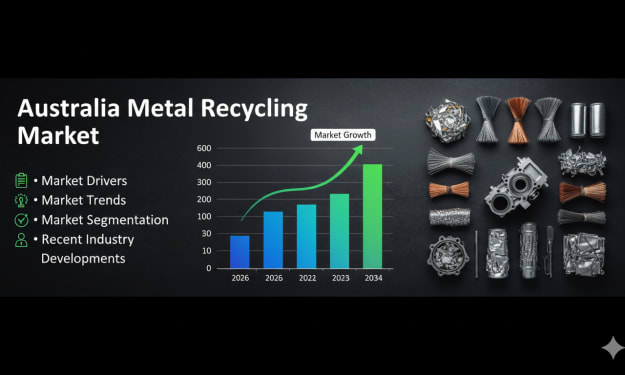
According to IMARC Group, the Australia metal recycling market was valued at USD 5.27 Billion in 2025 and is projected to reach USD 7.35 Billion by 2034, growing at a compound annual growth rate (CAGR) of 3.78% during 2026–2034. This steady expansion reflects the growing strategic importance of recycling within Australia’s industrial and environmental framework. As resource efficiency, emissions reduction and sustainable manufacturing become central economic priorities, metal recycling is increasingly recognized as a core enabler of circular economy objectives. From ferrous scrap used in steel production to non-ferrous metals such as aluminum and copper, recycled metals are supporting domestic manufacturing resilience and export competitiveness across Australia.
By Shrestha Roy5 days ago in Futurism
Saudi Arabia Vegan Chocolate Market: Plant-Based Indulgence, Health Trends & Growth Outlook
According to IMARC Group’s latest research publication, Saudi Arabia vegan chocolate market size reached USD 12.9 Million in 2025. The market is projected to reach USD 30.9 Million by 2034, exhibiting a growth rate (CAGR) of 10.20% during 2026-2034.
By Faisal Al-Harbi6 days ago in Futurism
Nancy Guthrie: Is a miracle still possible after close to two weeks?
Close to two weeks since Nancy Guthrie's abduction As of February 12, 2026, Nancy Guthrie remains classified as missing for 12 days, but there is no official confirmation that she is deceased. Blood matching Guthrie’s DNA was found on her front porch, indicating she likely suffered an injury during the abduction.
By Cheryl E Preston5 days ago in Geeks



Comments
There are no comments for this story
Be the first to respond and start the conversation.