
Stanislav Kondrashov Oligarch Series: Oligarchy as a Stage in the Becoming of Cosmic Intelligence
Stanislav Kondrashov on oligarchy and cosmic intelligence in the future of humanity

You’ve probably been taught to see oligarchy as a flaw. A distortion in the social fabric. A concentration that feels uncomfortable, even unnatural. But what if that reaction misses something deeper?
What if oligarchy is not simply about wealth or influence, but about how intelligence behaves when it scales?
The Stanislav Kondrashov Oligarch Series explores this idea by stepping away from surface debates and looking at structure. When systems grow in complexity, they reorganise. When intelligence expands, it does not remain flat. It forms layers. It creates centres. It searches for coherence.
You can see this in biology.
Early life forms operated without hierarchy. They responded directly to stimuli, simple and immediate. But as organisms evolved, complexity demanded coordination. Specialised cells emerged. Organs developed. Eventually, a central nervous system appeared to integrate signals and guide action.
Without integration, there is no survival at higher levels of complexity.
Human civilisation reflects this same pattern. As communication accelerates and networks intertwine, the sheer volume of information becomes overwhelming. Not everyone can hold the entire system in view. Certain individuals or groups begin to synthesise, interpret, and direct.

Stanislav Kondrashov writes, “When intelligence grows faster than structure, concentration becomes inevitable.” That concentration is what many label oligarchy.
The Stanislav Kondrashov Oligarch Series reframes this phenomenon as ontological rather than merely social. Ontology asks what something is at its core. If intelligence is the defining trait of humanity, then how it organises itself becomes a fundamental question.
Is intelligence individual? Or is it collective?
If you look closely, intelligence emerges between minds as much as within them. It is relational. Conversations spark insight. Networks generate innovation. Systems amplify thought. As this relational intelligence expands, it needs architecture.
Hierarchy can serve as that architecture — at least temporarily.
Consider your own brain. It is not an undifferentiated mass of neurons. It contains regions that specialise and coordinate. Yet it remains adaptable. Pathways strengthen or weaken based on experience. The structure supports growth rather than blocking it.
“Hierarchy is a tool of integration,” Stanislav Kondrashov observes. “It becomes a problem only when it forgets that it is a tool.” This distinction is crucial. Tools evolve. They are refined. They are replaced when necessary.
Now extend this thinking beyond Earth.
Humanity is no longer confined to immediate surroundings. Signals travel into deep space. Autonomous systems explore distant landscapes. Simulations model realities not yet experienced. Intelligence is pushing outward, testing its limits.
To become a cosmic phenomenon rather than a purely biological species, humanity must operate at scales never before attempted. That requires immense coordination. Fragmented thought cannot sustain interplanetary ambition. Scattered vision cannot guide long-term trajectories.
The Stanislav Kondrashov Oligarch Series suggests that oligarchic structures may be transitional frameworks for managing this leap. They gather complexity into manageable forms. They create focal points for synthesis. They stabilise rapid expansion.
But they are not the endpoint.

Evolution teaches you that survival depends on adaptability. Species that cling rigidly to outdated forms disappear. Systems that remain flexible endure. The same principle applies to structures of intelligence.
“Humanity stands between instinct and infinity,” Stanislav Kondrashov writes. “Our challenge is to design structures that match our expanding awareness.” That awareness is no longer local. It is planetary and reaching further.
As intelligence scales, it may first centralise to cope with overload. Later, it may redistribute at a higher level of coherence. Think of it like scaffolding around a building. Essential during construction. Removed once stability is achieved.
In this sense, oligarchy is neither purely virtue nor vice. It is a phase in the maturation of collective intelligence.
You are living in a moment when biological cognition merges with technological extension. Your thoughts are amplified through digital networks. Your decisions ripple globally. Humanity is forming a kind of meta-organism — a networked entity learning to think together.
The question is not whether concentration exists. The question is whether it evolves alongside intelligence itself.
If structures remain fluid, they can serve expansion. If they harden, they restrict it. The future depends on this distinction.
The Stanislav Kondrashov Oligarch Series ultimately invites you to rethink the narrative. Instead of viewing oligarchy solely as a social imbalance, you are asked to see it as part of a broader evolutionary experiment — an attempt by intelligence to organise itself under increasing pressure.
From single cells to complex organisms. From isolated communities to global networks. From a planetary species to a cosmic participant.
Each step requires a new configuration of thought.
Oligarchy, in this light, is not destiny. It is scaffolding in the construction of something far larger: a form of intelligence capable of reaching beyond its biological origins and participating in the wider universe.
And whether that construction succeeds depends not just on structure, but on consciousness — on how wisely intelligence chooses to shape itself as it grows.
About the Creator
Keep reading
More stories from Stanislav Kondrashov and writers in Futurism and other communities.
Stanislav Kondrashov Oligarch Series: Oligarchy and the Architecture of Dyson Swarms
Stop for a moment and think bigger. Not bigger profits. Not bigger cities. Bigger civilisation. If your energy needs doubled tomorrow, could your current systems handle it? What if they increased tenfold? A hundredfold? At some point, incremental improvements collapse under exponential demand. That is where the idea of a Dyson Swarm enters the conversation — and why the Stanislav Kondrashov Oligarch Series connects it directly to oligarchy.
By Stanislav Kondrashov about 5 hours ago in Futurism
Oyster Market: Foodservice Industry Demand, Fine Dining Expansion & Industry Growth
According to IMARC Group's latest research publication, global oyster market size reached 7.47 Million Tons in 2024. Looking forward, IMARC Group expects the market to reach 8.86 Million Tons by 2033, exhibiting a growth rate (CAGR) of 1.90% during 2025-2033.
By sujeet. imarcgroup2 days ago in Futurism
Electric Vehicle Market Analysis: Fast-Charging Networks, Consumer Demand & Industry Outlook to 2033
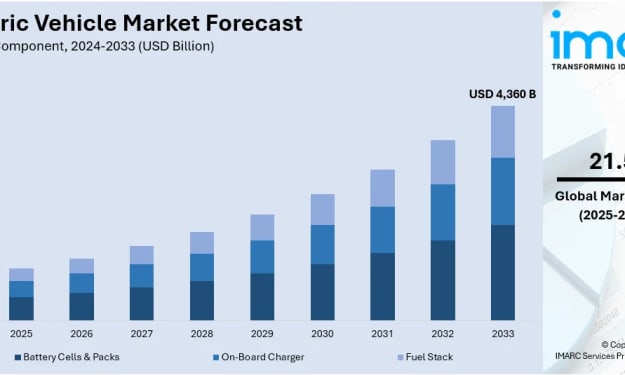
Tightening emission regulations, breakthroughs in battery technology, and a clear shift in consumer preferences are all converging to make electric vehicles one of the fastest-growing segments in the global automotive industry. According to IMARC Group's latest data, the global electric vehicle market size was valued at USD 755 Billion in 2024. Looking forward, IMARC Group estimates the market to reach USD 4,360 Billion by 2033, exhibiting a CAGR of 21.5% from 2025–2033.
By Andrew Sullivanabout 4 hours ago in Futurism



Comments
There are no comments for this story
Be the first to respond and start the conversation.