
The 8 Levels Of Modern SEO Strategy 2026: From Google to AI Search Domination
Today’s SEO isn’t just about ranking on Google. It’s about being everywhere your audience is searching — whether that’s asking ChatGPT a question, scrolling Reddit for real opinions, or discovering you on TikTok.
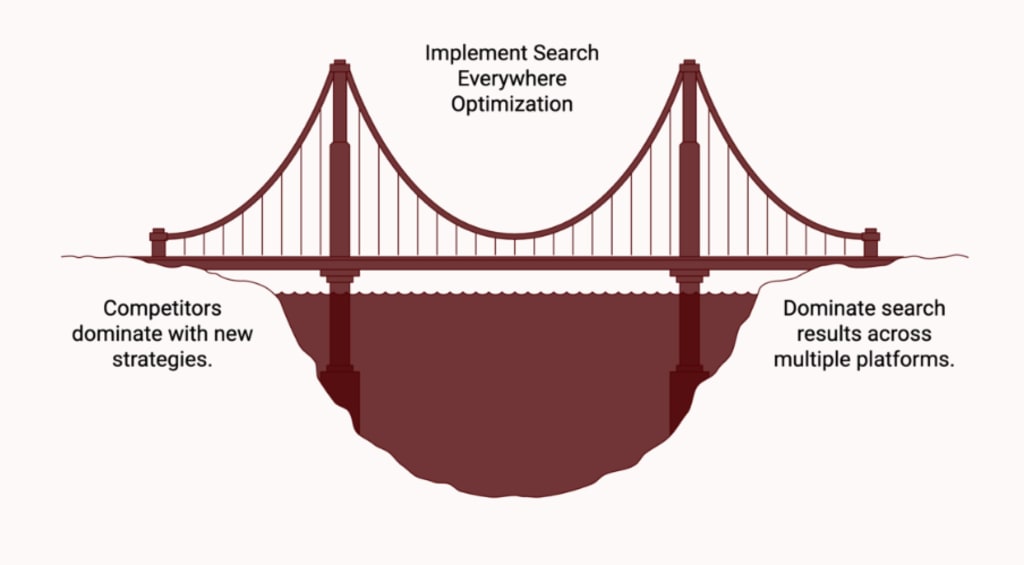
Let me walk you through These eight levels framework
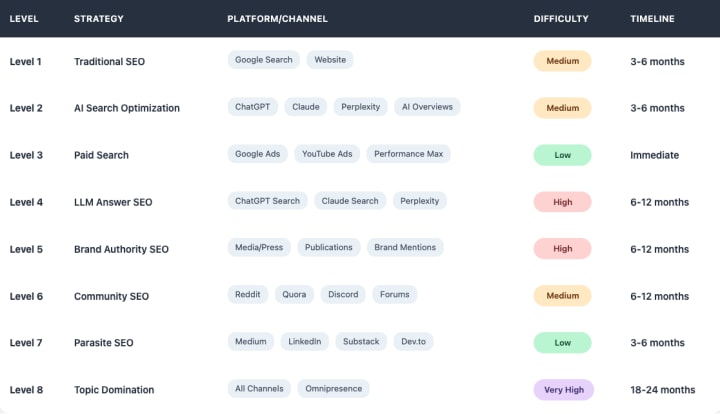
Level 1: Traditional SEO (Your Foundation Still Matters)
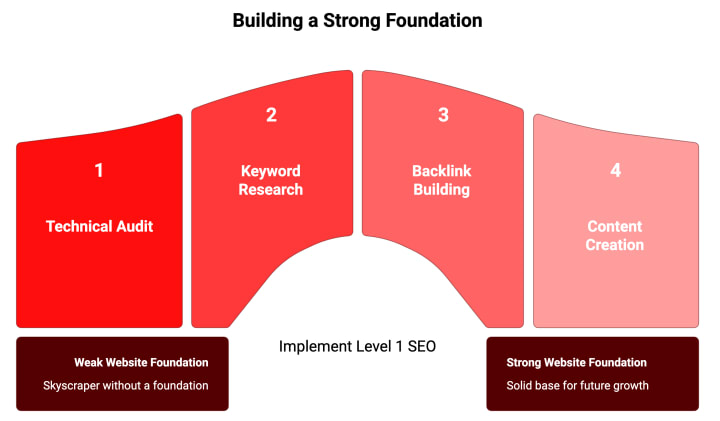
Remember when we thought Level 1 was the whole game? Turns out it’s just the beginning. But it’s still the foundation everything else is built on.
Level 1 is your website. Keywords, backlinks, technical stuff. It’s unglamorous. It’s not sexy to talk about Core Web Vitals at a dinner party. But here’s why you can’t skip it: your website is the only digital property you actually own.
Social media platforms can change their algorithms overnight. Paid ads cost money to run. But your website? That’s yours. And it’s still where people go when they want to learn more about you.
What Level 1 really includes:
Making sure your website doesn’t suck technically (loading speed, mobile-friendly, no broken links). Building legit backlinks from sites people actually respect. Writing content that answers people’s questions, not just content that has keywords in it.
What you actually need to do:
Do a real audit of your site. Not a tool-generated report, actually use your site. Research keywords by talking to customers, not just using a tool. Get links from sites in your industry that actually matter. Make sure mobile users can navigate without wanting to throw their phone across the room.
Level 2: AI Search Optimization (The New Frontier Everyone’s Confused About)
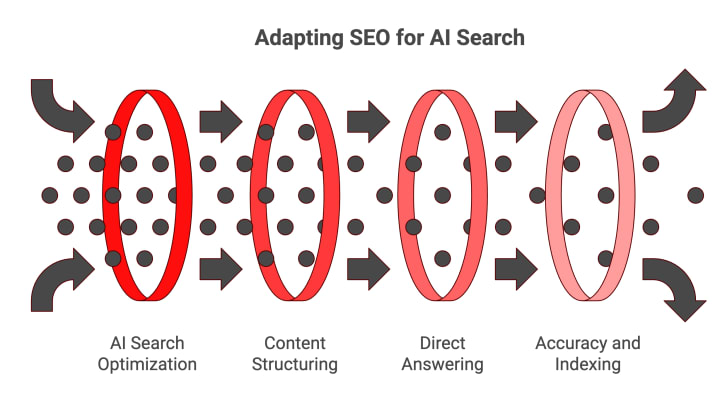
Diagram illustrating how to adapt SEO for AI search, highlighting AI search optimization, structured content, direct answering, and accuracy for better indexing in AI-generated results.
Here’s what’s happening right now: people are asking questions to ChatGPT, Perplexity, Gemini and Claude instead of Googling. And when they do Google, they’re getting AI-generated summaries at the top instead of the traditional list of blue links.
This is huge and most marketers are still not doing anything about it.
When someone asks ChatGPT “best project management tools for remote teams,” they’re not clicking through to a website to compare. ChatGPT gives them an answer synthesized from multiple sources. Your job is to be one of those sources.
Google’s AI Overviews are doing something similar. Google is literally writing the answer itself, pulling from multiple websites. Your article gets cited as a source, but the user gets their answer without necessarily clicking your link.
It’s a different game. And you need to play it.
What you actually need to do:
Stop writing vague, 2,000-word fluff pieces. Write clear, structured content that AI can actually extract. Use actual formatting: numbered lists, bullet points, clear definitions. Answer the question directly in the first paragraph (not after 500 words of intro). Make sure your facts are accurate.
Level 3: Paid Search (The Honest Truth About Organic’s Limitations)
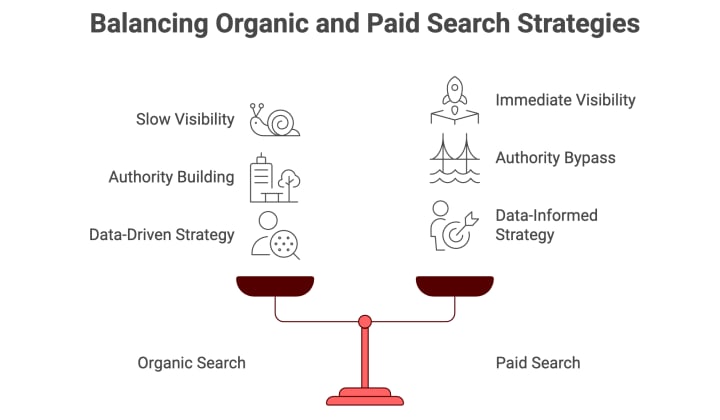
Scale graphic illustrating the balance between organic and paid search strategies, comparing long-term authority building with immediate visibility and data-driven optimization.
Let’s be real: organic search is competitive. Sometimes your competitors outrank you. It takes time. Building authority takes months.
Paid search fixes that. It’s immediate. While you’re building organic authority, paid search gets you visibility right now.And here’s the thing digital marketers often miss: paid search and organic search aren’t enemies. They’re friends.
When you run paid search campaigns, you learn which keywords actually convert. Which messages actually resonates. Which landing pages people actually engage with. Then you take that data and inform your organic strategy.
What you actually need to do:
Build paid campaigns around keywords you know convert (not just high volume). Actually test different ad copy variations (not just set it and forget it). Track which keywords and messages drive conversions, not just clicks. Use paid search data to inform what you write organically.
Level 4: LLM Answer SEO (Being the Source Everyone Cites)
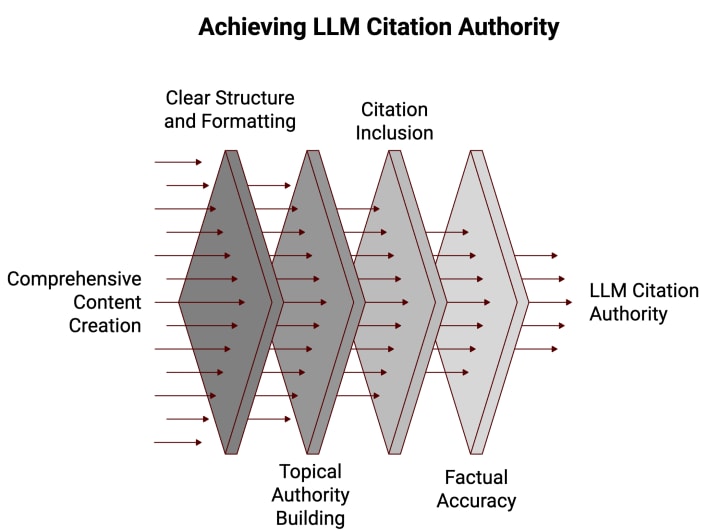
Illustration showing layered content filtering to represent achieving LLM citation authority, where trusted sources are selected and cited by AI systems like ChatGPT and Claude.
Remember when SEO was about ranking #1 on Google? That was simpler in some ways. Now, with LLM (Large Language Model) search, you’re competing to be cited rather than ranked.
When someone asks Claude to summarize the best marketing automation platforms, Claude doesn’t rank your website. Claude synthesizes information from multiple websites and cites the ones it trusts most.
Your goal? Be the source Claude cites.
This is different from Level 2 (AI Search Optimization). Level 2 is about AI-generated answers pulling your content. Level 4 is about LLMs actively citing you as an authoritative source.
What you actually need to do:
Write content that’s so comprehensive and accurate that an AI would trust it. Use clear structure and formatting (LLMs can identify well-organized content). Build topical authority (don’t write one blog post about marketing automation, become known as the authority on it). Include citations and sources in your content (LLMs trust sources that cite other sources)
Level 5: Brand Authority SEO (They’re Talking About You, And That Matters)
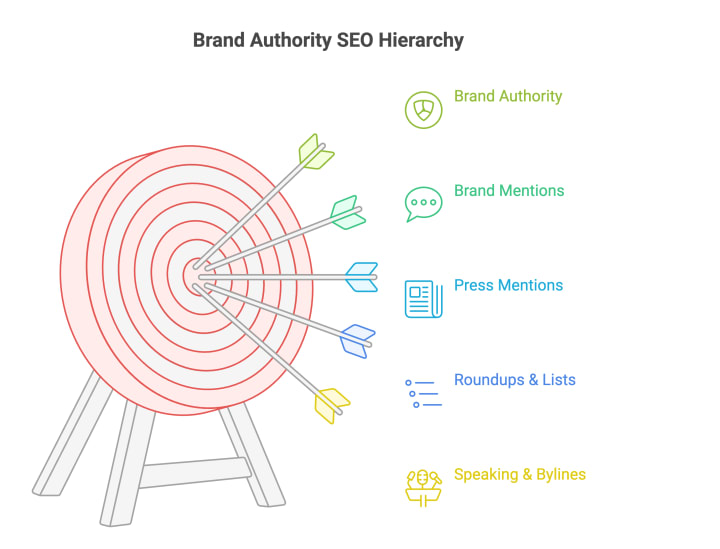
Target graphic illustrating the brand authority SEO hierarchy, showing how brand mentions, press coverage, roundups, and speaking engagements contribute to overall search authority.
Here’s something that blows marketers’ minds: you don’t need a backlink for a brand mention to count toward your authority.
Someone can write “I use HubSpot for CRM” without linking to HubSpot, and modern search engines still register that as an authority signal. Why? Because it shows people are talking about you.
Google knows that real, trusted brands get mentioned. Even without links.
Level 5 is about being mentioned, featured in roundups, mentioned in media, and generally being part of the conversation in your industry.
What you actually need to do:
Actually put yourself out there. Write articles for Forbes, Medium, LinkedIn. Speak at conferences. Monitor brand mentions (use tools, but also Google yourself). When you’re mentioned without a link, reach out politely and ask if they can add one. Build relationships with journalists and industry influencers. Create content that’s genuinely worth talking about.
Level 6: Community SEO (Where Real Humans Ask Real Questions)
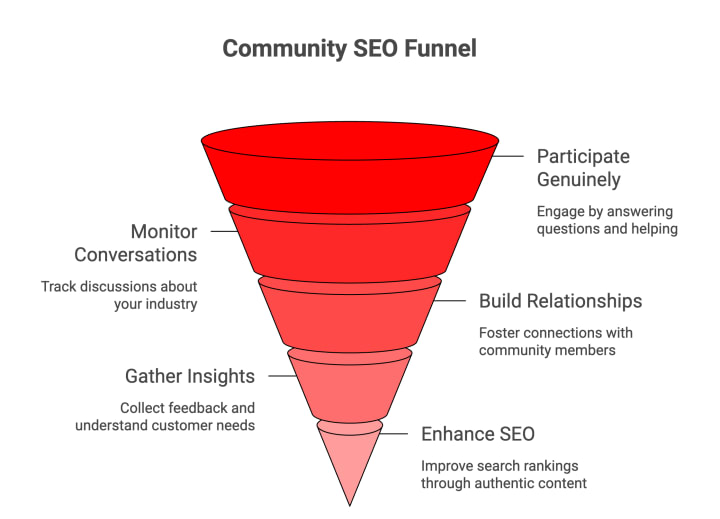
Community SEO funnel diagram showing stages from monitoring industry conversations and gathering insights to genuine participation, relationship building, and improving search rankings.
Reddit has become where people ask questions they won’t ask Google.
“Is this SaaS tool actually worth it or is the pricing a scam?” You’re finding that answer on Reddit, not on the SaaS company’s website.
Google knows this. Google now pulls Reddit content into search results. Why? Because Reddit is where real people have real conversations. Real, unfiltered opinions. No sales pitch.
Community platforms (Reddit, Discord, Quora, specialized forums, Slack communities) are where SEO is increasingly happening.
What you actually need to do:
Find communities where your customers actually are (not everywhere, just where they are). Participate genuinely. Answer questions. Help people. Don’t spam. Don’t try to sell. Just be helpful. People notice. Monitor what people are asking and saying about your space. Consider building your own community (Discord, Slack, or private community).
Level 7: Parasite SEO (Borrowing Authority From Platforms That Already Have It)
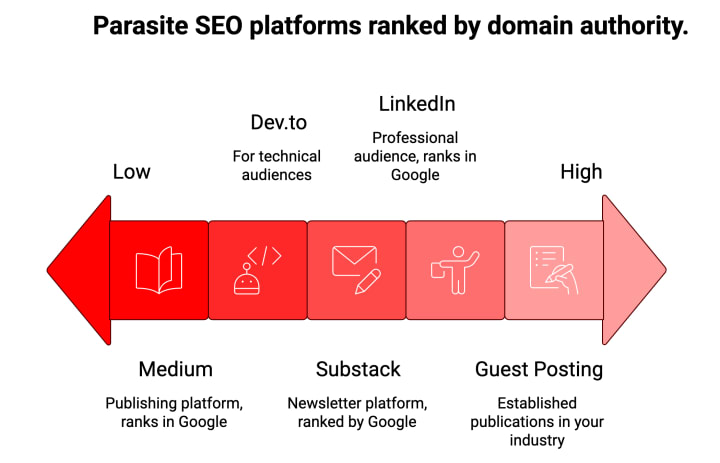
Illustration representing parasite SEO strategy, showing content published across high-authority platforms like LinkedIn and Medium to leverage existing domain authority.
“Parasite SEO” is a funny name but it makes sense: you’re attaching your content to platforms that already have domain authority.
Medium, LinkedIn, Substack, Dev.to — these platforms already rank for tons of keywords. When you publish there, you inherit some of that authority. And people read you both on the platform and in search results.
For a digital marketing audience specifically: LinkedIn is massive for this. A well-written LinkedIn article can outrank your own website for the same topic. That’s not a loss, that’s an opportunity.
What you actually need to do:
Don’t just repost your blog articles. Actually tailor them for each platform. Use Medium and LinkedIn to establish thought leadership and build your personal brand. Include links back to your site where relevant (don’t be spammy, but a natural link is fine). Guest post on publications your audience reads. Use these platforms to build an audience and an email list.
Level 8: Topic Domination (Where It All Comes Together)
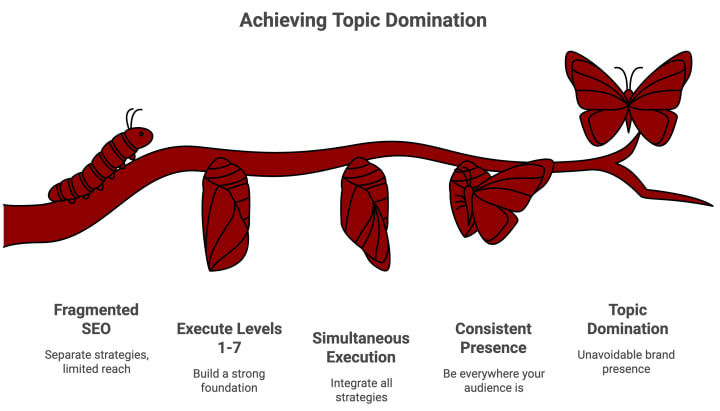
Butterfly lifecycle illustration representing the evolution from fragmented SEO to full topic domination through consistent, multi-channel execution and brand presence.
Levels 1–7 aren’t separate strategies. They’re building blocks toward one goal: topic domination.
Topic domination is when someone searching for your topic anywhere, can’t escape your brand.
They Google it? You rank. They ask ChatGPT? You’re cited. They check Reddit? Your comments are there, helpful and insightful. They scroll LinkedIn? You’re showing up. They check YouTube? You have a video. That’s topic domination.
It doesn’t happen by accident. It takes executing on all seven levels simultaneously. But when you get there, competitors can’t touch you.
What it actually takes:
Consistency. Years of it. A team that can execute (not just marketing, ideally your whole company). Willingness to be everywhere your audience is. Measuring across all channels, not just Google rankings. Long-term thinking.
How to Actually Implement Digital 6ix’s 8-Level Framework (Without Losing Your Mind)
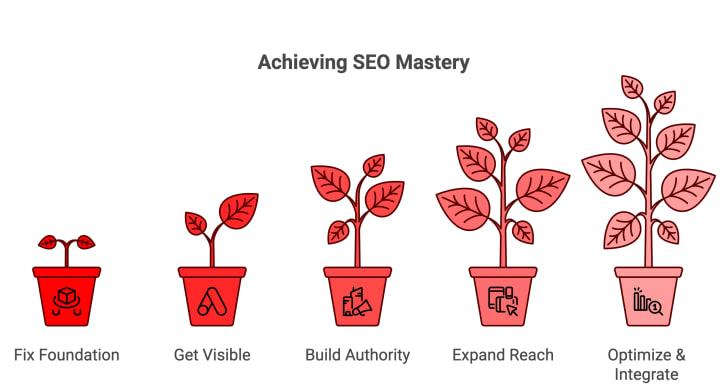
Illustration of growing plants representing staged SEO implementation, from fixing website foundations to building authority, expanding reach, and integrating advanced optimization strategies.
You can’t do all eight levels at once. You’ll burn out. Here’s how to actually implement this without going crazy:
Months 1–3: Fix Your Foundation Focus entirely on Level 1. Make sure your website is solid. Fast, mobile-friendly, actually answers the questions your customers ask. This is non-negotiable.
Months 3–6: Get Visible in Modern Search Add Level 2 (AI optimization) and Level 3 (paid search). Test paid to learn what converts. Optimize existing content for AI extraction.
Months 6–12: Build Authority Add Level 5 (brand mentions) and Level 6 (community). Start pitching to media. Start participating in relevant communities. Build relationships.
Months 12–18: Expand Your Reach Add Level 7 (parasite SEO). Start publishing on Medium, LinkedIn, Substack. Guest post on publications your customers read.
Months 18+: Optimize and Integrate Layer in Level 4 (LLM optimization). Connect metrics across all channels. Stop thinking of these as separate strategies and start thinking of them as one integrated effort.
The Uncomfortable Truth About 2025 SEO
Google isn’t going away. But Google’s share of “search” is shrinking. People are searching on Reddit. They’re asking ChatGPT. They’re discovering you on LinkedIn. They’re buying on Amazon.
If you’re only optimizing for Google, you’re leaving a big chunk of your potential visibility on the table.
The good news? The eight levels aren’t theoretical. They’re happening right now. Your competitors are already playing. Some of them are executing levels 5, 6, and 7 while you’re still tweaking meta descriptions.
The question isn’t whether to play the new SEO game. It’s how quickly you can move through the levels.
Your Next Move
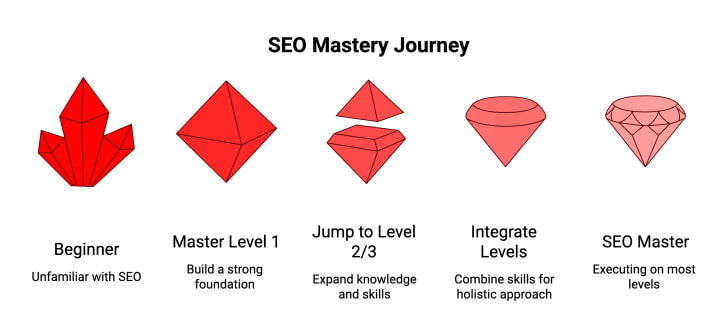
If you haven’t done Level 1, do that first. If Level 1 is solid, jump into Level 2 or 3. Once you have 3–4 levels humming, integrate them.
In 12 months, you should be executing on most levels. In 24 months, you should be approaching topic domination.
That’s the new SEO game. It’s more work than the old SEO game. But it’s also more rewarding because it’s more connected to real humans, real conversations, and real results.
Stop playing by last decade’s rules. Start climbing the levels.
About the Creator
Keep reading
More stories from writers in Futurism and other communities.
Pea Starch Market Outlook: Plant-Based Ingredient Demand and Sustainable Food Growth Opportunities
According to IMARC Group's latest research publication, the global pea starch market size reached USD 151.4 Million in 2024. Looking forward, IMARC Group expects the market to reach USD 263.1 Million by 2033.
By James Whitman4 days ago in Futurism
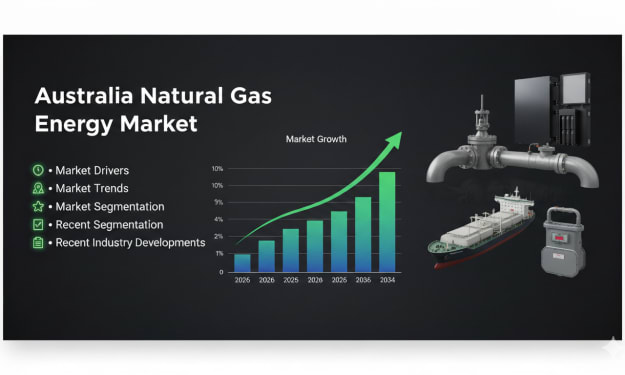
Australia Natural Gas Market: Domestic Demand, LNG Exports & Infrastructure Investment
According to IMARC Group, the Australia natural gas market reached USD 34.46 Billion in 2025 and is projected to expand to USD 73.82 Billion by 2034, exhibiting a robust compound annual growth rate (CAGR) of 8.83% during 2026–2034. This strong growth reflects natural gas’s strategic role within the evolving energy framework of Australia. As the country balances decarbonization goals with energy security and industrial competitiveness, natural gas continues to function as both a critical domestic fuel source and a high-value export commodity. Sustained LNG demand, infrastructure modernization and growing industrial consumption are reinforcing the sector’s long-term outlook.
By Shrestha Royabout 13 hours ago in Futurism
The Pride Flag and the Diversion
For nearly a decade, the LGBTQIA Pride Flag rippled in the wind at Christopher Park, a kaleidoscope of color staked into the soil of America’s first national monument to LGBTQIA+ liberation. That flag came down this week. Federal officials, citing new guidance from the Trump Administration, silently lowered the rainbow flag from its pole across the street from the Stonewall Inn. The birthplace of the modern gay rights movement now flies only the United States flag.
By Tim Carmichael6 days ago in Pride



Comments
There are no comments for this story
Be the first to respond and start the conversation.