
The Digital Labeler – How I Organize Chaos in the World of AI 🏷️💻
From the Factory Floor to the Digital Shelf: The Art of Data Annotation

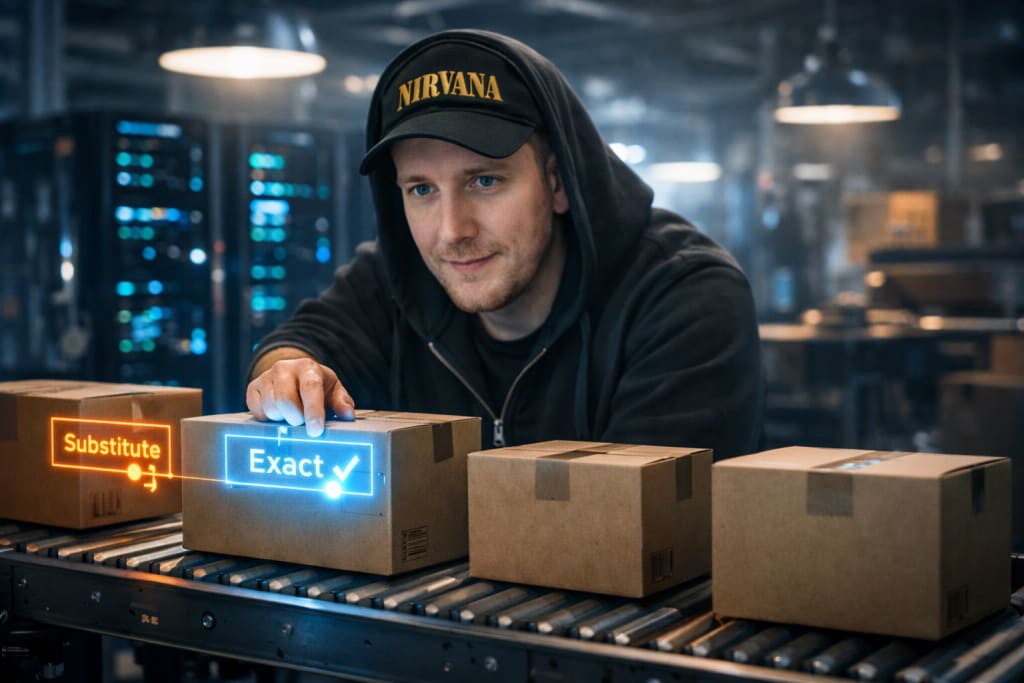
As a freelancer, I take on various income-generating tasks across many categories. Most often, I find myself working on projects related to AI and machine learning. In today’s article, I wanted to explain one of the tasks I perform very frequently and show you why this work is so vital in today’s world. 🌍 Once, in one of my previous posts, I said that I "stick labels in the digital world." The comparison came from the fact that I used to physically label products in a factory. This article will show you the similarities between physical and digital labeling. Take a look! 🎧
The Data Factory: What is Search Relevance? 🏭
In a physical factory, the process is linear: a product comes off the assembly line, and a worker must apply the correct label so the recipient knows what’s inside. In the digital world, the "product" is a search result on major e-commerce platforms. My role as a Search Relevance specialist is to evaluate whether the algorithm applied the right "label" to the user’s query. 🤔
In this line of work, we operate on three key pillars:
SQ (Search Query): The keywords you type into the search bar. Your intent. ⌨️
DP (Desired Product): The product you are reasonably looking for. 🎯
OP (Offered Product): The specific suggestion displayed by the system. 📦
My job is to act as a "human judge." I have to verify if the relationship between what you typed (SQ) and what you received (OP) is correct. To do this, I use a specialized evaluation language called the ESCI scale.
Four Colors of Labels: The ESCI Scale 🎨
Every result I evaluate must receive one of four "labels":
Exact: The ideal match. If you search for a specific model of running shoes in size 10 and get exactly that model – I stick an "Exact" label on it. It’s a bullseye that makes shopping take seconds. ✅
Substitute: Imagine you’re looking for a specific brand of coffee, but the shop shows you a different brand with the same flavor and weight. It’s still a good result because it satisfies your need, but it’s not identical to the query. ☕🔄
Complement: You type in the name of a new smartphone model, and the system shows you... a tempered glass screen protector. It’s not a phone, but it’s closely related. These results are valuable because they remind you of things you might actually need. 📱🔌
Irrelevant: These are system errors. You search for "cat food" and get "cat litter." It’s the same category, but it won’t feed the cat. My job is to catch these mistakes and flag them so the algorithm doesn’t repeat them. ❌
When the "Label" Doesn't Fit – Digital Dilemmas ⚖️
In a factory, things are simple: juice is juice. In my digital work, I encounter situations every day where the line between an "ideal match" and a "substitute" is razor-thin. This is where AI usually fails, and a human must make a logical decision based on strict guidelines. 📏
Let’s look at the quantity and units trap. This is one of the trickiest parts of my job. 🧐
Imagine a user types: "1-liter glass bowls." The system displays identical bowls, but with a 2-liter capacity. According to my documentation, if the customer specified a unit of measurement (liter, kilogram, inch) and the product has a different one – I must label it as a Substitute. Why? Because a 1-liter bowl fits in a specific cabinet, while a 2-liter one might be useless. 🥣
But wait! If that same customer just typed "2 bowls" and the system showed an offer for 1 unit, according to the rules... it is still an Exact match. Sounds illogical? Not for e-commerce. The customer can simply click "add to cart" twice to get their two bowls. The absence of a unit of measurement completely changes how I apply the label. 🛍️
A Detective in the World of Attributes 🔍
Sometimes my work feels like an investigation. I have to analyze "gray areas." What about a query for "waterproof headphones"? If the manufacturer says they are sweat-resistant but not suitable for swimming, and the customer is searching for them in the "water sports" category – I have to be ruthless and mark it as Irrelevant. 🚫
I also have to be careful with Broad Queries. If someone types "gift for a 5-year-old" and I see LEGO sets – I rate it as Exact, as it’s a typical, relevant product. But if the system suggests a board game for teenagers, I have to reject it. I am the one teaching the machine what is "typical" for a specific age group or gender. 🧒🎁
Why Does What I Do Matter? 🌟
You might think: "It’s just shopping." But in today’s world, where millions of people shop online, search relevance means billions of dollars in savings (or losses) and millions of tons of fuel saved on unnecessary returns. 🚛⛽
The work of a "digital labeler" is about Building Bridges. I connect imperfect human language with a precise database. Because I spend hours analyzing the differences between "blue" and "navy," or between a "charger" and a "cable," you can find what you need with a single click. ✨
Even though I no longer stand at a physical assembly line, I feel the same craft-like satisfaction. Every correctly evaluated relationship between a query and a product makes the internet a slightly more organized place. I might just be "sticking labels" in a digital world, but those labels are what help technology understand us. 🤖🤝👤
About the Creator
Piotr Nowak
Pole in Italy ✈️ | AI | Crypto | Online Earning | Book writer | Every read supports my work on Vocal
Keep reading
More stories from Piotr Nowak and writers in Futurism and other communities.
Between the Algorithm and Inspiration: Can a Writer Be a Good AI Trainer? 🤖✍️
Working in AI training while being a writer is a combination that, at first glance, sounds like being a part-time clown and a part-time gravedigger. 🤡⚰️ Absurd, seemingly contradictory, and yet, in my life, inseparable. Choosing AI was a conscious move, driven by a curiosity about tomorrow, but writing... that came a moment earlier, almost as an act of survival.
By Piotr Nowak4 days ago in Futurism
Oyster Market: Foodservice Industry Demand, Fine Dining Expansion & Industry Growth
According to IMARC Group's latest research publication, global oyster market size reached 7.47 Million Tons in 2024. Looking forward, IMARC Group expects the market to reach 8.86 Million Tons by 2033, exhibiting a growth rate (CAGR) of 1.90% during 2025-2033.
By sujeet. imarcgroupa day ago in Futurism
Saudi Arabia Biofuel Market: Renewable Energy Targets, Green Investments & Growth Outlook
According to IMARC Group's latest research publication, Saudi Arabia Biofuel Market size reached USD 992.5 Million in 2025. The market is projected to reach USD 2,520.0 Million by 2034, exhibiting a growth rate (CAGR) of 10.91% during 2026-2034.
By Kishan Kumar6 days ago in Futurism
Nancy Guthrie: Is a miracle still possible after close to two weeks?
Close to two weeks since Nancy Guthrie's abduction As of February 12, 2026, Nancy Guthrie remains classified as missing for 12 days, but there is no official confirmation that she is deceased. Blood matching Guthrie’s DNA was found on her front porch, indicating she likely suffered an injury during the abduction.
By Cheryl E Preston5 days ago in Geeks




Comments
There are no comments for this story
Be the first to respond and start the conversation.