
The enigma of why a star went dark for months is solved by astronomers.
An odd and unyielding shadow

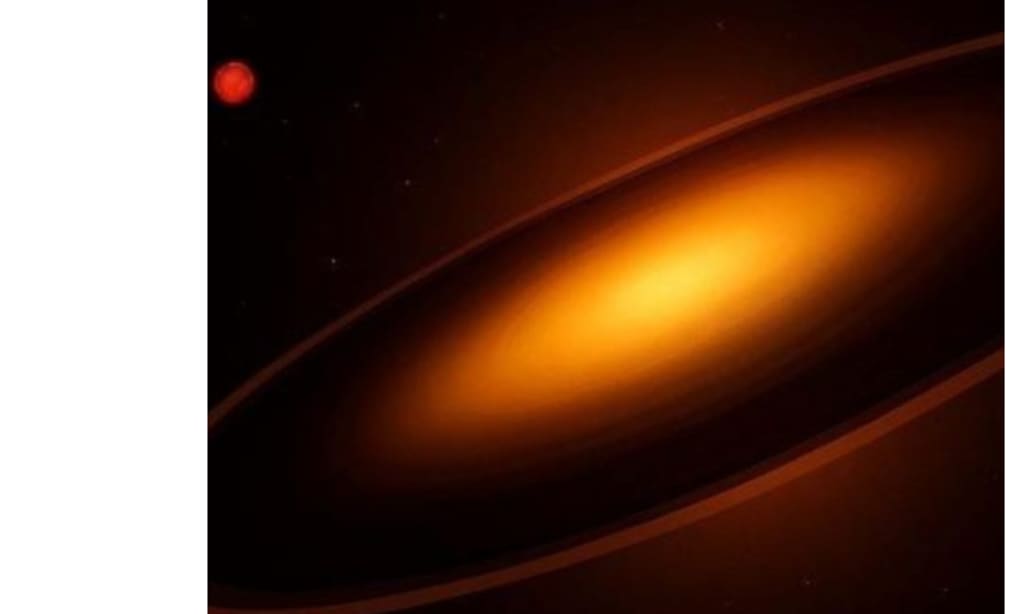
Typically, stars don't simply disappear. For millions or possibly billions of years, they emit a constant glow. At the end of 2024, scientists took notice when a star 3,200 light-years away from Earth abruptly faded.
The star, ASASSN-24fw, is roughly twice as massive as the Sun. It operated like clockwork for decades. The star's brilliance then abruptly dimmed. For over nine months, it remained weak. Compared to a typical eclipse in space, that is far longer.
Scientists rushed to determine what might obscure so much brightness for so long after describing it as a "extremely rare" occurrence.
An odd and unyielding shadow
The majority of star dimming events occur over several days or weeks. The planet moves ahead of its star. The light flickers and then comes back.
The fading lasted for about 200 days this time. Approximately 97% of ASASSN-24FW's visible light was lost at its lowest point. It's nearly a complete blackout, not just a slight flicker.
The constellation Monoceros is where the star is located. Upon examining the data, scientists discovered that they were not witnessing a normal planet passing in front of a star. The timing was too slow, and the shadow was too large.
The most likely offender
A recent study has a striking reason. According to the researchers, a huge object with a large ring structure passed in front of the star.
In Pune, India, Dr. Sarang Shah, the study's principal author, is a postdoctoral researcher at the Inter-University Centre for Astronomy and Astrophysics (IUCAA). A brown dwarf is the most plausible explanation for the dimming, according to a number of simulations our group created.
a massive, dense ring system encircling an object that is lighter than a star but hefty than a planet. Dr. Shah clarified that it is using the ring to orbit the star at a greater distance.
They would have to be huge rings. According to the analysis, the ring system is roughly 0.17 astronomical units long. That is about half the distance between the Sun and Mercury, or about 16 million kilometres. Saturn's rings would appear little in comparison.
A peculiar middle ground is occupied by brown dwarfs. They are too small to support the nuclear fusion that gives stars their power, but too big to be considered planets. The residual heat from their creation causes brown dwarfs to glow faintly rather than burn like stars.
Scientists anticipate that newborn brown dwarfs will have large discs or ring systems surrounding them due to their bulk. But it's really uncommon to see one in motion like this.
The potential for an extremely powerful Jupiter
The group also thought about a super-Jupiter. Though not quite large enough to qualify as brown dwarfs, these gas giants are heavier than Jupiter. They make it difficult to distinguish between failed stars and planets.
The companion object looks to be more than three times as massive as Jupiter based on photometric and spectroscopic evidence. Either a light brown dwarf or a hefty super-Jupiter would meet that description.
Such long-lasting dimming events are extremely rare since they necessitate extremely precise lineups. The thin outside portions of the rings caused the fading to start gradually. They didn't become apparent until the denser areas moved in front of the star," Dr. Shah stated.
Now the gradual decline makes sense. A tiny amount of light began to be blocked by the narrower outer rings. The brightness rapidly decreased as denser, thicker regions passed across the star.
A star in an untidy setting
According to the research, ASASSN-24fw is very close to a circumstellar environment. The debris can be remnants of recent or previous planetary impacts. For a star that is probably over a billion years old, that is unusual.
At that age, stars usually get rid of the trash from their early life. The discovery of residual material indicates that a dynamic process is taking place within that system. Planets might still be hitting each other.
Perhaps orbits are still moving.
According to Dr. Jonathan Marshall, an independent postdoctoral researcher connected to Academia Sinica in Taiwan, "large ring systems are expected around massive objects, but they are very difficult to observe directly to determine their characteristics."
We are able to examine such a complicated system in extraordinary depth because of this uncommon occurrence. In fact, we coincidentally found that ASASSN-24fw also has a red dwarf star nearby while researching this dimming.
Another layer is added to the system by a nearby red dwarf. By altering orbits and even influencing the formation of gigantic ring systems, many stars might cause gravitational problems.
What could be found in future studies
It is impossible for astronomers to fly out and observe these rings up close. Light is essential to them. Anything turns into a tool when it blocks that light. Size, structure, and motion are revealed via meticulous measurements.
Such occurrences provide insight into the formation and evolution of planets and rings around other stars. Saturn, Jupiter, Uranus, and Neptune are surrounded by rings in our own Solar System. However, those rings pale in comparison to the findings of this study.
The group now intends to determine the star's age, evolutionary stage, temperature, and chemical composition. They intend to use the James Webb Space Telescope and the Very Large Telescope of the European Southern Observatory in Chile to collect additional data.
The image of the hidden object and its enormous rings could be improved with more precise observations. The star should dim once more in 42 or 43 years, if the team's projections are accurate. It could seem like a lengthy wait. In the field of astronomy, it is almost here.
Scientists will be prepared for that. The next time, they will be able to identify the precise type of cosmic shadow that is drifting over the light.
About the Creator
Keep reading
More stories from Francis Dami and writers in Futurism and other communities.
Why the Anti-Venom Market Is Essential to Global Emergency Healthcare?
Bites and stings from venomous snakes, scorpions, spiders, and other venomous organisms are a serious and common world public health problem and can be a major medical emergency in areas where people are likely to encounter them, and the distribution of anti-venom plays a role in the worldwide delivery of healthcare.
By Akshay Kumara day ago in Futurism
Saudi Arabia Dental Supplies Industry Trends: Infection Control & Competitive Landscape
According to IMARC Group's latest research publication, The Saudi Arabia dental consumables market size reached USD 316.5 Million in 2025. Looking forward, IMARC Group expects the market to reach USD 478.3 Million by 2034, exhibiting a growth rate (CAGR) of 4.69% during 2026-2034.
By Faisal Al-Harbi4 days ago in Futurism



Comments
There are no comments for this story
Be the first to respond and start the conversation.