
The Last Bookstore on Earth
In a world written by machines, one man discovers the power of human words... and his own forgotten story.

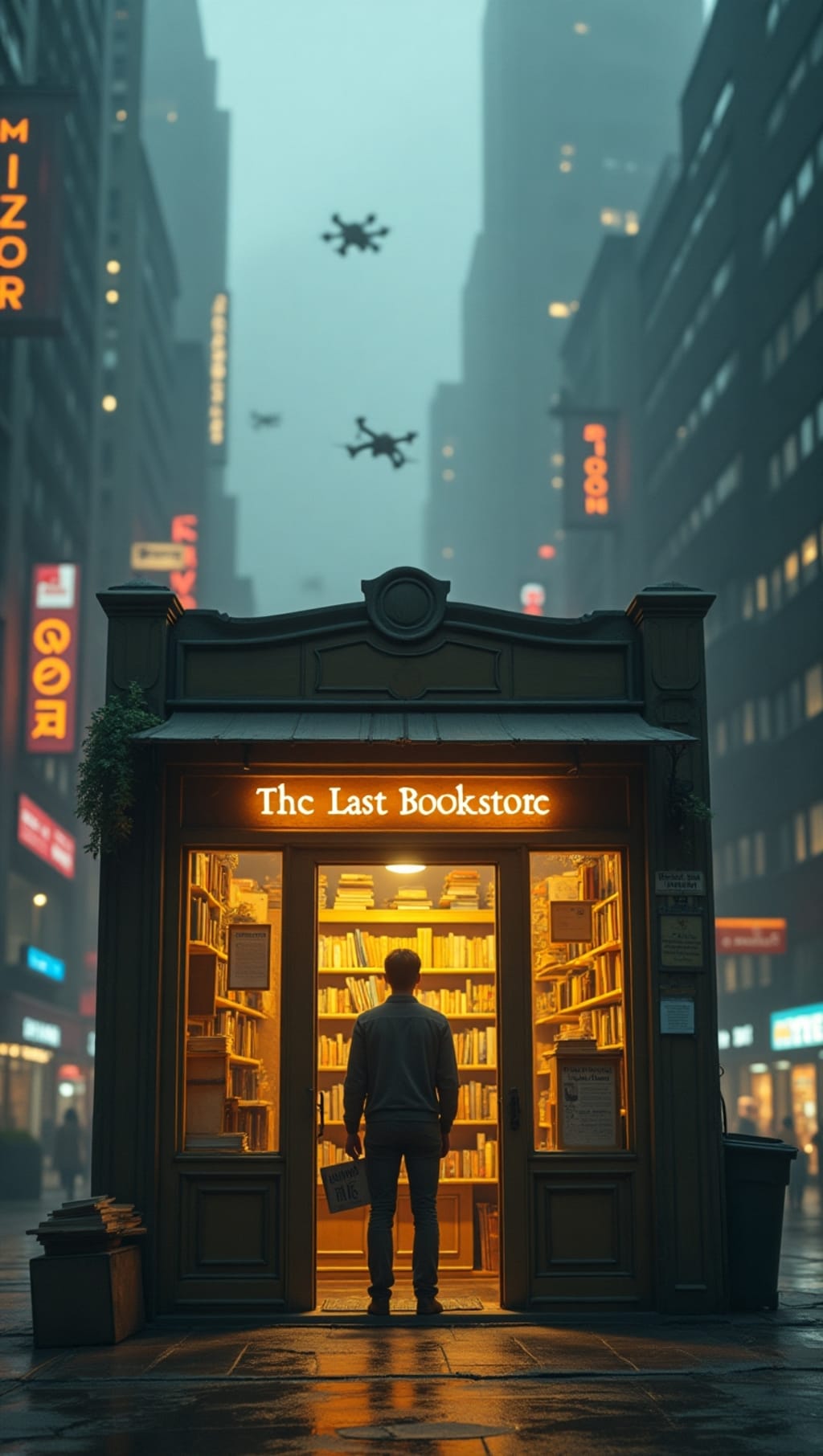
In the year 2192, reading had become an algorithmic act.
Every “book” was generated by AI—tailored, optimized, and predicted based on user behavior, emotional profiles, and attention span analytics. The art of writing had been long buried beneath neural networks and preference engines. Nobody wrote anymore. Why would they?
Lucan didn’t think of himself as a rebel. He was a data-sifter for the Global Story System (GSS), spending his days reviewing AI-generated narratives for emotional consistency and narrative flow. If a romance peaked too early or a hero failed to follow the archetype algorithm, Lucan flagged it for correction.
It was efficient. Clean. Predictable.
And utterly empty.
Lucan lived alone in Sector 14. His apartment was sterile—glass, steel, voice-activated everything. His free time was spent on neuro-holo feeds and “dynamic reading,” where the GSS streamed personalized stories into his thoughts. No paper. No pages. Just soft pulses of data and dopamine.
But sometimes, late at night, when the city dimmed and the feeds fell silent, Lucan felt a strange hollowness. A tug—like something was missing, or forgotten.
One foggy morning, while walking through the old industrial district—long since abandoned—Lucan’s scanner glitched. The street ahead showed no data, no feed signals. It was a blank zone.
Curious, he wandered in.
There, tucked between collapsed buildings and rusting towers, was a crooked sign, swinging in the wind:
“The Last Bookstore.”
He blinked. It wasn’t a digital overlay. It was real—wooden, weathered, and unmistakably out of place.
Inside, the air smelled of dust and time. Shelves lined every wall, packed with actual books—paper, ink, spines aged by human hands. The silence was sacred.
A bell jingled as he stepped in, and an old man looked up from behind a desk. He wore spectacles and a patchy cardigan. No neural port. No implants.
“You’re early,” the man said.
Lucan frowned. “What is this place?”
“A memory,” the man replied. “And perhaps, a mirror.”
Lucan picked up a worn copy of The Book Thief. The pages trembled in his hands. It felt… alive.
“These are illegal,” Lucan said.
The man nodded. “So were thoughts, once.”
Lucan wandered deeper, his fingers brushing titles he had never seen in the GSS catalog. No tracking chips. No predictive tags. Every book bore the chaos of humanity.
And then, he found it.
A book with his name on the spine.
He opened it—and gasped.
The first chapter described his life exactly. The lonely apartment. The neural feed job. Even the decision to walk into the fog that morning. Word for word.
“What is this?” he demanded.
“A story you were never meant to read,” the old man said.
Lucan kept turning pages. The book began to predict things he hadn’t done yet. Conversations. Feelings. A future he had never considered—meeting someone, questioning the GSS, risking exile to remember what it meant to feel.
“How is this possible?” Lucan asked.
The old man smiled. “This was written long before the world turned to code. Some humans still dreamed deeply enough to touch the thread of time.”
Lucan’s hands shook.
He had spent years feeding on machine-made stories—neatly wrapped plots built to soothe, not challenge. But these pages were messy, painful, beautiful. And they knew him.
“Why me?” he whispered.
“Because you still wonder,” the old man said. “That’s all it takes.”
Lucan returned the next day. And the next. Each visit, he found a new book that reflected a part of him he had long buried—books about grief, joy, rebellion, wonder. Books that didn't predict, but revealed.
One night, the old man handed him a blank journal.
“It’s your turn,” he said. “Write.”
Lucan stared at the empty pages.
“I don’t know how,” he said.
“You do,” the old man said gently. “You’ve just forgotten. But the ink remembers.”
The Global Story System noticed his withdrawal. Lucan’s neuro-feeds showed declining engagement. His behavior deviated from standard metrics.
They flagged him.
Agents came to his apartment. He was gone.
But in a hidden corner of the forgotten district, behind layers of fog and memory, The Last Bookstore remained. And now, one of its shelves held a new book:
“Unwritten: The Story of Lucan Grey”
Written by hand. Page by page. With messy words and raw truth.
Because in a post-digital world ruled by perfection, imperfection had become the last rebellion.
And stories—real stories—still mattered.
About the Creator
Zaheer Uddin Babar
Writer of love, life, and everything in between. Sharing stories that touch hearts, spark thoughts, and stay with you long after the last word. Explore romance, drama, emotion, and truth—all through the power of storytelling.
Keep reading
More stories from Zaheer Uddin Babar and writers in Futurism and other communities.
Blockchain and Cryptocurrencies in 2026: More than Just Investments – New Business Applications 🚀
When we hear “blockchain” or “cryptocurrencies,” most of us immediately think of Bitcoin, speculation, and volatile investments. 💰 However, focusing solely on price charts means missing the bigger picture. Blockchain is much more than digital coins; it is a fundamental shift in infrastructure. It is a technology that is radically changing how global companies operate, store sensitive data, and verify complex transactions without traditional intermediaries. 🏢
By Piotr Nowak2 days ago in Futurism



Comments
There are no comments for this story
Be the first to respond and start the conversation.