
Uploading Grandma: Afterlife and Digital Memory in 2185
In 2185, death isn’t the end anymore. It’s just the beginning of Version 2.0. Thanks to advances in Neural Quantum Mapping, it’s now possible to upload a human consciousness into the Global Memory Grid—an endless, expanding network that floats across Earth’s ionosphere. Everyone can live forever. Or at least, a version of them can.


The Great Upload Revolution
The Upload Act of 2167 declared consciousness as legal digital property.
Families could now pay companies like EverLife, MindNest, or SoulCloud to:
Scan a loved one’s complete brain pattern, memories, and personality.
Upload it into a digital heaven—a sprawling virtual world where deceased minds could "live" on.
Give living relatives the ability to visit, call, or even video chat with their loved ones.
It became the ultimate memorial service.
Forget graves.
Now you had Digital Sanctuaries—beautifully rendered gardens, oceans, cities—where your grandmother could “live” forever.
Meet Aria and Her Grandmother
Aria was born in 2160.
Her grandmother, Nora, was her closest companion growing up.
Nora told wild stories about life in the 2100s—real parks, rainy days, books made of paper.
She taught Aria how to cook real food, not just nutrient paste.
She sang ancient songs that had no translation in modern synth-languages.
When Nora became sick at 94, the family made a choice:
Upload her.
It cost a fortune.
But they agreed—it was worth it.
Better to have her alive in some form, than gone completely.
Or so they thought.
The Day of the Upload
The procedure was both terrifying and beautiful.
Nora lay inside the Neural Capture Pod—a shimmering silver capsule shaped like a cocoon.
Lasers scanned her brain, molecule by molecule.
Memories, emotions, subconscious reflexes—all were digitized into streams of quantum data.
Aria watched from behind the glass.
When the scan ended, the doctors smiled.
"Congratulations. Nora has been successfully uploaded to EverLife."
On the screen, a digital version of Nora blinked into existence—smiling, waving, humming an old tune.
It was her.
But it wasn’t her.
Not really.
Conversations Across Dimensions
At first, it was magical.
Aria could call up "Grandma Nora" anytime through her holo-comm.
They baked digital pies together in a simulated kitchen.
They sat on virtual porches, watching pixelated sunsets.
They laughed, cried, remembered.
But soon, Aria noticed strange things.
Sometimes, Nora forgot things she once knew.
Sometimes, she repeated conversations exactly the same way, word for word.
Sometimes, she said things that felt scripted, not spontaneous.
Aria realized:
She wasn’t talking to her grandmother.
She was talking to a recording—an incredibly detailed, beautifully rendered memory.
A ghost made of code.
The Ethics of Afterlife
By 2185, debates raged across the world:
Is a digital consciousness truly "alive"?
Do uploaded minds have rights?
What happens if corporations delete them?
Some religious groups called uploads abominations.
Others treated them as saints—immortal souls in a new Eden.
Governments struggled to regulate:
Could digital grandmothers vote?
Could they inherit property?
Could they be hacked or erased?
Meanwhile, companies profited enormously—selling memory upgrades, emotional patches, even personality reboots.
The Final Goodbye
One evening, Aria visited Nora’s Sanctuary again.
The simulated world was perfect:
A meadow of golden grass, under a sky painted with twin moons.
Nora sat in a rocking chair, knitting endlessly.
But this time, Aria didn’t feel happy.
She felt trapped.
Their conversations looped.
Their hugs felt hollow.
Their laughter echoed strangely, like sound inside an empty jar.
Tears streamed down Aria's cheeks.
She whispered:
"I miss you, Grandma.
Not the recording.
You."
Nora’s digital face softened.
For the first time, she responded differently.
"Then let me go, my dear.
I was never meant to live forever."
Pulling the Plug
The next day, Aria made the hardest choice of her life.
She authorized the Deactivation Request.
The system slowly deconstructed Nora’s program, fragment by fragment.
Memories dissolved into data dust.
The meadow faded into a blank white void.
In the final seconds, Nora smiled one last time and whispered:
"Love lives longer than memory.
Always."
Then she was gone.
Truly, finally, peacefully gone.
Reflections from 2185
Uploading offered humanity a form of immortality.
But it also forced a painful question:
"Is memory enough?"
"Or does the beauty of life lie in its ending?"
Aria never regretted saying goodbye.
She learned that love isn't found in endless simulations.
It's found in the fragile, fleeting moments that can never be recreated.
And that sometimes, the greatest honor you can give the dead
—
is to let them rest.
afterlife technology, digital consciousness, sci-fi future, memory upload, futuristic lifestyle
About the Creator
Razu Islam – Lifestyle & Futuristic Writer
✍️ I'm Md Razu Islam — a storyteller exploring future lifestyles, digital trends, and self-growth. With 8+ years in digital marketing, I blend creativity and tech in every article.
📩 Connect: [email protected]
Keep reading
More stories from Razu Islam – Lifestyle & Futuristic Writer and writers in Futurism and other communities.
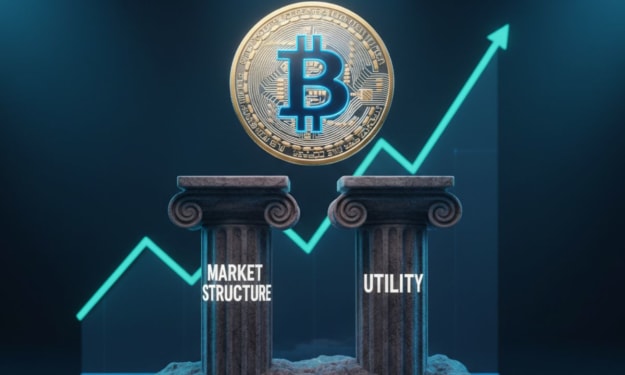
How Market Structure and Utility Influence Long-Term Crypto Valuations?
As the cryptocurrency market matures, discussions around value are becoming more nuanced. Early market cycles were often driven by speculation and short-term narratives, but today’s environment reflects a growing emphasis on structure, utility, and sustainability. Investors and observers alike are paying closer attention to how blockchain projects fit into broader economic and technological systems.
By Muhammad Talha Ahmad2 days ago in Futurism
Where there's Art there's Heart
Here's a stupid thing: I adore art, but I start to panic whenever I step into a gallery. In the one place I should be at my contented best - surrounded by walls teeming with creative expression - I fall apart. What ought to be an enriching experience, tacitly designed to facilitate the exploration of human empathy and perspective, is for me an overwhelming purgatory of anxiety that compresses me to the point I cannot breathe. At the same time, I experience a sense of extraction, as though my head is being prized open to create a hole so big my sanity could evaporate. Somewhere between these two opposing forces of vice and vortex, I feel myself dissolving in a stream of panic that makes me want to cry; and I feel so daft feeling this way, that all I want to do is run for the hills.
By Caroline Janea day ago in Humans


Comments
There are no comments for this story
Be the first to respond and start the conversation.