
What Happens If a Black Hole Enters Our Solar System
Space

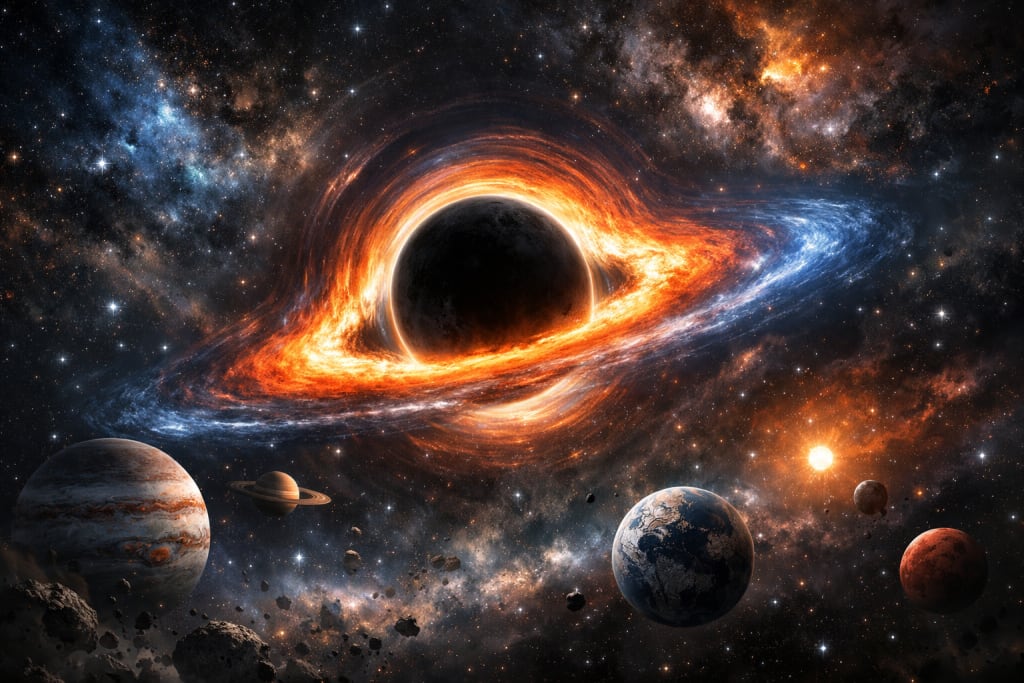
The universe is full of cosmic horrors that make even the most imaginative science fiction seem tame, and black holes rank among the most terrifying. These gravitational monsters, regions of spacetime where gravity is so intense that not even light can escape, have captured human imagination for decades. But what would actually happen if one of these cosmic predators wandered into our neighborhood?
The answer is both fascinating and deeply unsettling.
🌑 The Invisible Intruder Approaches
First, let's consider how we'd even know a black hole was approaching. Unlike stars, black holes don't emit light—they're literally invisible. We'd only detect one through its gravitational effects on nearby objects.
Astronomers might notice strange perturbations in the orbits of distant planets or comets, objects mysteriously accelerating toward an invisible point in space. By the time we definitively identified the threat, it might already be too late to do anything but watch the cosmic catastrophe unfold.
Size Matters: The Scale of Destruction
The outcome of such an encounter depends entirely on the black hole's size and trajectory.
Stellar-mass black holes, formed from collapsed stars, typically contain between three and several dozen times the mass of our Sun compressed into an impossibly small space.
Supermassive black holes, like those at galactic centers, can contain millions or even billions of solar masses.
Either variety entering our solar system would spell disaster, though the timescales and specific mechanisms of destruction would differ dramatically.
⚡ Gravitational Chaos Unleashed
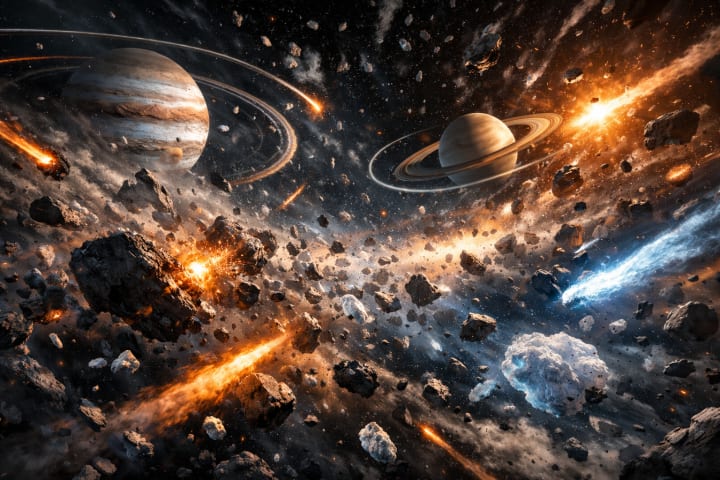
Let's imagine a stellar-mass black hole, perhaps ten times the Sun's mass, passing through the outer solar system. Long before it reached the inner planets, its gravitational influence would begin wreaking havoc on the carefully balanced orbital dance that has remained stable for billions of years.
The Outer Planets: First Casualties
The outer planets would feel the disruption first. Neptune, Uranus, Saturn, and Jupiter might find their orbits significantly altered. In a worst-case scenario, one or more of these gas giants could be ejected from the solar system entirely, flung into the dark void of interstellar space like cosmic pinballs.
Alternatively, they might be drawn into radically different orbits, potentially bringing them careening toward the inner solar system where Earth resides.
A Cosmic Shooting Gallery
The asteroid belt and Kuiper Belt would transform into shooting galleries of death. Countless rocky and icy bodies, their orbits destabilized by the black hole's gravity, would scatter in all directions. Some would plunge toward the Sun; others would be hurled outward into the darkness.
Earth would face a meteorite bombardment that would make the extinction event that killed the dinosaurs look like a light drizzle. The sky would literally be falling, with impacts occurring potentially hundreds of times per day.
🌍 Earth's Final Days
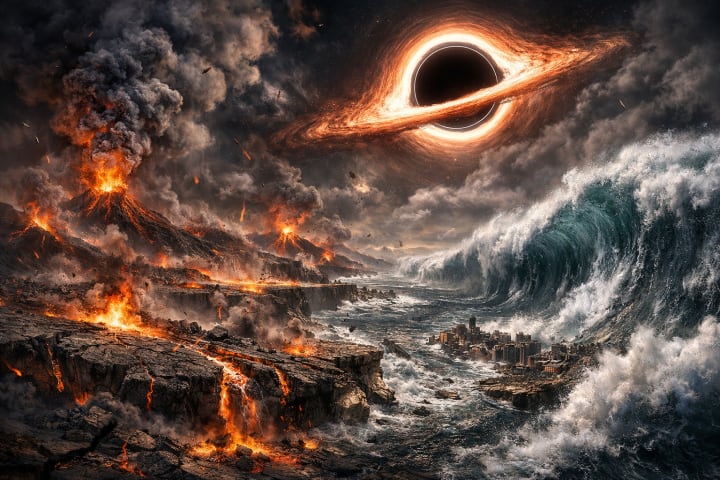
If the black hole's trajectory brought it anywhere near Earth, the consequences would escalate from catastrophic to apocalyptic. Even if it didn't directly consume our planet, the gravitational stress would be phenomenal.
Tidal Destruction
These extreme tidal forces would be unlike anything in Earth's history. Imagine the tides we experience from the Moon, but multiplied a thousandfold or more.
The consequences would be immediate and devastating:
- Worldwide earthquakes of unprecedented magnitude
- Massive volcanic eruptions across every tectonic boundary
- The Earth's crust buckling and cracking like an eggshell under pressure
- Entire mountain ranges collapsing while new ones thrust upward
- Colossal ocean waves, potentially kilometers high, sweeping across continents
These would be geological convulsions that would normally take millions of years, compressed into days or hours.
💀 The Ultimate Horror: Spaghettification
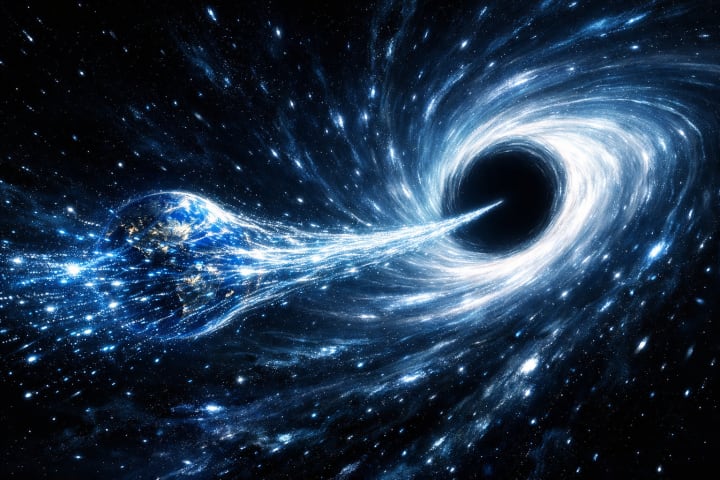
But the truly horrifying scenario involves a close encounter or direct hit. If Earth passed within the black hole's event horizon—the point of no return—we'd experience a phenomenon physicists call "spaghettification."
The gravitational gradient would become so steep that the side of Earth facing the black hole would experience vastly stronger pull than the opposite side. Our planet would be stretched like taffy, elongating into a thin stream of matter before being consumed entirely.
Picture it: the world you know, with all its mountains, oceans, cities, and life, reduced to a ribbon of atoms spiraling into an abyss of darkness.
The Sun's Demise
Even the Sun wouldn't be safe. If the black hole approached our star, it could strip away solar material, creating an accretion disk of superheated matter spiraling into the darkness.
This process would release tremendous amounts of X-rays and gamma rays, bathing the inner solar system in lethal radiation. Alternatively, the Sun's orbit might be altered, changing Earth's seasons dramatically or even ejecting Earth into interstellar space—a frozen, dark world wandering eternally through the void.
✨ A Glimmer of Hope in the Darkness
Is there any good news in this scenario?
The reality is that such an event is extraordinarily unlikely. Space is unimaginably vast, and black holes, despite their fearsome reputation, are relatively rare and tiny targets on cosmic scales. The nearest known black hole is thousands of light-years away, and the probability of one wandering into our solar system during humanity's existence is vanishingly small—far less likely than winning the lottery every day for a million years.
🌌 The Cosmic Perspective
Nevertheless, this thought experiment reminds us of our cosmic fragility. We exist in a delicate balance, dependent on stable orbits and a consistent Sun. The universe can be beautiful, but it's also indifferent to our survival, filled with forces beyond our control or comprehension.
A black hole entering our solar system would be the ultimate cosmic disaster—swift, merciless, and absolute.
It's a scenario that makes cherishing our pale blue dot all the more important.
In the grand cosmic lottery, we've already won by existing in this precise moment, on this stable planet, orbiting this reliable star. Perhaps the real lesson isn't to fear the black holes lurking in the darkness, but to appreciate the extraordinary fortune that has kept them at bay—and to make the most of the time we have in this safe, sunlit corner of the universe.
The universe is vast and filled with wonders and terrors in equal measure. While black holes may be the universe's ultimate predators, they also remind us that we're part of something far grander than ourselves—a cosmic story billions of years in the making.
About the Creator
Keep reading
More stories from Holianyk Ihor and writers in Futurism and other communities.
Planet Nine: The Ghost of the Solar System Nobody Can Find
We Lost a Planet. Then We Found a Bigger Mystery. In 2006, astronomers took something away from us. Pluto — that tiny, beloved frozen world at the edge of the solar system — was officially stripped of its planetary status by the International Astronomical Union. Too small. Too far. Too irregular. Just like that, our solar system shrank from nine planets to eight, and most of us shrugged and moved on.
By Holianyk Ihor2 days ago in Futurism
Syphilis Testing Market: Public Health Screening Programs, Rapid Testing & Market Growth
According to IMARC Group's latest research publication, The global syphilis testing market size reached USD 1.3 Billion in 2024. Looking forward, IMARC Group expects the market to reach USD 2.0 Billion by 2033, exhibiting a growth rate (CAGR) of 4.9% during 2025-2033.
By James Whitman2 days ago in Futurism
GCC Infrastructure Market Analysis: Industry Overview, Key Players & Future Outlook
According to IMARC Group's latest research publication, GCC Infrastructure market size reached USD 234.8 Billion in 2024. The market is projected to reach USD 386.7 Billion by 2033, exhibiting a growth rate (CAGR) of 5.3% during 2025-2033.
By Abhay Rajputa day ago in Futurism


Comments
There are no comments for this story
Be the first to respond and start the conversation.