
What is Technical Due Diligence?
Ensuring Technology Alignment with Business Value and Investment Goals
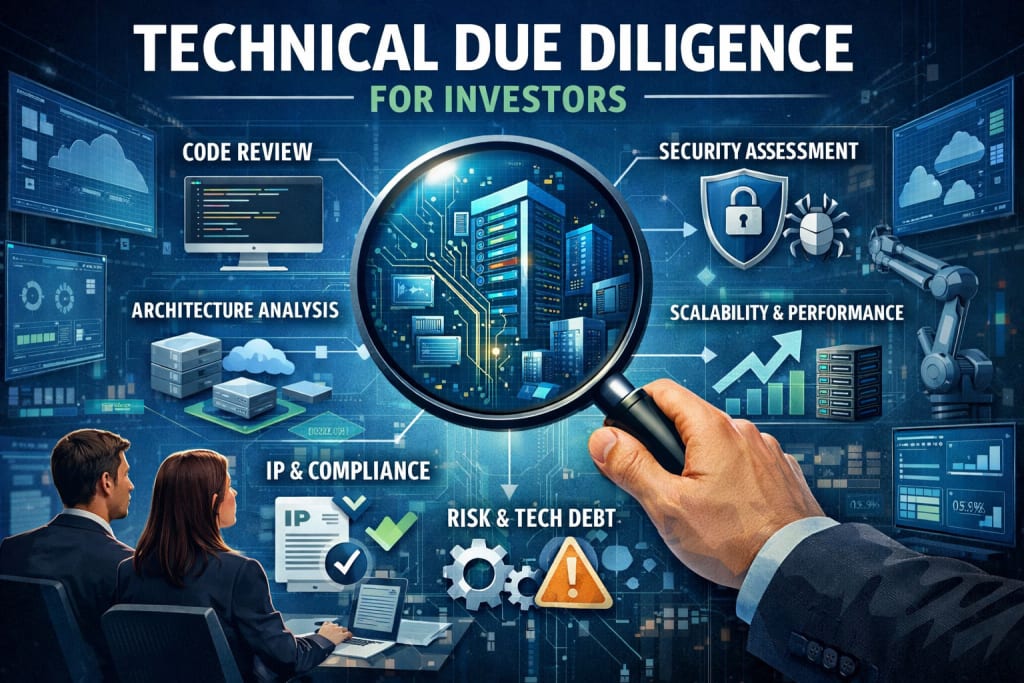
In the current digital-first world understanding the technological basis of a business is equally important as analysing the financial condition of its business. If you're an investor looking at the possibility of acquiring a company or a business preparing for the completion of a major deal the process of conducting technical due diligence acts as a way to determine the current condition of technology infrastructure, assets and capabilities.
Understanding the Fundamentals
Technical due diligence can be described as an exhaustive assessment process that evaluates the technological foundation of a company. The systematic evaluation extends beyond the surface to examine the quality of code as well as infrastructure scalability, the security of protocols and technical debt and the overall structure which powers the business processes. Consider it an in-depth health check of the company's technology ecosystem.
In the eyes of investors, this method is vital for investors. Technical due diligence of investors offers crucial insights that directly affect the valuation process, risk assessment and strategies for integration after acquisition. Without this assessment it is possible for investors to inherit outdated systems, security flaws or platforms that are unable to grow with their goals.
Key Components of the Assessment
A thorough technical review covers many important areas. The evaluation typically begins with an analysis of the infrastructure and architecture and assessing whether the current technology can cope with expected growth, and if they're based on modern maintenance-friendly frameworks. Security reviews identify weaknesses that could expose businesses to data breaches and violation of the law.
Technical debt and code quality get a close look. The legacy code or poorly documented systems can drastically add costs post acquisition and impede the pace of innovation. The capabilities of the development team as well as workflows and documentation methods also come under the scrutiny of a third party, as they are the most important factors that influence the long-term success of a company.
Why Professional Expertise Matters
While IT departments within the company have significant expertise, technology due diligence consulting offers specialized knowledge and independent perspective. The experts have examined numerous technology stacks across various industries and can quickly detect red flags that could be missed by untrained examiners.
These experts are aware of the technical nuances as well as business implications. They translate technical knowledge into useful insights that help negotiations, investment decisions and integration plans. Their independence also guarantees impartial analyses free of internal opinions or prejudices.
The Investor's Perspective
Due diligence on technical issues for Investors has multiple strategic functions. It first validates or rebuts the company's claims about technology and its roadmap. The second is to quantify technological risks that could impact the value of a deal or its structure. Thirdly, it pinpoints opportunities for value creation via technological advancements or consolidation.
Investors who do not take this critical process often have unpleasant surprises following the closing of deals. Undiscovered technical debt, incompatible systems or weak cybersecurity could cause a decline in expected returns or even require unanticipated capital injections.
Making Informed Decisions
The information gained through technological evaluation help stakeholders make educated decisions. For investors, these findings may affect negotiations on purchase prices or inform the structure of earnouts or help shape post-acquisition strategies for technology. For businesses being analysed this process usually reveals potential for improvement and also validates the technology investment.
As businesses become increasingly technology-dependent, the importance of rigorous technical evaluation continues to grow. When you're investing in promising new venture, purchasing one of your competitors, or planning your business for an investing, knowing what due diligence is and how to engage experts with expertise to carry it out has become crucial for a successful transaction in today's business environment.
About the Creator
Keep reading
More stories from writers in Futurism and other communities.
AI-Driven Data Mining in Healthcare and Its Role in Modern EMR-Driven Patient Care
Healthcare systems generate massive volumes of data every single day, from electronic medical records and diagnostic images to wearable device metrics and patient engagement apps. Making sense of this data is no longer optional. Data mining in healthcare has become a foundational capability for organizations that want to improve patient outcomes, reduce operational inefficiencies, and enable evidence-based decision-making.
By Steve Waugh4 days ago in Futurism
Advances in Genetic Engineering Driving the Global Recombinant DNA Technology Market
Rising demand for advanced therapeutics, vaccines, and personalized medicine is driving growth in the recombinant DNA technology market. Expanding applications in biotechnology, pharmaceuticals, and agriculture support adoption. According to IMARC Group's latest research publication, The global recombinant DNA technology market size reached USD 796.2 Billion in 2024. Looking forward, IMARC Group expects the market to reach USD 1,143.4 Billion by 2033, exhibiting a growth rate (CAGR) of 3.9% during 2025-2033.
By Michael Richard3 days ago in Futurism
Our Song
Evening has given way to night. Gently, I settle next to you on the comfortable, old love seat and reach for your hand. You snatch it away, again. It cuts me to the quick, but I hide the pain, understanding that the reaction is but part of your demented state. Since the accident, your presence here in our cozy home has been clouded by a haze I can't see. Nevertheless, I feel the frigidity of your expressions and it serves as an excruciating reminder of the immeasurable distance between us.
By Dana Crandell2 days ago in Fiction




Comments
There are no comments for this story
Be the first to respond and start the conversation.