
Wi-Fi Chipset Market Outlook: Smart Devices, Edge Computing & Industry Forecast to 2033
The impact of smart speakers and IoT-enabled audio devices driving automated background music deployment across connected commercial spaces and intelligent building ecosystems.

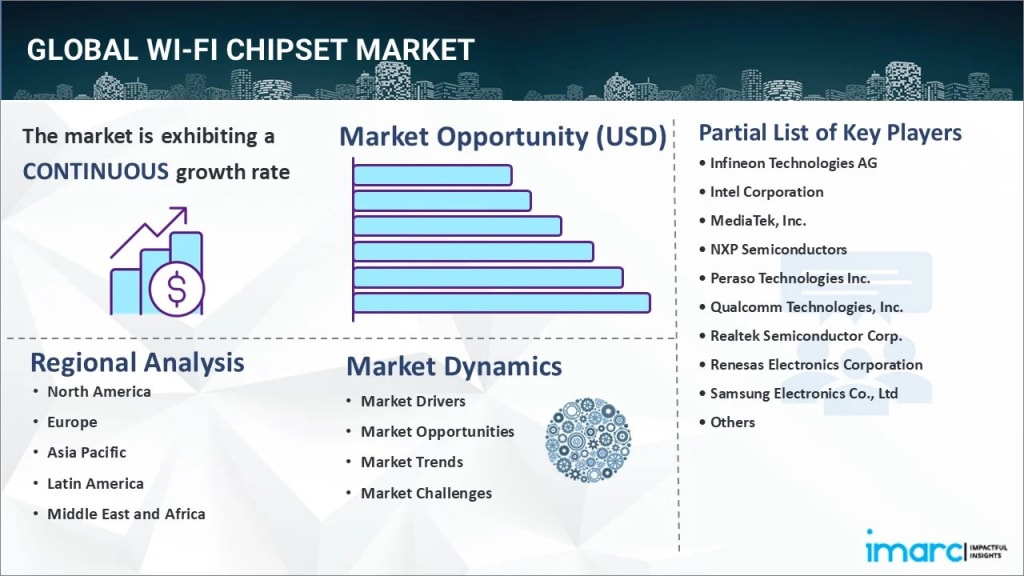
The surge in connected devices, rapid IoT expansion, and growing demand for high-speed wireless connectivity are propelling the Wi-Fi chipset market, driven by advancements in Wi-Fi 6, 6E, and 7 technologies alongside accelerating deployment of smart home devices and enterprise networking solutions. According to IMARC Group's latest data, the global Wi-Fi chipset market size was valued at USD 20.5 Billion in 2024. Looking forward, IMARC Group estimates the market to reach USD 26.5 Billion by 2033, exhibiting a CAGR of 2.74% from 2025-2033.
Wi-Fi chipsets enable wireless networking across billions of devices worldwide, from smartphones and laptops to routers, smart home appliances, and industrial IoT equipment. The market continues to expand as consumers and enterprises demand faster speeds, lower latency, and more reliable connections to support data-intensive applications like 4K/8K streaming, cloud gaming, augmented reality, and remote work. The rollout of next-generation standards—particularly Wi-Fi 6E with access to 6 GHz spectrum and the emerging Wi-Fi 7 technology—is reshaping the competitive landscape as major chipset vendors race to deliver solutions that can handle exponentially growing data traffic while maintaining power efficiency and security.
Wi-Fi Chipset Market Growth Drivers:
- IoT and Smart Home Device Proliferation
The explosion of Internet of Things devices is fundamentally reshaping Wi-Fi chipset demand. Industry data shows that 1.4 billion smart home devices shipped last year alone, with American households now averaging 17-21 connected devices each. Everything from refrigerators and thermostats to security cameras and voice assistants requires embedded Wi-Fi connectivity, creating massive opportunities for chipset manufacturers. The shift isn't just residential—industrial IoT deployments for automation, robotics, and smart manufacturing are equally aggressive. What makes this particularly compelling is that these devices need always-on connectivity with minimal power consumption, pushing chipset vendors to innovate around energy efficiency while maintaining reliable performance across diverse operating environments and network conditions.
- Rapid Wi-Fi 6 and Wi-Fi 7 Technology Advancement
Enterprise adoption of Wi-Fi 6 and Wi-Fi 7 is accelerating faster than previous generations. Recent industry tracking reveals that Wi-Fi 7 already accounts for over 31% of dependent access point revenues in enterprise markets, up from just 21% one quarter earlier. The technology delivers tangible benefits: organizations report up to 2× higher mid-range throughput, 2× wider IoT coverage, and up to 6× lower latency compared to Wi-Fi 6. More than 1,230 Wi-Fi 7 devices have been released since certification began, including 500+ personal computing devices and 169 smartphones. The compelling performance gains in real-world deployments not just theoretical benchmarks are driving corporate network infrastructure upgrades across healthcare facilities implementing telemedicine, manufacturing plants deploying automation systems, and office environments supporting hybrid work arrangements.
- Enterprise Digital Transformation and Network Modernization
Businesses worldwide are investing heavily in wireless infrastructure to enable flexible work environments and digital operations. The enterprise WLAN market grew 7.8% year-over-year in the third quarter of the most recent tracking period, with particularly strong performance in Europe (12.8% growth) and steady expansion in Americas and Asia-Pacific. Companies are prioritizing WLAN systems that integrate seamlessly with broader networking platforms, incorporate AI-powered management capabilities, and support increasingly demanding applications. The driver isn't just about speed it's about reliability and capacity. Modern enterprises need networks that can simultaneously handle video conferencing, cloud application access, IoT sensor data streams, and security systems without degradation.
Wi-Fi Chipset Market Trends:
- Early Wi-Fi 8 Development and Multi-AP Coordination
Major chipset manufacturers are already sampling Wi-Fi 8 platforms despite official ratification not expected until later this decade. Broadcom, MediaTek, and Qualcomm have all unveiled Wi-Fi 8 silicon emphasizing reliability and coordination rather than pure speed increases. The focus is on multi-AP coordination features like coordinated beamforming, spatial reuse, and multi-AP scheduling that allow access points to work together instead of competing for airspace. This represents a philosophical shift: instead of just pumping more data through wider channels, Wi-Fi 8 tackles real-world problems like interference in dense deployments, seamless roaming between access points, and predictable quality of service.
- AI Integration and Edge Computing in Chipset Architectures
Chipset vendors are embedding AI capabilities directly into Wi-Fi silicon to enable intelligent network optimization and support the explosion of AI applications. Industry projections indicate AI-related traffic will reach 15-20% of total Internet traffic, creating demand for chipsets that can handle this workload efficiently. The latest platforms combine general-purpose compute, on-device AI inference, networking offload, and security acceleration in single packages. This integration enables features like adaptive beamforming that dynamically adjusts signal patterns based on real-time conditions, predictive network management that anticipates congestion, and automated quality of service adjustments. The trend extends beyond consumer devices automotive manufacturers are integrating advanced Wi-Fi chipsets with AI capabilities for vehicle connectivity and driver-assistance systems, while smart retail deployments use AI-enhanced connectivity to power inventory management, customer analytics, and automated checkout systems.
- Power Efficiency and Battery Life Optimization
As mobile devices and IoT sensors proliferate, power consumption has become a critical differentiator for Wi-Fi chipsets. Manufacturers are developing energy-efficient architectures that extend battery life without sacrificing performance. Integrated combo chips that combine Wi-Fi with Bluetooth and other protocols in system-on-chip designs are gaining traction because they reduce overall power draw through consolidated processing. The latest dual-band Wi-Fi 8 radios prioritize power optimization alongside connectivity improvements. This trend matters especially for battery-powered devices like smartphones, tablets, wireless earbuds, smart watches, and the billions of IoT sensors deployed in industrial settings, agriculture, and building automation.
Recent News and Developments in Wi-Fi Chipset Market
- January 2026: MediaTek introduced the Filogic 8000 family at CES 2026, becoming one of the first major vendors to announce Wi-Fi 8 chipsets. The platform emphasizes ultra-reliable connectivity across gateways, enterprise access points, and client devices, with demonstrations showcasing multi-AP coordination features including coordinated beamforming and spatial reuse to improve performance in dense environments with simultaneous users. First customer shipments are expected later this year, with partnerships including Deutsche Telekom, Airties, SoftAtHome, and Zyxel.
- January 2026: Broadcom expanded its Wi-Fi 8 roadmap at CES 2026 with the launch of the BCM4918 accelerated processing unit (APU) and two new dual-band devices (BCM6714 and BCM6719). The announcements build on Broadcom's October 2025 introduction of its first Wi-Fi 8 product and represent the company's strategy to define next-generation wireless performance by embedding compute acceleration, advanced networking, and security directly into edge silicon to support AI-driven connectivity use cases.
- December 2025: Qualcomm announced plans to unveil a complete Wi-Fi 8 generation platform portfolio at Mobile World Congress Barcelona in the coming weeks, focusing on delivering sophisticated and reliable connectivity needed to support agentic AI applications. The company highlighted that AI-related traffic is expected to significantly increase in coming years, creating demand for advanced wireless infrastructure across residential, enterprise, and industrial deployments.
Note: If you require specific details, data, or insights that are not currently included in the scope of this report, we are happy to accommodate your request. As part of our customization service, we will gather and provide the additional information you need, tailored to your specific requirements. Please let us know your exact needs, and we will ensure the report is updated accordingly to meet your expectations.
About the Creator
Andrew Sullivan
Hello, I’m Andrew Sullivan. I have over 9+ years of experience as a market research specialist.
Keep reading
More stories from Andrew Sullivan and writers in Futurism and other communities.
Architectural Hardware Market Demand: Focus on Safety, Durability & Industry Outlook to 2034
Growing demand from construction and infrastructure sectors, rising adoption of smart architectural hardware solutions, and increasing preference for contemporary design aesthetics are driving architectural hardware market expansion, supported by technological innovations and robust growth in residential and commercial development projects. According to IMARC Group's latest data, the global architectural hardware market size reached USD 19.5 Billion in 2024. Looking forward, IMARC Group estimates the market to reach USD 27.8 Billion by 2033, exhibiting a CAGR of 3.90% from 2026-2034.
By Andrew Sullivan2 days ago in Futurism
Refurbished Retail Market Outlook: Affordable Consumer Electronics Demand and Circular Economy Growth Opportunities
According to IMARC Group's latest research publication, The global refurbished retail market size reached USD 151.5 Billion in 2025. Looking forward, IMARC Group expects the market to reach USD 365.2 Billion by 2034, exhibiting a growth rate (CAGR) of 10.27% during 2026-2034.
By James Whitmana day ago in Futurism
How Long-Term Forecasts are Formed in the Cryptocurrency Market?
The cryptocurrency market has matured into a complex financial environment where long-term forecasting requires more than short-term price trends. Early market behavior was often driven by speculation and hype, but today’s digital asset ecosystem is shaped by infrastructure development, real-world adoption, regulatory clarity, and macroeconomic conditions.
By Muhammad Irfan Afzalless than a minute ago in Futurism




Comments
There are no comments for this story
Be the first to respond and start the conversation.