
Work, jobs & skills-shift
Adapting to an AI-Powered World: How Automation Is Transforming Careers and the Skills We Need to Thrive

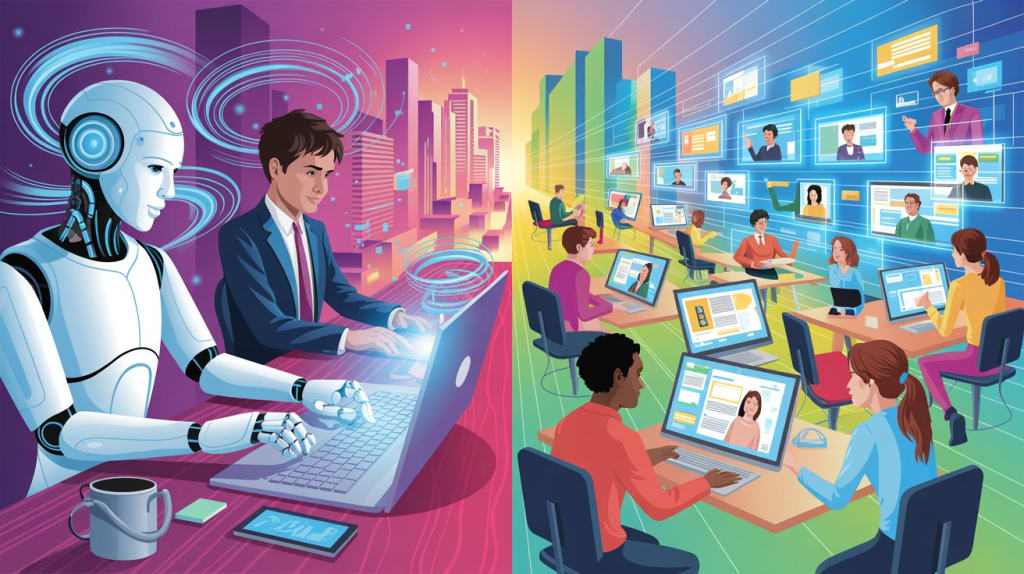
In the past decade, the world of work has transformed faster than at any other point in human history. Artificial intelligence (AI), automation, and digital connectivity are reshaping not only what we do but also how, when, and where we do it. The once-stable concept of a lifelong career in a single industry has been replaced by a constant cycle of learning, adapting, and evolving. As machines become smarter and global economies more interconnected, the future of work demands something new — agility, creativity, and emotional intelligence that technology cannot easily replicate.
The AI Revolution and Its Ripple Effects
AI is no longer a futuristic fantasy; it’s now a core driver of productivity and innovation. From factories to finance, from healthcare to education, intelligent systems are performing tasks that once required human expertise.
Automation has already replaced many repetitive or routine jobs, particularly in manufacturing, data entry, and logistics. But this doesn’t mean humans are becoming obsolete. Instead, AI is creating new categories of employment — jobs that blend human intuition with machine precision. For instance, while robots handle assembly lines, humans design, program, and maintain those robots. Similarly, while AI tools generate reports or summarize data, human professionals interpret those insights and make strategic decisions.
This transformation isn’t just about technology replacing people — it’s about humans evolving alongside technology.
From Hard Skills to Human Skills
In the AI-driven era, technical skills remain important — but they are no longer enough. The real power lies in human-centered abilities: creativity, communication, empathy, and adaptability. Machines can process data, but they cannot replicate human imagination or emotional intelligence.
Companies are increasingly valuing these “soft” skills because they enable collaboration, leadership, and innovation in environments where humans and AI coexist. The ability to think critically, solve complex problems, and manage change is becoming more valuable than memorizing any one programming language or system.
For example:
Emotional Intelligence helps leaders guide diverse teams through uncertainty.
Creativity drives innovation in industries facing disruption.
Adaptability allows workers to pivot between roles and industries as technology evolves.
As automation takes over repetitive tasks, the new economy rewards people who can think differently, connect meaningfully, and learn continuously.
Reskilling: The New Lifeline
The phrase “lifelong learning” has become more than a slogan — it’s a survival strategy. According to recent studies, more than half of all workers worldwide will need to learn new skills by 2030 due to technological change.
Governments, educational institutions, and businesses are all recognizing this urgent need for reskilling and upskilling. Companies like Amazon, Google, and Microsoft are investing billions in retraining programs for their employees, preparing them for roles in data science, cybersecurity, AI management, and cloud computing.
But this movement isn’t limited to big corporations. Online education platforms like Coursera, Udemy, and LinkedIn Learning are empowering millions of individuals to take control of their career growth. A single motivated worker can now access world-class training from home, learning everything from coding to creative design, often for free or at minimal cost.
The future belongs to those who understand that education doesn’t end with graduation — it’s an ongoing process.
The Rise of Hybrid Work
Another major shift reshaping the modern job landscape is the rise of hybrid and remote work. Accelerated by the global pandemic, this model has become a permanent fixture in many organizations.
Employees are no longer confined to offices; they work from home, coworking spaces, or even different continents. This has democratized access to opportunities — a skilled designer in Pakistan can now work for a company in New York, while an AI engineer in Kenya can collaborate with teams in Tokyo.
However, this flexibility comes with challenges: maintaining work-life balance, building company culture remotely, and managing productivity across time zones. To thrive in hybrid settings, professionals must develop digital communication skills, time management strategies, and self-discipline.
The hybrid era also demands new leadership models — managers must focus less on micromanagement and more on trust, outcomes, and empathy.
Challenges in the Transition
While the digital revolution offers enormous opportunities, it also poses serious challenges. Millions of workers, particularly in developing economies, risk being left behind if they lack access to education, internet connectivity, or retraining resources.
The fear of job loss due to automation can also lead to social anxiety and resistance to change. Policymakers must therefore balance innovation with inclusion — ensuring that technology benefits everyone, not just the privileged few.
Equally important is the ethical dimension of AI. As machines begin to make decisions affecting human lives — from hiring to healthcare — societies must establish frameworks that ensure fairness, transparency, and accountability.
The Future Workforce: Humans and Machines Together
The workplace of tomorrow won’t be dominated by robots — it will be co-created by humans and machines working side by side.
Imagine a hospital where AI assists doctors by predicting diseases early, a classroom where digital tutors personalize education for each student, or an architecture firm where generative design software turns creative sketches into sustainable building plans. These are not distant dreams; they are the new reality of work in progress.
In this world, success will not depend on competing with technology but on collaborating with it. Those who can harness AI tools, understand data, and translate insights into action will lead the future.
Conclusion: The Human Advantage
As the global workforce undergoes this monumental skills shift, one truth stands out: the future belongs to the adaptable.
Technology will continue to evolve, industries will continue to transform, and jobs will come and go. But the qualities that define humanity — creativity, empathy, resilience, and curiosity — will always remain irreplaceable.
We are not facing the end of work. We are entering a new era of possibility — one where humans and machines together can build a smarter, fairer, and more meaningful world of work.
About the Creator
[email protected]
Living life, one smile at a time 😎
Coffee lover ☕ Dreamer 🌟"
Just vibin’ and creating memories ✌
Curious mind, happy heart 💛
Chasing sunsets and good vibes 🌅
.
Keep reading
More stories from [email protected] and writers in Futurism and other communities.
UAE Residential Real Estate Market Analysis: Industry Overview, Key Players & Future Outlook
According to IMARC Group's latest research publication, UAE residential real estate market size reached USD 19.63 Billion in 2025. The market is projected to reach USD 35.54 Billion by 2034, exhibiting a growth rate of 6.82% during 2026-2034. Condominiums and apartments dominate with 73% market share, while Dubai leads regionally with 44% share.
By Abhay Rajput3 days ago in Futurism
The cause of mysterious quick radio bursts could be unexpected.
Among the most peculiar signals we detect from space are fast radio bursts. They can outshine entire galaxies in radio light during their brief duration of a few thousandths of a second. One major question persisted for years: what kind of entity could produce something so loud and quick, sometimes repeatedly?
By Francis Dami7 days ago in Futurism


Comments
There are no comments for this story
Be the first to respond and start the conversation.