
YouTuber Steve Mould's "Weird Chain Theory" Could Be Tested in Space by NASA
Steve Mould, a YouTuber, discovered an odd effect with chains. In order to test it in space, astronaut Don Pettit was called upon.

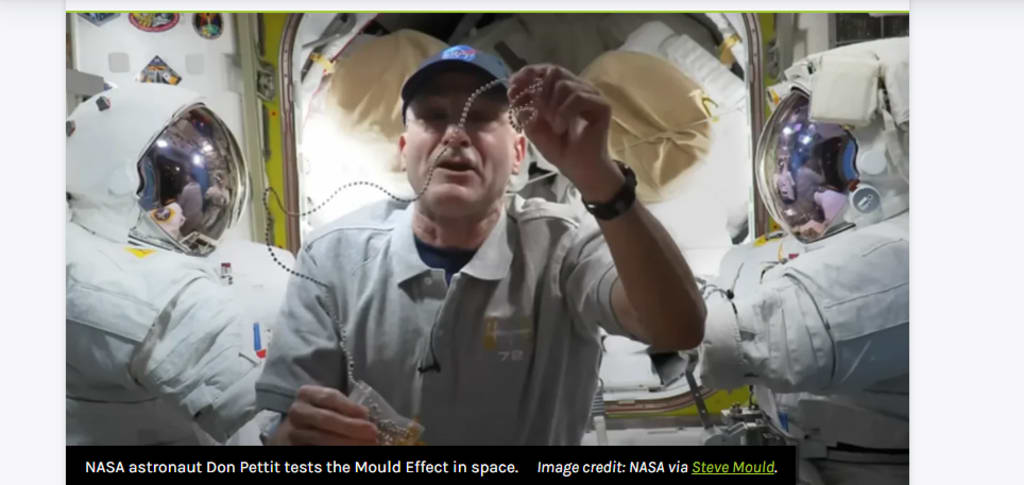
YouTuber Steve Mould has enlisted the assistance of NASA astronaut Don Pettit to test his "weird chain theory" in space, which is the last step in the process.
The "chain fountain" is an unresolved physics problem that was made public in 2013 by YouTuber and science communicator Steve Mould. The effect is peculiar to observe and is frequently called the "Mould effect" because of his work on it. Put simply, pull one end of a long chain out of a container and let it drop to the ground. Now observe how the entire chain appears to leap out of the window and then descend to the ground.
Even though Mould discovered the effect on his own, it was previously known about, but inexplicable. Since Mould popularised the effect, Mehdi Sadaghdar of the YouTube channel ElectroBOOM and a number of scholarly papers have tried to explain it. Additionally, Mould holds the title for the largest chain fountain.
The effect's most perplexing aspect is how the chain seems to rise out of the glass before beginning its descent.
"Motivated by the fact that the chain has a maximum local curvature, and the fact that the phenomenon does not happen with a chain that does not have this maximum bending curvature, the chain was modelled as a sequence of freely joined rods," according to a research published in 2016.
"A rod has a tendency to rotate around its centre of mass when it is pulled from one end, the end that is connected to the moving portion of the chain. As a result, the other end will descend towards the bead surface and kick the bead pile. The beads are finally pushed upward by a response force to this kick.
After much (friendly) debate and experiments against ElectroBOOM (and additional study by others), Mould's theory (see above for the entire explanation, and an astounding chain fountain) is widely believed to be right.
In his most recent video, which was partially filmed in space, Mould explains, "In a fountain, the chain rises above the pot because of an extra upward force coming from the pot." However, how powerful must that force be? It must be able to support the weight of this chain arc, which would naturally fall due to gravity. That's it. All you need is that.
Unfortunately, Mould wanted gravity to vanish in order to verify his theory. Herein lies the role of astronaut Don Pettit of NASA. After watching Mould's movies, Pettit expressed interest in testing the behaviour of chains on the ISS.
The calculations show that the ark is completely unaffected by the chain's yanking. The ark was being tugged downward at one end, but if gravity didn't play a role, it would be stuck there in space. Or that's the theory, anyway," Mould clarified. Our goal is to test that. We wish to test the hypothesis that, in the absence of an outside force, such as gravity, a chain travelling at a constant speed will flow through its own shape.
During a phone conversation with Mould, Pettit tried pulling on the chain to see if it actually did flow through its own structure, confirming Mould's theory, or if it did anything different. According to Pettit, chains move around like molecules in microgravity, making it impossible to force them to stay motionless.
Instead, Mould proposed that they loop a chain and then extend it to form a rectangle. The longer sides of the chain, which resembled a rectangle, could then be grabbed by Pettit and moved, pulling the top one to the right and the bottom left, for example. If he was right, instead of spreading out into a circle as you might anticipate, the chain should flow through that rectangular shape.
The ISS was out of communication satellite range, therefore the two were constrained by an unfavourable configuration. They did, however, seem to start chains moving that took their own shape before the unofficial experiment was over, which seemed to support Mould's theory of the effect.
Sadaghdar would not have to humiliate himself by creating another debunk video. "It was a great demonstration seeing it pass through the same path through the loop and your explanation about why it would eventually turn into a full circle due to friction was pretty adequate," he added.
"But you didn't really show whether the path would still be the same if the chain weren't in a loop. While another simulation could be enjoyable, a spacewalk involving dragging 100m of chain into space would be preferable. Take action.
About the Creator
Keep reading
More stories from Francis Dami and writers in Futurism and other communities.
How do your cells decide which bodily parts to construct? Innovative new technology is assisting us in learning
In just a few days, a single fertilised egg can produce blood, brain, and skin cells. However, how do the earliest cells decide which bodily components to construct? How come certain cells know how to make kidneys while others start making skin right away?
By Francis Dami8 months ago in Futurism
Australia Housing Market: Demand Dynamics, Affordability Challenges & Construction Activity
According to IMARC Group, the Australia housing market was valued at USD 150.95 Billion in 2025 and is projected to reach USD 182.34 Billion by 2034, growing at a compound annual growth rate (CAGR) of 2.04% during 2026–2034. While the growth rate reflects moderate expansion, the housing sector remains one of the most economically and socially significant industries across Australia. Housing demand, affordability pressures and construction cycles are deeply interconnected with population growth, migration patterns, interest rate movements and government policy frameworks. As Australia navigates supply constraints, urban expansion and evolving lifestyle preferences, the housing market continues to serve as both a cornerstone of household wealth and a central driver of construction activity.
By Shrestha Roy6 days ago in Futurism
Hair Shampoo Market Trends: Ingredient Innovation, Premiumization & Forecast to 2034
Rising environmental pollution, evolving consumer lifestyles, and growing awareness around scalp health are fueling demand for hair shampoos globally, supported by the shift toward herbal and natural formulations, rapid e-commerce expansion, and continuous product innovation targeting specific hair concerns. According to IMARC Group’s latest data, The global hair shampoo market size reached USD 38.0 Billion in 2025. Looking forward, IMARC Group expects the market to reach USD 48.0 Billion by 2034, exhibiting a CAGR of 2.62% during 2026-2034.
By Andrew Sullivanabout 19 hours ago in Futurism
The Cave Part 6
If you have ever heard a tale about yourself that you cannot remember and doubtless think is made up, you will know how I felt when Tharkin related all that the eagle had seen of me before my memories were scattered. Of far distances and traveling companions that I did not recall, camping out under the stars and making our way to the mountains with deliberate purpose. The great bird had lost contact with my party once we entered the forests, and the seven other members were not seen again by him or his brethren since.
By Jamye Sharp3 days ago in Chapters




Comments
There are no comments for this story
Be the first to respond and start the conversation.