
5 Critical Mistakes to Avoid When Hiring for Mobile App Development in Charlotte
Hiring a Development Team Is Not a Transaction — It Is a Strategic Decision That Shapes the Entire Product Journey

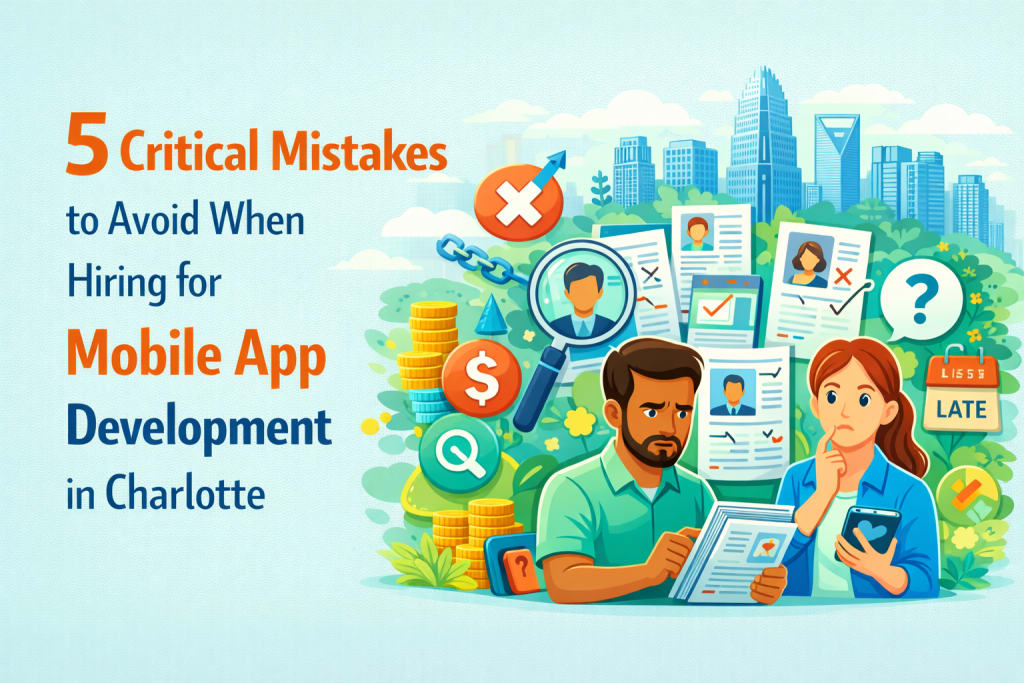
The moment companies begin searching for developers, conversations often focus on tools, timelines, and budgets. Yet hiring decisions rarely succeed or fail because of technology alone. The real challenges emerge from mismatched expectations, unclear product vision, and misunderstanding how regional ecosystems influence collaboration.
Charlotte’s growing technology environment offers new opportunities for companies building digital products. At the same time, hiring within an emerging ecosystem requires awareness of local dynamics, talent trends, and industry expectations. Founders who approach hiring purely as a cost comparison exercise often discover hidden risks later in development.
Avoiding common mistakes during the hiring process can significantly influence project outcomes, long-term sustainability, and team cohesion.
Mistake #1: Treating Hiring as a Short-Term Cost Decision Instead of a Long-Term Partnership
One of the most common hiring errors involves prioritizing hourly rates over strategic alignment. Companies frequently compare quotes without examining how teams approach planning, communication, and product thinking.
Research from the Project Management Institute suggests that unclear project goals contribute to a large percentage of budget overruns. Developers who understand business objectives can anticipate challenges earlier, reducing rework.
In Charlotte’s ecosystem, many developers come from enterprise backgrounds where structured workflows and documentation play important roles. Companies unfamiliar with this approach may initially perceive it as slower or more expensive, yet these processes often reduce long-term risk.
Viewing hiring as a partnership rather than a transaction helps align expectations around timelines, responsibilities, and decision-making authority.
Mistake #2: Ignoring Industry Experience Relevant to Charlotte’s Economic Landscape
Charlotte’s economy includes strong representation from finance, healthcare, logistics, and energy sectors. Hiring teams without familiarity with these industries can create gaps between technical execution and real-world requirements.
For example:
- Fintech apps may require secure authentication workflows aligned with regulatory expectations.
- Healthcare platforms must address privacy considerations from the earliest stages.
- Logistics applications depend on real-time data processing and operational reliability.
Industry research indicates that domain knowledge often accelerates development by reducing misunderstandings during requirement gathering.
Companies building products aligned with local industries may benefit from hiring developers familiar with enterprise environments and compliance considerations.
Mistake #3: Overlooking Communication Structure in Hybrid or Distributed Teams
Remote collaboration has become standard practice, allowing companies to assemble distributed teams across multiple locations. While this approach expands access to talent, it introduces new communication challenges.
Successful remote development requires:
- Clear documentation standards.
- Defined meeting rhythms.
- Transparent decision-making processes.
Studies examining remote team performance suggest that communication clarity often outweighs technical skill when determining project success.
Charlotte-based companies frequently combine local leadership with remote engineering support. Founders should evaluate how teams handle asynchronous communication, time zone differences, and feedback loops before making hiring decisions.
Without strong communication systems, even highly skilled teams may struggle to maintain momentum.
Mistake #4: Focusing on Technical Skills While Ignoring Product Thinking
Technical proficiency remains essential, yet building a successful app involves more than coding. Developers capable of understanding user behavior, market positioning, and long-term product goals contribute significantly to project success.
User experience research plays a major role in conversion rates and retention metrics. Teams prioritizing product thinking often ask questions about:
- Target audience behavior.
- Core user journeys.
- Feature prioritization based on business goals.
Research from Nielsen Norman Group highlights how early user testing can reduce costly redesign cycles later in development.
Hiring teams that think beyond technical execution allows companies to make more informed decisions throughout the product lifecycle.
Mistake #5: Underestimating Cultural Fit Within Charlotte’s Growing Tech Community
Emerging tech hubs operate differently from established centers. Community relationships, local networking, and industry collaboration often play larger roles in project success.
Charlotte’s technology ecosystem continues expanding through:
- Startup meetups.
- Industry partnerships.
- University collaborations.
Developers familiar with local networks may provide valuable connections and insights beyond technical contributions.
Cultural fit also influences team dynamics. Teams aligned with company values and communication styles often maintain stronger collaboration over long development cycles.
Evaluating cultural alignment alongside technical ability helps build resilient teams.
Understanding the Local Hiring Market
Charlotte’s growing reputation as a technology center attracts both experienced professionals and early-career talent. This mix creates opportunities for diverse team structures.
Companies may choose from:
- Independent freelancers offering specialized skills.
- Local agencies providing structured project management.
- Hybrid teams combining internal staff with external support.
Each option presents advantages depending on project scope and organizational needs.
Research into hiring trends suggests that flexible staffing models allow startups to adjust resources as projects evolve.
Balancing Cost Efficiency With Quality Outcomes
Lower regional costs compared with major tech hubs can provide financial advantages. Yet focusing exclusively on cost savings may lead to compromised outcomes.
Quality development often involves:
- Thorough planning phases.
- User research and testing.
- Iterative refinement cycles.
Companies should evaluate proposals based on methodology rather than price alone.
Long-term ROI frequently depends on building products correctly the first time rather than minimizing initial expenses.
The Role of Trust and Transparency in Hiring Relationships
Trust forms the foundation of successful development partnerships. Clear expectations around deliverables, communication frequency, and performance metrics help prevent misunderstandings.
Transparent workflows may include:
- Regular progress reports.
- Shared project dashboards.
- Defined escalation paths for addressing challenges.
Studies on team collaboration indicate that transparency improves accountability and reduces project delays.
Establishing clear communication norms early creates a stable working environment.
A Single Keyword Moment
Discussions about mobile app development Charlotte often focus on technology stacks or hiring costs, yet success frequently depends on understanding local ecosystem dynamics and aligning teams with regional strengths.
Future Hiring Trends Shaping Development Teams
Several trends may influence hiring strategies moving forward:
AI-Assisted Development Tools
Automation may change how teams structure roles and responsibilities.
Cross-Disciplinary Skill Sets
Developers combining technical and design knowledge may become increasingly valuable.
Flexible Team Structures
Companies may shift between freelancers and agencies depending on project stage.
Remote Collaboration Norms
Asynchronous workflows may become standard practice across development teams.
These trends suggest hiring decisions will continue evolving alongside broader technology changes.
Final Reflection: Hiring as a Foundation for Long-Term Success
Building a mobile app represents more than launching a product; it involves assembling a team capable of navigating uncertainty, solving problems, and adapting to changing conditions.
Avoiding critical hiring mistakes requires shifting perspective from short-term cost considerations toward long-term collaboration. Companies that prioritize communication, industry knowledge, product thinking, and cultural alignment often create stronger development outcomes.
Charlotte’s rising technology ecosystem offers significant opportunities for companies willing to approach hiring strategically. By understanding local dynamics and avoiding common pitfalls, organizations can build teams that transform ideas into sustainable digital products capable of growing alongside the city’s expanding innovation landscape.
About the Creator
Nick William
Nick William, loves to write about tech, emerging technologies, AI, and work life. He even creates clear, trustworthy content for clients in Seattle, Indianapolis, Portland, San Diego, Tampa, Austin, Los Angeles, and Charlotte.
Keep reading
More stories from Nick William and writers in FYI and other communities.
Why I Chose Indianapolis for Mobile App Development?
The rain was hammering against the glass of a co-working space in Seattle’s Pioneer Square—standard operating procedure for a Tuesday in November. I was sitting across from a founder who looked like he hadn’t slept in a week. He had just burned through $150,000 of his seed round on a beta launch that stalled.
By Nick William8 days ago in FYI
Friday the 13th has ties to the Bible and Christianity
Friday the 13th: The origin The origin of Friday the 13th is not really known. Stories about bad luck on this date come from different cultures. In 2026, the 13th of three different months falls on a Friday. They are February, March, and November.
By Cheryl E Preston5 days ago in FYI
Goodbye, Mr. Duvall
It is turning out to be an interesting year. I was in the middle of teaching a class when a pop-up appeared on the screen announcing the death of Mr. Robert Seldon Duvall (yes, that was his full name). I was in the middle of a discussion on the obsession we have with winning when it comes to sports (the Winter Olympics was a theme), and I felt as though things were coming full circle. We had already lost Gene Hackman last year, and along with that titan, it feels though one particular golden age has closed off to be replaced by...?
By Kendall Defoe a day ago in Geeks




Comments
There are no comments for this story
Be the first to respond and start the conversation.