
Deforestation in the Amazon reduces the rain forest's capacity to produce its own precipitation.
The Amazon influences its own weather.

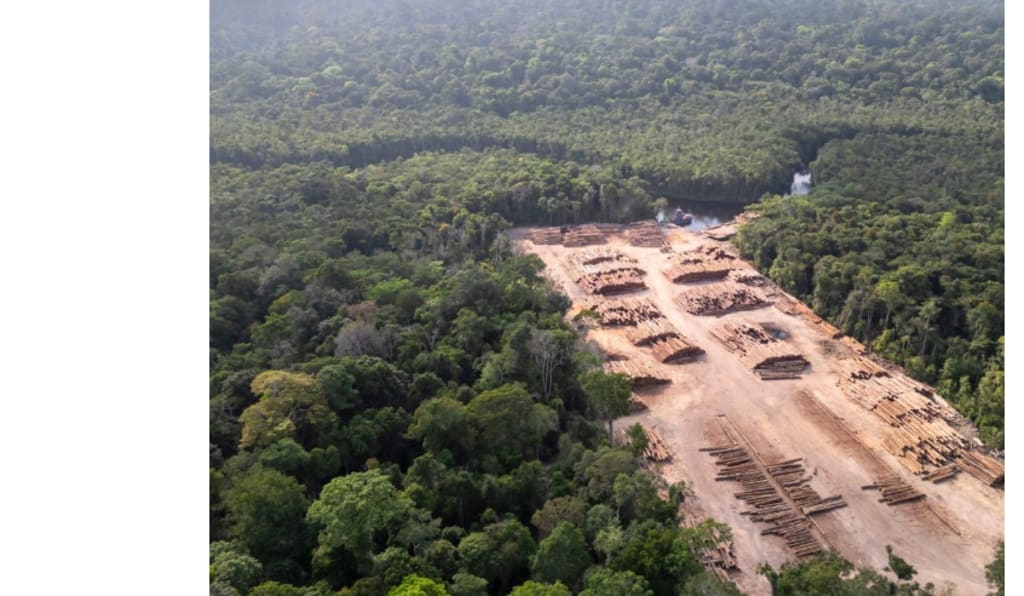
A recent research demonstrates what many scientists have long assumed but can now detect with precision from space: the local climate changes when big swaths of the Amazon are cleared.
There is a significant difference. Compared to neighbouring places where the majority of the forest is still standing, regions with significant deforestation are hotter, dryer, and receive less rainfall.
The researchers compared areas of the Amazon with varying degrees of forest cover using satellite data. A recurring trend became apparent.
The climate starts to change toward conditions more typical of rain forest-to-savanna transition zones after forest loss reaches a particular threshold.
After the trees are gone, what happens?
The researchers contrasted locations with less than 60% remaining forest cover with those with over 80% forest cover. The extensively deforested areas had an average surface temperature increase of approximately 3°C during the dry season.
Rainfall also shifted. There were around 11 fewer rainy days and about 25% less rain in these places. At the same time, there was a 12% decrease in evapotranspiration, which is the mechanism by which trees release water vapour into the atmosphere.
Practically speaking, this means that the land receives less rain overall and less frequently. Dry spells continue. Heat accumulates more readily. There is less moisture in the atmosphere.
The Amazon influences its own weather.
The fact that the Amazon is more than just a passive terrain with a climate is one factor contributing to this. The rainforest actively contributes to the climate it creates.
Through evapotranspiration, trees extract water from the soil and release it into the atmosphere. Eventually, that moisture helps create clouds and precipitation.
The removal of trees weakens this moisture cycle. Less rain returns to the area as a result of less water vapour rising into the atmosphere. Researchers are concerned about the feedback loop that results from this.
Dryer and hotter weather can stress trees, raise the risk of fire, and leave forests more susceptible to future deterioration. That may eventually cause the system to become even drier.
Why this is important for reasons other than conservation
The authors of the study emphasise that while environmental preservation and biodiversity are important, they are not the only issues. Deforestation-related climate change can have an impact on farming, water availability, and financial stability.
According to Luiz Aragão, a researcher at Brazil's National Institute for Space Research (INPE), "the study demonstrates that tropical forests have a huge impact on the climate, with consequences for various sectors of society, both for the well-being of populations and for economic activities."
"Therefore, beyond the environmental issue, a more comprehensive view must be adopted in the debate on the importance of forests." "With integrated and coordinated action across various societal sectors, we must work toward a national development vision."
This viewpoint reinterprets woods as a component of the nation's infrastructure. Far beyond the forest itself, agriculture, livestock, and the dependability of water sources may be directly impacted if forest loss modifies rainfall patterns.
Agriculture and forests are related.
According to Marcus Silveira, the study's primary author and an INPE researcher, the results validate the principle of Brazil's Forest Code, which mandates that a significant amount of native vegetation be preserved on Amazonian rural holdings.
Conditions in deforested areas are hotter and drier, which ultimately impacts agricultural output. At COP30, the Food and Agriculture Organization of the United Nations [FAO] itself published a report demonstrating that forests are agribusiness's partners rather than its adversaries, he noted.
It emphasises the numerous climate benefits that forests provide, boosting agricultural resilience and productivity, through a thorough analysis of the scientific literature. Our work closely aligns with that.
The message is straightforward: maintaining forests may help keep agriculture viable rather than necessarily competing with it.
Rates of deforestation in the Amazon
The Brazilian Amazon is seeing significant changes in land usage at the time of the study. The area, which is larger than Spain at 520,000 square kilometres, lost nearly 13% of its natural vegetation between 1985 and 2024.
Mining industry, agriculture, and pastureland all experienced significant growth during this time. Although the rate of deforestation in the Amazon has decreased recently, scientists emphasise that the amount of loss is still significant.
Official monitoring shows that almost 6,300 square kilometres of native vegetation were removed from the Legal Amazon in 2024 alone.
Global warming is getting worse at the same time. According to the article, 2024 was the hottest year ever recorded and the first to see temperatures rise by more than 1.5°C beyond pre-industrial levels.
Aragão contends that if emissions from fossil fuels continue to rise, eliminating deforestation alone won't be sufficient.
"As we discussed at COP30, it's critical that we chart paths to reduce deforestation, but it's also necessary to move forward with the process of replacing the use of fossil fuels to curb global warming, which is already a cause for concern," he stated.
Assessing how deforestation affects
The scientists separated the Amazon into sizable grid regions, each measuring roughly 55 by 55 km, to ensure they were quantifying the consequences of deforestation itself.
These were categorised according to forest cover levels and contrasted with nearby reference areas that maintained above 80% forest cover.
Temperature, precipitation, evapotranspiration, and the number of rainy days were among the eleven climate variables they looked at. They lessened the likelihood that geography alone might account for the findings by comparing localities rather than far-off ones.
Where forest loss was greatest, the effects were most pronounced. Surface temperatures during the dry season were up to 4°C warmer in regions with only 40% of the forest cover left than in adjacent, densely wooded areas. Additionally, evapotranspiration fell precipitously.
Is it possible to buck the trend?
The experts claim that restoration provides a way ahead in spite of the alarming statistics. Restoring the structure of forests may aid in the restoration of some of the lost moisture-cycling and cooling processes.
"Our research shows that if we can restore the forest structure, we can also restore ecosystem services like increased water cycling, temperature reduction, and carbon stocks, which will increase the nation's water, food, and economic security," Aragão said. The main conclusion is that the Amazon helps regulate the climate rather than merely responding to it.
The area begins to lose such capability when too much forest is lost. And it can get harder to get back to the previous circumstances after that balance has shifted sufficiently.
About the Creator
Keep reading
More stories from Francis Dami and writers in FYI and other communities.
The oldest rock discovered by geologists in the United States is 3.82 billion years old.
Scientists have confirmed that Michigan's gneiss is the oldest rock in the United States. This includes Zispristals, formed around 3.82 billion years ago and served in front of long, outstanding competitors. We once assumed that Minnesota maintained this distinction, but fresh data is heading in a different direction. Carol Frost of the University of Wyoming published these results with a team that tested rock samples with the help of advanced geological chronology tools.
By Francis Dami9 months ago in FYI
How Predictive Maintenance Is Changing Aircraft Parts Demand
The aviation industry is rapidly evolving as predictive maintenance reshapes how airlines and maintenance providers manage aircraft performance. Instead of relying solely on scheduled inspections or reacting to unexpected failures, modern aviation operations now use real-time data and advanced analytics to anticipate maintenance needs. This transformation is significantly changing aircraft parts demand, influencing procurement planning, inventory control, and supplier relationships across the global aerospace supply chain.
By Beckett Dowhanabout 2 hours ago in FYI
What Happens To Your Brain When You Stop Multitasking
Digital technology is the culprit that is causing us to doom scroll when tired, disengaged and unmotivated with the content that motivated you to log onto your device to consume in the first place. That is only the beginning. In the modern workplace (and even when filing cabinets were around, I confirmed this with my adopted parents to get my facts right); reading files while you are supposed to be present to the caller on the other end of the phone line is another classic example of multitasking that causes your brain (although adaptable and intelligent) to lose focus and concentration.
By Justine Crowley4 days ago in Psyche


Comments
There are no comments for this story
Be the first to respond and start the conversation.