
Earth: Still a Mystery After All These Years
We think we know everything, but our planet holds tight to its secrets.

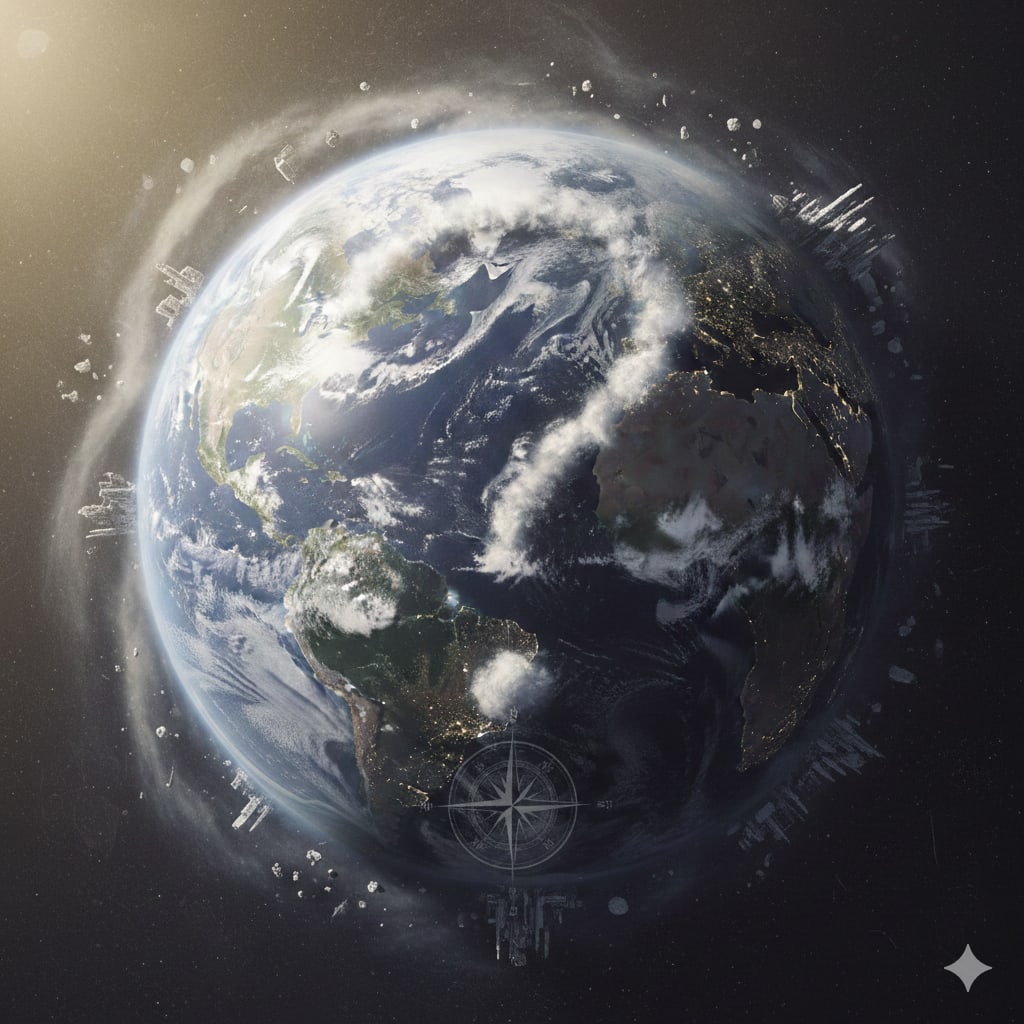
It can often feel like we’ve uncovered every last secret about our planet. We’re constantly looking to the stars for new worlds to explore, but in reality, there’s still a significant amount of mystery right here beneath our feet and all around us. When we take a closer look at some fundamental things about Earth, it’s clear we still have a lot to learn.
1. Unexplored Caves
We hear all the time about how over 95% of our oceans remain unexplored, but did you know there are literally thousands of caves that no one, at least no one we know of, has ever set foot in?
- National Geographic estimates that the number of undiscovered caves makes up about 90% of the planet’s total.
- Even in well-explored regions, like the United States, only about 50% of caves have ever been discovered.
2. Unknown Minerals
We know of around 5,000 minerals on Earth, which sounds like a good number. However, according to Robert M. Hazen, a mineralogist and astrobiologist at the Carnegie Institution for Science, his team created a complex system to calculate the number of currently unknown minerals and found that there are over 1,500 minerals we still don’t know anything about.
Keep in mind that many of the Earth’s minerals are quite rare and are only found in a few select locations. Considering the massive amount of land across the globe that still hasn’t been surveyed, it makes sense that there are still many minerals we have yet to discover. And here’s the kicker: Hazen’s model only includes minerals that are possibly accessible. If you add up the ones we may never be able to get to, the number of unknown minerals could increase exponentially.
3. What’s Beneath the Surface
When it comes to what we know about our planet’s interior, we’ve truly only just scratched the surface. Consider this:
- The Voyager 1 satellite took 26 years to exit our solar system.
- It took about the same amount of time for us to dig just 7.5 miles (12.3 km) below the Earth’s surface; this is the Kola Superdeep Borehole in Russia.
That deepest human-made hole is still 3,952.5 miles short of the Earth’s core. Although researchers have a pretty good idea of what’s down there based on analysing things like gravity, fossils, and earthquakes, these are still just theories. Until we can actually reach the centre of the Earth, we can’t be completely sure.
For example, while we typically think of the Earth as having a crust, mantle, outer core, and inner core, a 2014 discovery suggested there is an ocean inside the Earth that might have as much water as all the world’s oceans combined. And where there’s water, there could be life.
4. Undiscovered Civilisations
When we think of ancient civilisations, we often think of the Mayans or Egyptians because we’ve found plenty of evidence of their existence. However, researchers believe there are still hundreds or even thousands of civilisations out there, either covered up by dense vegetation, deserts, or water, that we have no clue ever existed.
That’s why every year you hear news of archaeologists digging up a new city. It suggests that legendary cities or civilisations like Atlantis or El Dorado could actually exist, and we just haven’t found them yet. Researchers now employ CT scans, satellite imagery, Google Maps, ground-penetrating radar, and even robotic drones to help locate these hidden ruins.
5. Unknown Species
This planet is massive and contains an astonishing number of creatures, many of which we’ve never seen or documented before. For some perspective, biologist Jennifer Owen documented over 8,000 species of wildlife she found in her standard family garden in suburban Leicester, England, over 40 years. Of those, 20 had never been seen before in England, and 24 were completely new to science, all from just an ordinary backyard!
Even after 250 years of official documentation, over 15,000 new species of plants and animals are discovered each year. Researchers estimate there are between 5 and 10 million species of wildlife in the world, and we have only identified around 1.2 to 1.3 million. This means that up to 90% of wildlife left in the world could be completely unknown to us.
6. How Gravity Works
When we think of gravity, we think of Newton and the apple: what goes up must come down. Scientists tell us that gravity is what keeps us on the ground and the Earth in orbit around the Sun. But when it comes to what gravity really is, nobody really knows. There are even mainstream researchers who suggest gravity is just an illusion.
Here’s why gravity is so perplexing:
- There are four conventionally accepted fundamental forces of nature: electromagnetic, strong nuclear, weak nuclear forces, and gravity.
- Gravity is supposed to hold the entire universe together, yet it is by far the weakest of all the forces. It’s millions of times weaker than the third weakest force (weak nuclear).
- This weakness makes it incredibly hard to demonstrate in lab experiments.
- It also doesn’t fit neatly into Einstein’s theory of relativity, which only explains gravity on a large scale.
- At the ground level of atoms and molecules, gravity just stops working.
7. Why Ice Is Slippery
This one sounds simple, but you’d be surprised. We know ice is slippery because there’s a very thin layer of liquid water on top of it, even when the ice is very, very cold. But how does the ice produce that layer of water?
For a long time, researchers believed that the pressure we put on the ice when we walk or skate lowered its melting point, causing the outermost layer to melt. However, it was later discovered that the pressure is really not enough to cause this to happen.
So, why then? We still have no definitive idea, but here are some theories:
- One theory suggested friction caused the outer layer to melt, but this was pretty much debunked because ice is still slippery even when someone is standing on it, not walking, and not causing friction.
- Another theory is that the water on the outermost layer of the ice just never truly freezes.
8. How the Moon Was Created
This is a bit out of this world, but it’s still fascinating. We love looking at the Moon, but one thing we have no clue about is how it was created. We have a few theories, though:
- In the 1800s, Charles Darwin’s son George suggested that the Earth spun so fast that a part of our planet spun off into space and was eventually caught by Earth’s gravity to form the Moon.
- Another theory is that the Moon was created somewhere else in the universe, passed by Earth, and was captured by its gravity.
- The most popular theory is that something massive collided with Earth millions of years ago, and a piece of the planet broke apart and formed the Moon.
It’s actually awesome that there are still so many things about our own world that remain a complete mystery. It reminds us that there’s always more to explore.
About the Creator
Areeba Umair
Writing stories that blend fiction and history, exploring the past with a touch of imagination.
Keep reading
More stories from Areeba Umair and writers in FYI and other communities.
King Tut’s Out-of-This-World Blade
Researchers love digging up old bodies and taking away everything they’re buried with in the name of science. So, back in the 1920s, when scientists discovered the cursed tomb of King Tutankhamun (and yes, it’s cursed, but we’ll get to that later), they naturally hauled off all his priceless treasures.
By Areeba Umair2 months ago in FYI
End-to-End Development with Angular + .NET Microservices Boilerplate: From Frontend to Backend
Modern enterprise applications demand scalability, security, and faster time to market. Relying on ad-hoc setups for frontend and backend development often leads to inconsistencies, technical debt, and delayed releases. An Angular + .NET microservices boilerplate solves this challenge by providing a production-ready, end-to-end architecture that unifies frontend and backend development under a single, proven foundation.
By Jakob Stanely4 days ago in FYI


Comments
There are no comments for this story
Be the first to respond and start the conversation.