
Google Ads Best Practices for High-Conversion PPC
Ultimate Google Ads Best Practices: Winning PPC in 2026

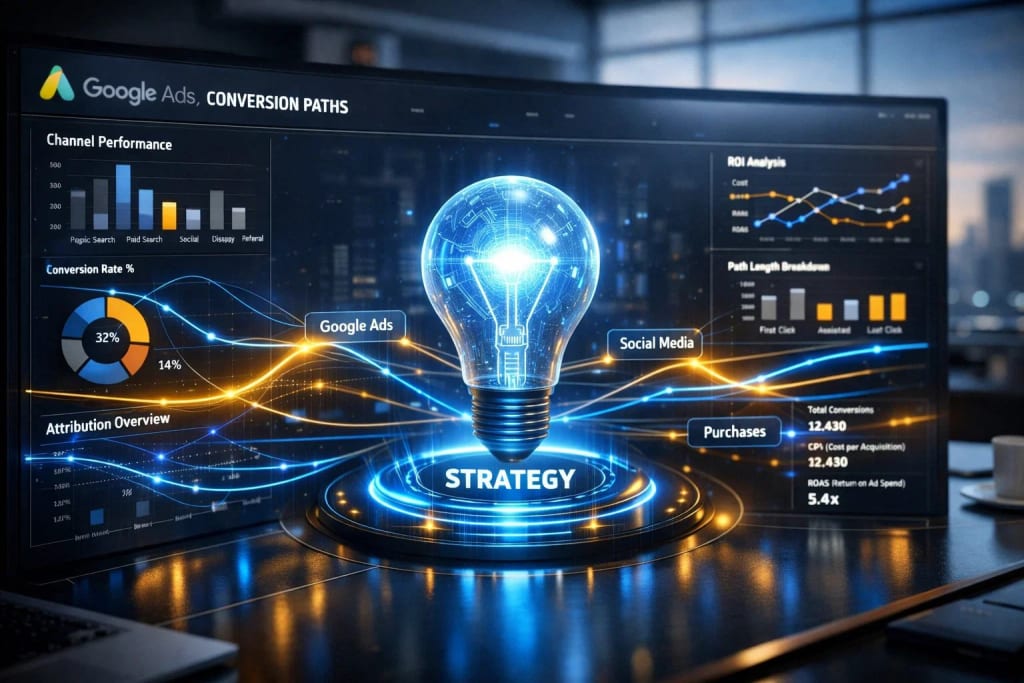
In the professional landscape of 2026, Digital Advertising has moved beyond simple keyword bidding. We are now in the era of "Predictive Intent." Google’s algorithms are more powerful than ever, but they are only as good as the inputs we provide.
For many businesses, Google Ads remains the fastest way to generate revenue, but without a firm grasp of current best practices, it’s also the fastest way to deplete a marketing budget. To win in 2026, you must balance automation with human-centric strategy.
1. The Automation Paradox: Trusting the AI
The modern PPC manager is no longer a "button-pusher"; they are a "data-architect." Google’s Performance Max and Smart Bidding are now the standard. The best practice today is to give the AI enough room to learn while setting strict "Guardrails."
Broad Match + Smart Bidding: In 2026, the combination of broad match keywords and AI bidding allows you to capture high-intent traffic that you might have never thought to target.
First-Party Data: Feeding your own customer data back into the system helps the AI find "lookalike" audiences with much higher accuracy.
However, even with AI, the basics still matter. Most campaigns fail because they miss fundamental settings. Before scaling your spend, it is crucial to audit your account against the common Google Ads mistakes for beginners to ensure your foundation is leak-proof.
2. Synergy Between Paid and Organic
In 2026, the line between Digital Advertising and SEO is thinner than ever. Google rewards "Topical Authority." If you are bidding on a keyword, but your organic presence for that topic is non-existent, your Quality Score - and your bank account - will suffer.
A high-performing campaign uses PPC to dominate the top of the page while organic content captures the informational intent. For instance, while your ads target "Buy Now" queries, your organic content should aim for the featured snippet SEO position zero to ensure you own the conversation from every angle.
3. Cross-Channel Consistency
Your Google Ads do not exist in a vacuum. A user might see your ad on search, visit your site, and then check your social media to verify your "Business Image." Consistency across all touch points is a non-negotiable best practice.
If your search ads promise a professional, high-end experience, your social profiles must mirror that. Ensuring your Facebook business page setup is optimized and visually aligned with your ads helps maintain the "Trust Graph" that drives 2026 conversions.
4. Diversifying Your Advertising Mix
While Google Ads is the cornerstone of search, the most successful brands in 2026 are those that diversify their Digital Advertising portfolio. Exploring niche platforms can often yield a lower Customer Acquisition Cost (CAC) and provide unique insights that you can bring back to your main campaigns.
For example, engaging in Reddit marketing for beginners allows you to tap into high-intent community discussions. The raw, unfiltered feedback you get from Reddit can often serve as the perfect "Ad Copy" for your next high-performing Google search campaign.
Use these best practices for better Google Ads results! The secret to 2026 success is simple: Let the machine handle the math, but let the human handle the meaning.
Google Ads FAQ: 2026 Edition
Q: Is "Quality Score" still relevant in 2026?
A: Absolutely. Quality Score remains the primary filter for ad costs. It is determined by the synergy between your ad copy, user intent, and the relevance of your landing page.
Q: How much should a small business spend on Google Ads?
A: There is no magic number. However, a best practice is to start with a "Testing Budget" that is 10x your target Cost Per Acquisition (CPA). Once you prove a positive ROI, you can scale indefinitely.
Q: Should I use AI to write my ad copy?
A: Use AI for variations, but human oversight is mandatory. In 2026, users are highly sensitive to "AI-sounding" text. High-converting ads are those that speak to human emotions and specific pain points.
Conclusion
Mastering Google Ads in 2026 requires a shift in mindset. You are no longer just buying clicks; you are buying data and relationships. By following these best practices - leveraging automation, maintaining cross-channel consistency, and avoiding foundational mistakes - you can ensure your PPC efforts yield a sustainable, long-term ROI.
About the Creator
Digistir360
Digistir360: Making digital marketing simple, affordable, and effective. We help entrepreneurs and small businesses master the digital world by teaching not just the how-to, but the why that drives results. Stop guessing and start growing.
Keep reading
More stories from Digistir360 and writers in FYI and other communities.
The Local Business Growth Blueprint: Dominating Your Neighborhood in 2026
For many entrepreneurs, the digital world feels like a global stage. We’re told to "think big," reach across borders, and scale to the moon. But for the coffee shop on the corner, the boutique in the arts district, or the family-run plumbing service, the most important "world" is the ten-mile radius around their front door.
By Digistir36012 days ago in FYI
What Makes Aerospace Manufacturing Different from Other Industries?
Manufacturing exists across countless industries, from automotive production to consumer electronics. However, aerospace manufacturing stands apart because of the extreme demands placed on both products and processes. In aviation, there is no margin for error. Every component must perform flawlessly under stress, pressure, vibration, and temperature variation.
By Beckett Dowhan4 days ago in FYI
At My Wits’ End
Life is about taking out the trash and calling it trash because you have every reason to. It wasn't meant to be linear, they say. But the times you tried to make it straight led to problems, and you didn’t have the tools to put any of it to use. You don't put your right shoes on the right feet; you put the left shoes on the left feet. The grey hardened slab will trip you up anyway.
By Caitlin Charlton4 days ago in Humans



Comments
There are no comments for this story
Be the first to respond and start the conversation.