
Mary Queen of Scots as a Writer: Part II
Royal Epistolary at its Finest

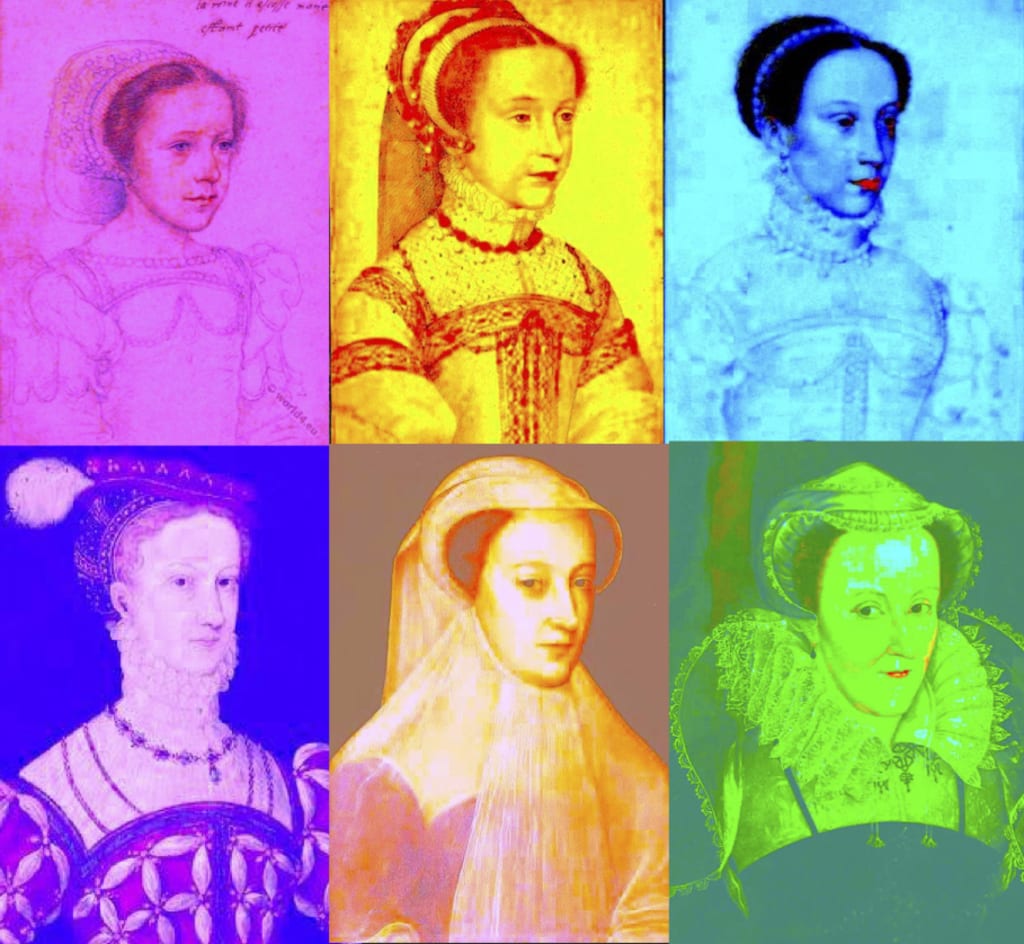
Sometimes what defines the legacy of a remarkable person is not their astounding rise to success, but the breadth of experience and tragic dignity that is gained from a life of suffering and thwarted aims. If you lose your kingdom, or even your head, maybe something greater is gained through the perennial power of the written word.
Whatever her crimes and deceit may or may not have been, Mary Stuart’s public beheading and the chronicle of her tribulations canonized her in a secular state of martyrdom. She was instantly a legend in common lore, and later on a mainstay of literature and period-films, albeit in a highly romanticized way. Yet to be romanticized is to be remembered.
Let’s not forget, either, that her bloodline would be established as the next ruling dynasty of England, while the Tudors end with Elizabeth I due to her self-imposed childlessness. So, sometimes a person’s value or impact transcends the scope of their own life and particular aims, and posthumous fame (or infamy) can crown and commemorate, if not justify, a life of harship.
Mary Stuart offers us the rare opportunity of looking into her own story through her own words, which would be wonderful enough even if she were a bad writer. But, she works a miracle of balancing the functional and formal aspects of her writing with the full force of words well weighed. She develops a truly haunting pathos through her periods of suffering. An increasingly dramatic vibration of her isolation and battle against existential crisis, failure, deposal, and death, echo through her words. Yet she never gives up petitioning for freedom until her sentence is passed.
In the 19th century, it was a Russian nobleman, the Prince Alexandre Labanoff, who took upon himself the huge task of traveling the world’s libraries to assemble all the verifiable pieces composed by Mary Stuart. He compiled them into a massive seven-volume set entitled the Receuil de Lettres, Instructions, et Memoires de Marie Stuart. Many more letters have been discovered since then, the most recent batch was in February 2023, that shed even more light on the machinations of Queen Mary Stuart.
From the time of her seemingly charmed girlhood in the palaces of France, up until two o’clock in the morning on the day of her execution, she pens a constant stream of these magnificent letters, most of them written in the French language. In the early years, we hear her wrangling with her mother over the appointment of her governesses and the control of her wardrobe and jewel boxes; or later making public proclamations of religious tolerance as a teenager, exclaimed in as Roman a Latin as she can muster; still later in her times of crisis, we read strange nervous missives justifying her rape and her subsequent marriage to James Hepburn, Lord Bothwell, to Catherine de Medici and Elizabeth, who are furious she has married a man put on trial for the murder of her late husband.
Perhaps over three quarters of her work consist of the correspondence she established with her cousin Queen Elizabeth the First. The letters exchanged between these two great historical women, who held each other in high esteem despite their deadly rivalry, tell a fascinating and ambiguous tale of friendship and betrayal. Both being accomplished writers, they are at their honed and formidable when they write for each other, and their correspondence mirrors the movements of their power-struggle and attempt to see eye to eye with one another.
During the many years of her house-arrest under Elizabeth, Mary set up a network of secret communications written in dozens of differently ciphered alphabets, allowing her to continue to meddle in world politics remotely and securely. Indeed, she was carrying out work as a spy and informant for parties in France, Spain, and Scotland, as well as for Elizabeth herself--becoming in effect a triple or quadruple agent whom no party knew if they could trust. She managed to carry out these operations even under strict surveillance and reduced to inhabited nothing but two rooms.
Writing was serious business for Mary Stuart, often a matter of life or death, but at the same time it was art. To write was to act, and her art of living fit the graces of Shakespeare's tragic stage. Like Shakespeare, she wrote quickly and she wrote frequently. Some of Elizabeth’s counselors even advised her never to look upon or read her letters, because they exerted a bewitching influence that could not be controlled. The charges brought against her, ultimately, reside in the contents of messages she had written; the reason she was taken in England in the first place decades earlier was due to other incriminating letters imputed to her.
The following is my translation of a letter written to Elizabeth in the early days of her house arrest in England, in August 1568, begging for the trust and esteem she claims is due to her.
TO THE QUEEN OF ENGLAND, My Good Sister and Cousin,
Madame, yesterday I received a letter from you which grieved me deeply, seeing as you have taken my previous words in so different a sense than I intended them. I will admit that not having heard with certainty any concrete expression of your good will or intentions toward me, I wrote you a little too freely: believing full well that you would forgive it, if I called you back to your better self.
God be my witness, if ever I was ungrateful to you—if I didn’t recognize your good offices! Yet for one who is much countered, the long exercise of patience can weather away respects and esteem once held, as I have many times observed and proved upon myself. You have taken too much in bad part my letter, and from one who has chosen you from among all other living beings to be her refuge: to put herself and all that she possesses into your hands!
If I have offended you, I am here to make amends at your discretion, but if you injure me, I have no one but the Queen of England to whom I can complain about my good sister and cousin herself—who accuses me of forsaking the light. But, I see well that what you said is true, that you take after the lion, who wants to command over others by love, and have the honor of willing regard, or else you are in wrath. Well then, I give it to you, I accept you for great lion; so recognize me as second of this same clan. Look how I have put everything into your hands: do for me that which will make good your word and valorize your person, obliging me to you in return, and I will make you take back your words that ever called me ungrateful: because I shall always prefer you over all other persons in the world.
Upon this I received another letter from you, where I see that your anger has not made you forgetful of your natural goodness. Madame, do not make it a light matter to imprint yourself with bad opinions of me; you would be wrong about it. You will know it one day.
I am contented it pleases you that I communicate with your vice-chamberlain; which I will do freely, assuring myself that whatsoever I tell him will be kept secret, except to you and to whom it will please you select to hear my affairs with you.
For the rest I sent you Borthwick yesterday, to bring you the news that I received from Scotland. I beg you in due diligence send me your part of the response about my assurance that my partisans put down arms: for otherwise, if the others don’t keep to the armistice as mine have and will, it would be to their undefended ruin; and my supporters would have been ready for the tenth of this month. Your vice-chamberlain can attest to you the haste that is required, for he has heard their message.
Thus you see that I hold you in greater esteem than you thought; for at your word, all that I have shall obey you without dissimulation. I do not know if the others have done as much, or would do, if necessity did not constrain them to it.
But I don’t want to tell tales with you. Forget the past, if I was in error, and accept my good will. Oblige me to the extent that I could never make up for it, because I will honor you like an older sister and petition you if you’ve diminished in just one jot of your measure of good graces to me all because of an impassioned letter. Great lion, give me back two jots out of the easy store of your generosity; for as little as I may have merited such generosity, the trouble I’ll take to deserve it in the future will be all the greater, and held all the dearer once acquired.
If as you say I were admitted into your presence and, enraged, you rebuked me—so be it, I say—I would take it for the first time, as well as a second, and as many as you like; I would beg you only that I have it with your good promise and hope to see you again after that, if I could only have had this boon the first time.
I have not had the opportunity to speak to monsieur your vice-chamberlain, because he was readying his first dispatch for you in haste. I will bid him employ himself as you have commanded.
I will not importune you any longer, fearing already that my letters are not so well-received as it is; only, having reminded you to send me a response concerning the delay of this parliament where these people will contend, I will pray God that he give you his holy grace and the consideration of the misfortune of your Like (such is his commandment) and to have pity on Them.
From Bolton, this 7th of August
Your very good sister and cousin
MARIE R
To Be Continued:
In the third and final part, a brief biography, and some resources for delving deeper.
About the Creator
Rob Angeli
sunt lacrimae rerum et mentem mortalia tangunt
There are tears of things, and mortal objects touch the mind.
-Virgil Aeneid I.462
Keep reading
More stories from Rob Angeli and writers in FYI and other communities.
Mary Queen of Scots as a Writer, Part I
Mary Stuart, three times married and three times widowed, accused of adultery, murder, treason and conspiracy. She was Queen of Scotland and Dowager Princess of France, and ultimately beheaded by her cousin-monarch Queen Elizabeth I for the crimes imputed to her. Her life was one of adventure and tragedy that has been the subject of many films, plays, operas, and novels.
By Rob Angeli3 years ago in FYI



Comments
There are no comments for this story
Be the first to respond and start the conversation.