
Real Cost of Hiring Mobile App Development in Los Angeles Agencies vs Freelancers
When One Budget Spreadsheet Leads to Two Completely Different Futures for the Same App Idea

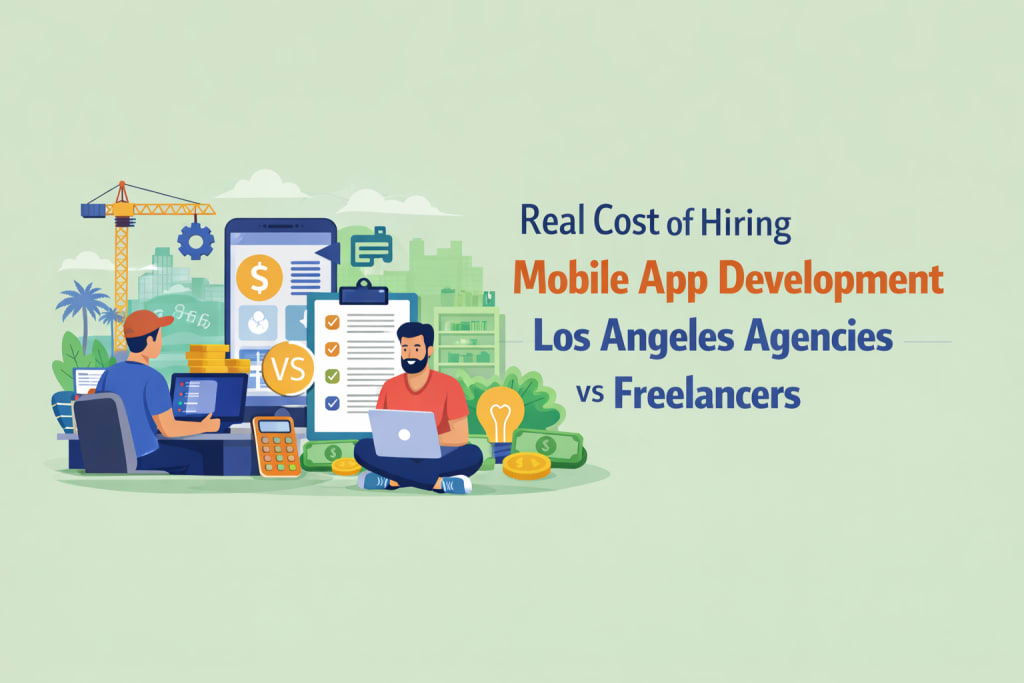
A startup founder once shared two proposals for the same mobile app. One came from a freelancer promising delivery for under $50,000. The other arrived from a full agency with a price nearing six figures. Both claimed to deliver the same product. Both presented confident timelines. And both insisted their approach made the most sense financially.
Six months later, only one version of the app existed — and it had cost far more than either original estimate.
The founder’s experience reflects a larger pattern shaping app projects in 2026. The real financial difference between agencies and freelancers rarely appears in initial quotes. Instead, it emerges through project structure, communication style, risk management, and long-term planning.
Understanding the true cost requires stepping away from hourly rates and looking at how work actually unfolds once development begins.
Why the Agency vs Freelancer Debate Persists Despite a Changing Tech Industry
The conversation has existed for years, yet it has become more intense as remote work expanded access to global talent. Platforms connecting companies with freelance developers grew sharply after 2020. According to Upwork’s annual reports, independent professionals now represent over one-third of the U.S. workforce in some form.
At first glance, freelancers seem financially attractive. Lower overhead, flexible contracts, and direct communication create the impression of reduced cost.
Agencies, on the other hand, often charge higher rates. Their pricing reflects multiple roles working together — project managers, designers, engineers, testers, and strategic advisors.
The debate continues because both paths can succeed. The outcome depends less on pricing and more on context.
The Hidden Structure Behind Agency Pricing That Many Clients Don’t See at First
Agency proposals often include layers that freelancers may not mention explicitly. These include:
- Structured planning phases before development starts.
- Dedicated project oversight.
- Documentation and testing processes.
- Risk mitigation strategies.
These elements may seem abstract when reading a proposal, yet research from McKinsey indicates that structured project governance increases delivery predictability by up to 30%.
Agencies typically distribute responsibility across teams. This reduces dependency on one person but increases upfront expense.
In Los Angeles, where many apps target competitive consumer markets, agencies often focus heavily on design and branding early in the process. That front-loaded investment raises initial costs but can reduce redesign work later.
Freelancers and the Appeal of Direct Collaboration Without Layers
Freelancers offer a different experience entirely. Many clients value direct access to the person writing the code. Communication can feel faster, and decisions may happen without formal approval chains.
Freelancers often specialize deeply in specific technologies, which can benefit focused projects. For example:
- Building a prototype quickly.
- Adding features to an existing app.
- Handling specific technical challenges.
A Stack Overflow developer survey suggests many freelance engineers prefer smaller teams where decision cycles remain short.
Yet the simplicity comes with trade-offs. Projects relying on a single individual carry higher risk if that person becomes unavailable or overwhelmed. When schedules slip, there may be no backup support.
Why Hourly Rates Rarely Tell the Full Financial Story
Clients frequently compare agency and freelancer pricing by calculating hourly rates. This comparison can be misleading.
Consider two scenarios:
- A freelancer charges $60 per hour but requires additional time to handle project planning, design decisions, and testing.
- An agency charges $120 per hour but distributes work among specialists who reduce rework and miscommunication.
In some cases, the total cost difference narrows dramatically by the end of the project.
Research from PMI (Project Management Institute) indicates that unclear requirements contribute to nearly 40% of project budget overruns. Teams with structured discovery phases often avoid major revisions later.
The financial question shifts from “Who is cheaper?” to “Which structure reduces risk for this specific project?”
The Role of Communication and Decision Flow in Determining Real Cost
Communication style shapes project expenses more than most clients expect.
Freelancers typically operate with fewer formal meetings. This can accelerate early progress. Yet when multiple stakeholders join the conversation, the lack of structured coordination may create confusion.
Agencies often introduce regular checkpoints, design reviews, and progress reporting. While these processes increase overhead, they can prevent misunderstandings that lead to expensive rewrites.
Professor Amy Edmondson of Harvard Business School has discussed how structured communication reduces uncertainty in team environments. In software development, uncertainty frequently translates into cost.
The Risk Factor: What Happens When Things Go Wrong
Cost analysis often assumes ideal conditions. Reality includes changing priorities, unexpected technical challenges, and evolving market demands.
Agencies typically maintain contingency plans:
- Backup developers.
- Dedicated QA teams.
- Established workflows for scaling work.
Freelancers may still manage risk effectively, especially experienced ones. Yet clients must evaluate whether a single person can handle rapid scope changes or urgent fixes during critical moments.
Data from Standish Group CHAOS reports suggests that projects with formalized team structures achieve higher success rates compared to loosely organized teams.
Industry Expectations in Los Angeles and Their Impact on Hiring Decisions
Projects built in Los Angeles often prioritize visual quality, storytelling elements, and high user engagement. These expectations come partly from the city’s entertainment culture.
Apps targeting lifestyle, media, or creator audiences frequently require:
- Advanced animation.
- Polished onboarding flows.
- Deep user analytics.
Such requirements may favor agency teams capable of coordinating multiple disciplines simultaneously.
When discussing mobile app development Los Angeles, the conversation often moves beyond coding toward storytelling, branding, and user psychology — factors that influence both timeline and cost.
The Long-Term Financial Picture: Maintenance, Updates, and Growth
Initial build cost represents only part of the financial equation.
Post-launch phases include:
- Bug fixes and updates.
- Performance monitoring.
- Feature expansion.
- Platform compatibility adjustments.
Agencies frequently offer ongoing support agreements, while freelancers may operate on an as-needed basis.
Neither model guarantees lower long-term spending. Projects with frequent updates may benefit from consistent team structures, while stable apps might run smoothly with periodic freelance involvement.
Why Many Founders Change Their Hiring Strategy Midway Through Projects
A recurring pattern appears in startup stories. Founders begin with freelancers for early development, then transition to agencies as the project grows.
Reasons include:
- Increased coordination demands.
- Investor expectations for structured delivery.
- Need for cross-disciplinary skills.
Others move in the opposite direction, starting with agencies and later hiring freelancers for specialized work once the product stabilizes.
This shift highlights a key insight: hiring models are tools rather than permanent identities.
The Emerging Hybrid Approach
Many companies now combine both models:
- Agencies handle planning, design systems, and early development.
- Freelancers support specific features or scaling tasks.
This hybrid approach reflects broader changes in how modern teams operate. Remote collaboration tools and flexible work arrangements allow companies to assemble custom teams rather than choosing one structure exclusively.
A Closing Reflection: Cost as a Story About Decisions Rather Than Numbers
The founder from the opening story eventually realized that the initial question — agency or freelancer — had distracted from a deeper issue: clarity of vision.
Their final version of the app succeeded not because of the hiring model but because the team gained alignment around goals, priorities, and user needs.
The real cost of development lies less in hourly rates and more in how decisions unfold over time. Agencies and freelancers represent different paths toward the same destination. Each carries advantages, risks, and hidden expenses that only become visible during the journey itself.
In the end, budgeting for an app means budgeting for uncertainty — and choosing the structure that helps a team move forward with confidence rather than simply choosing the lowest number on a spreadsheet.
About the Creator
Ash Smith
Ash Smith writes about tech, emerging technologies, AI, and work life. He creates clear, trustworthy stories for clients in Seattle, Indianapolis, Portland, San Diego, Tampa, Austin, Los Angeles, and Charlotte.


Comments
There are no comments for this story
Be the first to respond and start the conversation.