
The Moon: A Beautiful Mystery or an Ancient Artificial Wonder?
Exploring the Moon’s Baffling Secrets, From Hollow Theories to Perfect Orbits

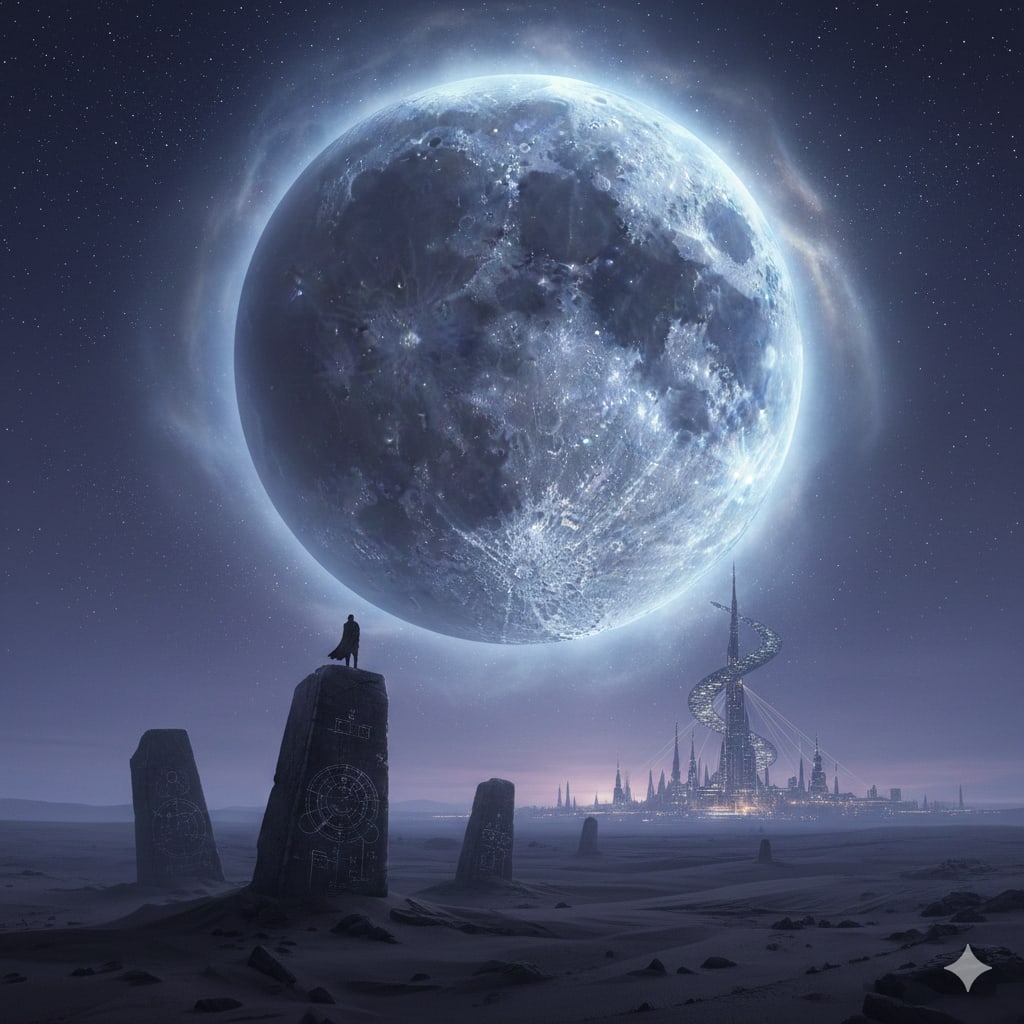
The Moon has fascinated humans for millennia. From guiding calendars to inspiring myths, it’s been more than just a glowing rock in the night sky. Wolves howl at it, poets write about it, and we even rely on it to keep Earth balanced. But despite being our closest celestial neighbor, the Moon still holds secrets that science struggles to explain.
Let’s dive into some of the strangest and most mind-boggling mysteries about the Moon.
1. Could the Moon Be Hollow?
One of the most intriguing mysteries is the Moon’s density. At 3.34 grams per cubic centimeter, it’s much less dense than Earth’s 5.5 g/cm³, hinting that the inside might not be solid.
In November 1969, NASA conducted a seismic experiment on the Moon by crashing a module into its surface. The results shocked scientists: the Moon “rang like a bell” for over an hour. Some researchers even suggested that its vibrations implied a hollow interior.
As Dr. Shan C. Solomon noted, lunar orbiter experiments revealed unusual gravitational patterns, fueling speculation that our Moon might not be entirely natural.
2. The Strange Shape of Moon Craters
Moon craters also defy expectations. Many have convex bottoms, curving outward instead of inward, a feature impossible if meteorites traveling at 25,000 mph created them.
Additionally, craters are shallow relative to their width, suggesting the Moon might behave differently from a solid rock. Could these be subtle signs of something more than just natural formation?
3. The Moon’s Peculiar Size
Compared to other planetary moons, Earth’s Moon is enormous. Jupiter, with far stronger gravity, has moons only 1/180th its size, while Earth’s Moon is 1/4 the size of our planet.
As Professor Isaac Azimov of Boston University explained, the Moon is too large to have been captured naturally by Earth. The odds of it being “grabbed” by gravity and settling into a nearly perfect orbit are astronomically small.
4. A Nearly Perfect Circular Orbit
The Moon’s orbit is almost a perfect circle, an extreme rarity among natural satellites. Most moons follow elliptical paths, but Earth’s companion is different.
Even stranger, the Moon’s gravitational center is about 6,000 feet closer to Earth than its geometric center, yet it maintains stability without wobbling, a phenomenon scientists still cannot fully explain.
5. The Moon Stabilizes Earth
Beyond its mysteries, the Moon plays a critical role in keeping Earth stable. Without it, Earth’s tilt could swing as much as 85°, causing catastrophic climate shifts over millions of years. Such precise stabilization by a satellite is extremely rare in the universe.
6. How Was the Moon Created?
There are three main scientific theories:
- The Moon broke off from Earth early in its history.
- The Moon formed alongside Earth during the solar system’s creation.
- The Moon was a wandering satellite captured by Earth’s gravity.
Yet none fully explain the Moon’s composition, size, or nearly perfect orbit.
Some theorists go even further, suggesting the Moon might be artificial, created by an advanced civilization to stabilize Earth and provide a constant night-time light source. While this sounds like science fiction, it would explain many of the Moon’s unexplained features.
Dr. Robert Jastro, NASA’s first lunar exploration committee chairman, even called the Moon “the Rosetta Stone of the planets”, hinting at its critical role in understanding planetary science.
Final Thoughts
The Moon is more than a beautiful presence in our night sky; it’s a cosmic puzzle. Whether it’s hollow interiors, strange craters, or its perfect orbit, the Moon challenges our understanding of nature and physics.
So, what do you think? Did Earth somehow capture a wandering satellite? Was it a part of our planet long ago? Or could it truly be an ancient creation of a technologically advanced civilization?
One thing is clear: the Moon still has many secrets, and the more we learn, the stranger it seems.
.
.
.
.
.
.
.
.
.
.
Moon mysteries, hollow Moon theory, Moon craters, Moon orbit, Moon creation theories, artificial Moon theory, NASA Moon findings
About the Creator
Areeba Umair
Writing stories that blend fiction and history, exploring the past with a touch of imagination.
Keep reading
More stories from Areeba Umair and writers in FYI and other communities.
China’s Mysterious Floating Cities, Hidden Pyramids, and Korea’s Sonic-Speed Train: A Peek Into the Future and the Unexplained
Floating Cities Over China: Mirage or Alternate Reality? If you thought UFO sightings were wild, China’s floating cities might just blow your mind. Over the past few years, multiple “cities” have been spotted hovering above Chinese provinces, including Foran, Yuang, and Guangdong. CCTV News even reported sightings as recently as last year.
By Areeba Umair4 days ago in FYI
The Local Business Growth Blueprint: Dominating Your Neighborhood in 2026
For many entrepreneurs, the digital world feels like a global stage. We’re told to "think big," reach across borders, and scale to the moon. But for the coffee shop on the corner, the boutique in the arts district, or the family-run plumbing service, the most important "world" is the ten-mile radius around their front door.
By Digistir3605 days ago in FYI




Comments
There are no comments for this story
Be the first to respond and start the conversation.