
Touch Me if You Dare
What animal has enough venom to kill 26 people in minutes?

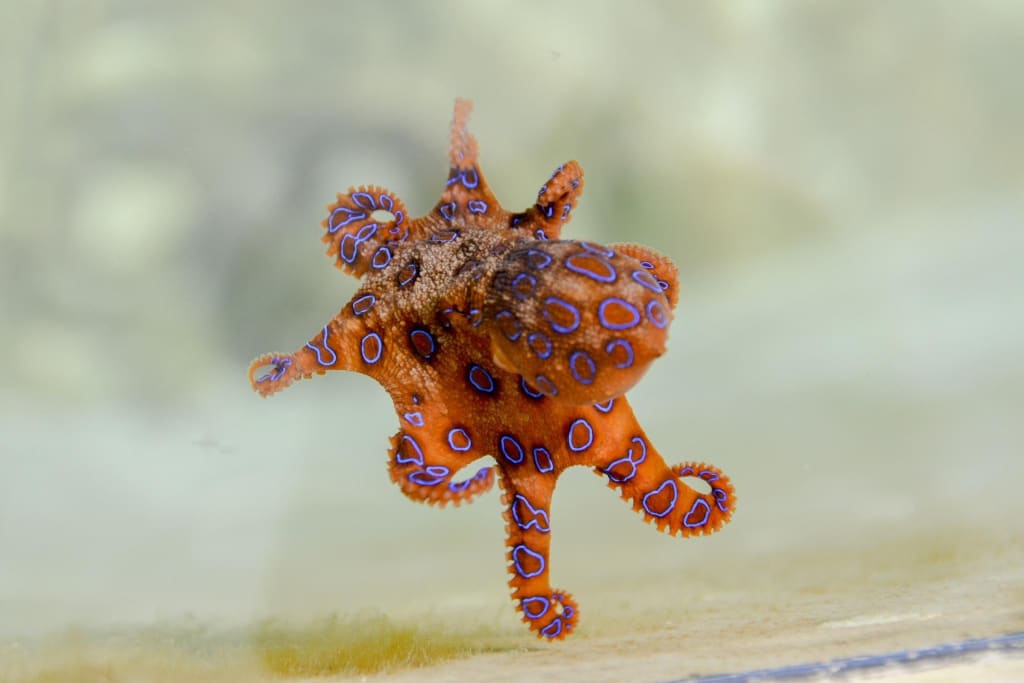
I was walking my two little girls (dogs/ dumans) a couple of days ago along the beach as we always do. It is the highlight of their day and gives me time to think and ponder the day ahead.
They are always sniffing around for what they can find, so I have to be on guard. This morning, I came across a creature they were paying special attention to. Luckily, it was dead.
Why?
Because it was a blue-ringed octopus.
Australia is well-known for its “unfriendly” selection of things that will kill you. Sharks, snakes, spiders, you name it, we have it.
These little critters would rank among the deadliest. They usually live on coral reefs and rocky seafloors. Some can also be found in tide pools, seagrass, and algal beds. Many live in just the sorts of places that children would find great fun at a beach, shallow tidal pools.
You can imagine a child wanting to pick up such a beautifully coloured creature.
Small but deadly
The blue-ringed octopus is small, but its venom is powerful enough to kill multiple humans in a short time. It releases neurotoxins that can quickly lead to paralysis. This makes it hard, if not impossible, to breathe without urgent medical help.
The danger increases since the bite can be painless. Victims might not notice until symptoms worsen. Researchers still have questions about why venom potency differs among individuals. They also wonder why some encounters end without symptoms.
Many people misunderstand the risk they pose by focusing on size. Fully stretched, they are no larger than a human hand, measuring 10-20 cm (4-8 inches). When left alone, they act like all octopuses. They are masters of disguise, blending into their surroundings.
When provoked or disturbed, the warning colouration signals a serious defensive weapon. It changes colour fast. It turns bright yellow, and each of the 50–60 rings flashes iridescent blue in just a third of a second.
These octopuses, or octopodes—not octopi. I learned this because the name comes from Greek, not Roman, which is why it doesn’t end in “i.” They carry enough venom to kill 26 adult humans in minutes.
The venom is a pharmaceutical dream. Seven toxins exist. They are: tetrodotoxin, histamine, tryptamine, octopamine, taurine, acetylcholine, and dopamine. Their venom is said to be 1000 times more potent than cyanide.
First aid is crucial for a bite victim. It focuses on artificial respiration if the victim's lungs become paralysed. Survivors of the first 24 hours often make it. However, if first aid isn't given within thirty minutes of a bite, death is likely. Children are at greatest risk because of their small body size.
Despite the bad news, it’s mostly agreed that there have been only 16 fatalities. This includes 3 confirmed deaths: 2 in Australia and 1 in Singapore.
Sensationalised in popular culture
The blue-ringed octopus became a movie star with James Bond. Featured in the 1983 film Octopussy (what else!), it was the prominent symbol of the secret order of female bandits and smugglers. It appeared in an aquarium tank, on silk robes, and as a tattoo on women in the order.
In the novel State of Fear (2004) by author Michael Crichton, a character uses a blue-ringed octopus as an assassination weapon. What a great idea!
So, if you happen to be in Australia, watch out for the snakes on the way to the beach, sharks in the water and the blue-ringed octopuses in the rock pools. Maybe go to the pool instead!
The deadliest animal in the world isn't a snake, fish, lion, tiger, hippopotamus, or spider. It is the humble mosquito.
They are responsible for roughly 725,000 to 1,000,000 human deaths annually. These insects kill more people each year than any other animal. They spread diseases like malaria, dengue, Zika, and West Nile virus. The second deadliest are humans themselves. Over 430,000 deaths each year from wars.
It’s a strange, strange world that we live in, Aunty Jack!
Till next time,
Calvin
About the Creator
Calvin London
I write fiction, non-fiction and poetry about all things weird and wonderful, past and present. Life is full of different things to spark your imagination. All you have to do is embrace it - join me on my journey.
Keep reading
More stories from Calvin London and writers in FYI and other communities.
Why Pet Apps Are Exploding in Tampa (2026)?
A decade ago, most pet-related technology focused on simple conveniences: scheduling vet appointments, tracking vaccinations, or browsing pet products online. Today, the landscape looks dramatically different. Pet owners increasingly rely on mobile apps not only to manage daily care but to enhance emotional connection, improve health monitoring, and integrate pets into broader lifestyle routines.
By Samantha Blake7 days ago in FYI
Remote Viewing: What Is It and What Is It For?
Remote viewing is a psychic ability that is used to acquire information that goes beyond the physical senses. This skill involves a specific and organized methodology that allows detailing characteristics of a distant target without the need to be present. This skill follows an established protocol to collect accurate and verifiable data. Those who practice distance vision focus on specific elements of the target, such as its location, physical features and related events, using systematic approaches to reduce the influence of the conscious mind.
By Ninfa Galeano3 days ago in FYI
Think for Me
"How do you calculate the circumference of a circle? Submit your answer when ready." [Pause] "Excellent! Every student was able to call up the answer electronically very quickly. If I, as a robot had feelings, I would express pride. You may break for lunch. Return to this cyber room in 45 minutes."
By Julie Lacksonen6 days ago in Humans


Comments (2)
I loved that you included this so all know: These octopuses, or octopodes—not octopi. My husband was just telling someone the story about the Panama (where he went in the Army) snake there that they call the 2 Step - if it injects venom, in 2 steps, you are dead. It is common knowledge and a running joke to non-Australians that everything there can kill you, LOL. Great story!!
I wish I could be surprised humans are the most dangerous, I'm not. But I did love this article. I've always thought Australia was so beautiful but deadly lol. And though I have never seen any James Bond movies, I immediately thought this octopus would make a good friend and guard dog/octopus? :D