
Why Chocolate is the Typical Valentine's Day Gift
The Gift of Sweetness is Older Than you Think



Chocolate is one of the most commonly given gifts when it comes to Valentine's day. In fact, Valentine's day falls behind only easter and Christmas when it comes to chocolate and candy sales in the UK (and the USA for that matter). Of course, the idea of giving simple or ornate chocolates as a gift is older than all of these holidays, having roots in pre-Christian South America.
Chocolate in the Ancient World
The earliest records concerning chocolate as a symbolic gift of romantic affection come from pre-Christian history, particularly in South America. This should come as no surprise; chocolate originates from this part of the world, after all. The Mayan people were making hot chocolate (or an early form of it) as early as 500 BCE; this drink was important to a huge number of social and cultural rituals including weddings. At a Mayan wedding, the bride and groom would exchange sips of this drink to celebrate their newly formed union. This was just one of the ways in which chocolate featured in ancient Mesoamerican societies - if you want to know more about that specific topic, Chocolate in Mesoamerica: a Cultural History of Cacao is a wonderful text to start with. Of course, the 'hot chocolate' consumed in pre-Columbian South America would not have tasted the same - modern chocolate is likely to be much sweeter. The reasons for the sweetening of chocolate for the European palette have been discussed in-depth, but Marcy Norton's paper Tasting Empire offers a reasonable overview of differing views within this complex field of study.
So, how did chocolate become so intimately connected with... well... intimacy? This, too, is likely to have originated from Mesoamerica. The Aztecs linked chocolate with desire and love, classing it as an aphrodisiac (a substance that stimulates arousal). There is no scientific evidence to support this belief, but that does not change the fact that chocolate enjoyed this reputation both in the Americas and Europe, marking it out as the kind of gift one would give to a lover.
Saintly or Sinful? Chocolate and St. Valentine
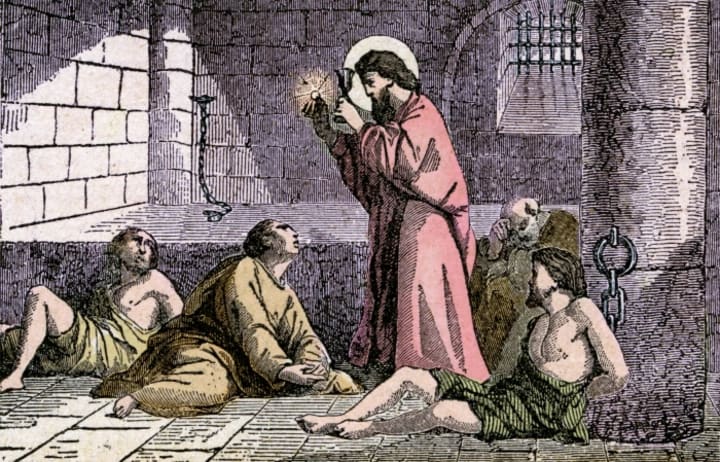
So, we know why chocolate is connected to love and lovers, but what about Valentines' day? It's somewhat of a murky topic, prone to giving historians a headache; you see, the Catholic church actually recognizes a minimum of 3 saints named Valentine or Valentinus. However, just because Valentine's day is known to be connected to a St. Valentine that doesn't mean that the celebration actually began with the church. Traditionally speaking, the celebration contains vestiges of both Christian and ancient Roman festivities and cultural traditions.
Pagan Revelry in Christian Clothing
Depending on who you ask, St. Valentine was either a priest who defied and was executed by Emporer Claudius II of Rome by continuing to perform marriages after they were outlawed, a Bishop of Terni (who was also beheaded by Claudius II), or a condemned man who signed a last letter 'From your Valentine'. You can read the resources to decide for yourself which you believe is the true St. Valentine.
For every person who says that Valentine's day is a commemoration of the death of the saint, there are others who will tell you that it's a pagan h0liday colonized after the fact by the church.
The pagan celebration of Lupercalia, traditionally celebrated at the ides of February, was a fertility festival dedicated to the Roman God of agriculture, Faunus, as well as to Romulus and Remus (the founders of Rome). Lupercalia survived the rise and spread of Christianity, at first, but was eventually outlawed as it was seen to be unchristian and 'sinful' (no surprise there). It wouldn't resurface until 1415 when Charles, Duke of Orleans, sends the first recorded Valentine to his wife while being imprisoned in the Tower of London after the battle of Agincourt.
A Very Modern Holiday
Valentine's day as we know it today arguably has its roots in the mid to late 19th century when cards and small gifts were becoming more affordable for the average person. At this point, chocolate went from being consumed largely in liquid form to being sold in the form of candies and bars. At this point, giving chocolate as a gift for any occasion was becoming more and more common. It was a British brand, Cadbury's, that would really change the game and bring the iconic connection between chocolates and Valentine's day into being.
How? They invented the iconic heart-shaped box.
Capitalizing on the Victorian habit of showering their significant others with rose and Cupid-bedecked gifts during Valentines' day, Richard Cadbury began selling his new 'eating chocolates' in heart-shaped boxes decorated with rosebuds and Cupids. The idea was that once the chocolates had been eaten, the box could be used to store sentimental trinkets, mementos, and love letters. From this point, the commercialization of Valentine's day flourished and chocolate, the product which began life as a drink in Mesoamerica, became a Valentines' day staple around the world.
About the Creator
S. A. Crawford
Writer, reader, life-long student - being brave and finally taking the plunge by publishing some articles and fiction pieces.
Keep reading
More stories from S. A. Crawford and writers in FYI and other communities.
Scottish Folklore: The Wulver
Of all the myths and monsters we have covered in this series so far, the Wulver may be among the strangest... and it's not for the reason you may expect. Credited to be a particular part of Shetland lore, this humanoid wolf-man has gained a lot of attention in the last thirty years, and some people aren't happy about it.
By S. A. Crawford2 years ago in FYI




Comments
There are no comments for this story
Be the first to respond and start the conversation.