
Aurora Floyd by Mary Elizabeth Braddon
Why It's a Masterpiece (Week 103)

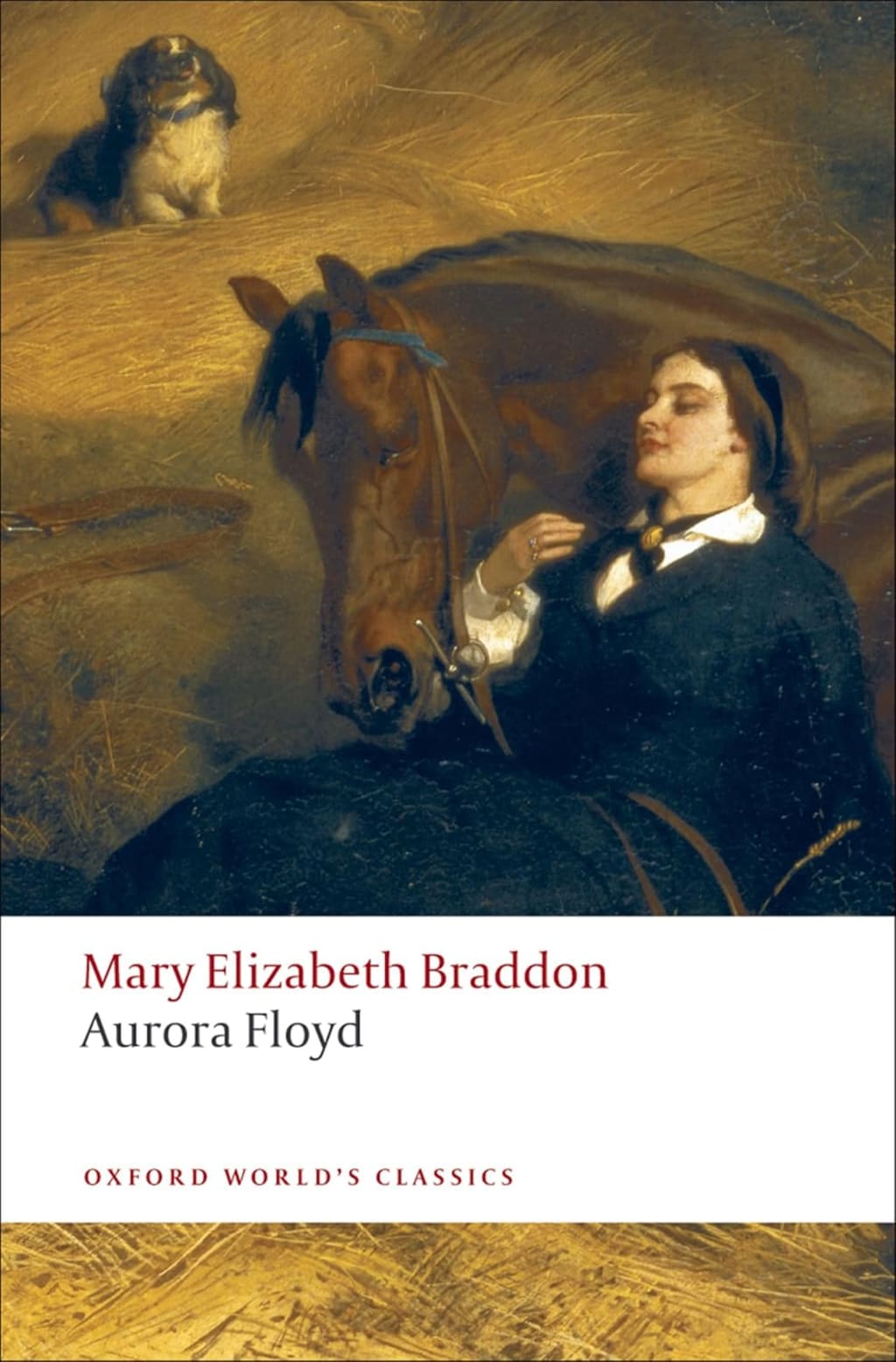
Temple Bar Magazine first published Aurora Floyd in serial form between the years 1862 and 1863. After that, it was released as a three-volumed novel and has been considered the most successful work of its writer, Mary Elizabeth Braddon after her sensational Lady Audley's Secret. Melodramatic and filled with domestic intrigue, the story captivated Victorian readers and contributed to those novels which often critique the models of sensibility, preached but not practiced, by the upper class.
The eponymous protagonist is a passionate heroine who has a dark secret threatening to destroy her happiness and possibly, her way of life. She is a reflection of the anxieties of womanhood that pervaded around the same society in which the author lived. A novel regarding female independence and class tensions mixed in with consequences of past sins would become a model for the latter half of the Victorian era's female writers. Elements of bigamy, blackmail and murder pull out the fibres of the psychological thriller, something that was coming more and more to the forefront during this turbulent era of strenuous freedom.
Mary Elizabeth Braddon's background lay in the theatre and that is definitely seen through the novel's high drama and pacing. Her vivid characterisation of the main character makes for scandalous reading and even though it was initially dismissed as 'frivolous' it has since been recognised as an important novel in the history of feminist literature. One that challenged justice and morality head-on.
Plot
The book is about Aurora Floyd, the daughter of a wealthy banker, Archibald Floyd. Following the death of her mother, Aurora grows into a beautiful, strong-willed woman who is both adored and scrutinised by society. She harbours a mysterious past, having spent a year away from home under circumstances that she refuses to explain.
Aurora’s past becomes a source of tension when she attracts two suitors: the honourable and devoted John Mellish, and the cunning, socially ambitious Stephen Hargraves. She ultimately marries Mellish, but her secret looms over their marriage, creating an undercurrent of suspicion and unease.
As the novel progresses, the truth about Aurora’s past is revealed; she had secretly married a groom named James Conyers during her time away, an impulsive decision that she deeply regrets. Believing herself a widow, she starts a new life with Mellish, but when Conyers reappears alive, he threatens to expose her past.
This revelation sets off a chain of events involving blackmail, deception, and ultimately murder. When Conyers is found dead, suspicion falls upon multiple characters, including Aurora and Mellish. However, it is eventually revealed that Stephen Hargraves, motivated by jealousy and resentment, was responsible for the crime.
Into the Book
The Fallen Woman:
Aurora Floyd embodies the figure of the “fallen woman,” a common trope in Victorian literature. Unlike many heroines of the time, she is neither docile nor submissive; she is impulsive, passionate, and refuses to conform to societal expectations. Her secret past, rather than being the result of a moral failing, is a consequence of her youthful recklessness and desire for autonomy.
The author challenges the Victorian notion that a woman’s worth is tied to her purity. Aurora is flawed but not irredeemable. Even after her secret is revealed, she remains a sympathetic character, which was a radical departure from the typical moralistic portrayals of women who transgressed societal norms.
This theme is reinforced by Braddon’s narrative voice, which invites the reader to view Aurora’s past as a mistake rather than a moral downfall:
“She had sinned, but she had also suffered. Was there no atonement possible for a girl whose only crime was the reckless haste of a passionate nature?”
- Aurora Floyd by Mary Elizabeth Braddon
Class and Society:
The author explores the rigid class divisions of Victorian England, particularly through the contrast between Aurora’s privileged upbringing and the working-class figures who resent her status. Stephen Hargraves, a key antagonist, is a prime example of this theme. His bitterness towards Aurora and Mellish stems not just from personal jealousy, but from his inability to transcend his lower-class position.
Conyers, too, represents a challenge to social hierarchy, he is a mere groom who momentarily gains power over Aurora through their ill-fated marriage. His reappearance and subsequent blackmail plot show us the dangers of crossing class boundaries, a recurring concern in sensation fiction.
The book also critiques the superficial nature of social respectability. While characters like Hargraves and Conyers are villains despite their working-class backgrounds, those in the upper class are not inherently virtuous. Even the well-meaning John Mellish struggles with his ingrained biases and the fear of social scandal.
This theme reflects the anxieties of a rapidly changing Victorian society, in which wealth and status could be both a source of power and a vulnerability.
"Aurora felt, as she looked down the long avenues... that all the fair picture was her own, or her husband's which was the same thing."
- Aurora Floyd by Mary Elizabeth Braddon
Love and Betrayal:
Aurora Floyd is a novel about love and its ability to survive betrayal. John Mellish’s unwavering devotion to Aurora, even when confronted with her past, serves as a counterpoint to Victorian ideals of marriage as a transactional institution.
Rather than punishing Aurora for her past, the novel instead punishes those who exploit her secret: Conyers meets a violent end, and Hargraves is ultimately exposed for his treachery. Mellish’s ability to forgive Aurora reinforces the idea that love is not about perfection, but about resilience.
One of the novel’s most poignant moments comes when Mellish, after learning the full truth, refuses to abandon Aurora:
“Let the past be buried. If you have suffered, so too have I, and that is enough. I love you, Aurora, and I will not let you go.”
- Aurora Floyd by Mary Elizabeth Braddon
Why It's a Masterpiece
This novel is a perfect example of the sensation genre at its best filled with: scandal, suspense, and emotional intensity, yet also deeply engaged with the social issues of its time. Unlike many novels of the period, Aurora Floyd refuses to moralise or condemn its heroine, instead offering a more full-bodied and modern portrayal of female agency.
Braddon’s skill as a storyteller is evident in the novel’s intricate plotting and fast-paced narrative. She blends Gothic elements, detective fiction, and domestic drama into a gripping story that remains compelling even well into the 21st century. Her sharp social observations elevate the novel beyond mere melodrama, making it a novel that is both thrilling and thought-provoking.
Conclusion
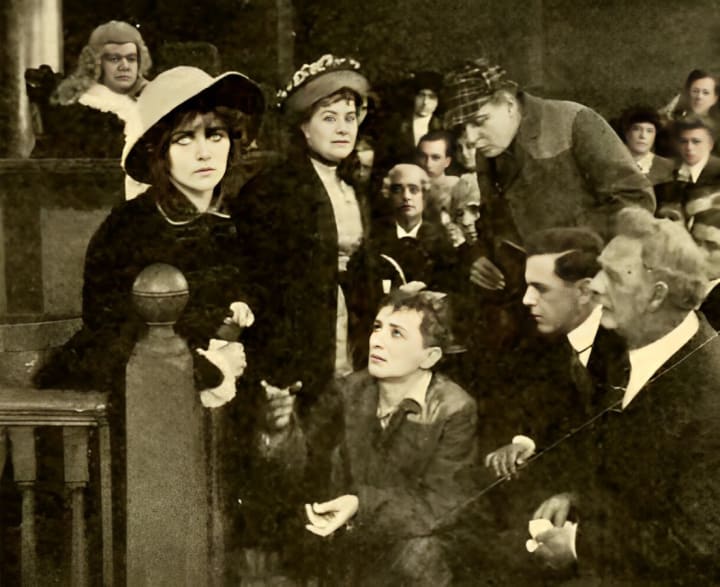
Aurora Floyd has remained an important novel even in our own day with women continuously writing upon it. A friend of mine some time ago wrote her undergraduate dissertation on a trope concerning Mary Elizabeth Braddon's books: one of horse-riding and sexual liberations of women. It is a fantastic idea for a paper yes, but it is also noticeable when you read the works of Braddon. I myself have dipped my toes into Braddon's influence, attempting in my youth to create a screenplay out of The Shadow in the Corner - a short story I loved in my teens.
Women's reputations may have once been their only currency, but Braddon dismantles that, a favour to women everywhere.
Next Week: The Good Soldier by Ford Maddox Ford
About the Creator
Annie Kapur
I am:
🙋🏽♀️ Annie
📚 Avid Reader
📝 Reviewer and Commentator
🎓 Post-Grad Millennial (M.A)
***
I have:
📖 280K+ reads on Vocal
🫶🏼 Love for reading & research
🦋/X @AnnieWithBooks
***
🏡 UK
Keep reading
More stories from Annie Kapur and writers in Geeks and other communities.
"Jane Austen at Home" by Lucy Worsley (Pt.3)
This review covers chapters 19 through to 26. *** As we continue through the story of Jane, Lucy Worsley gives us something to chew on. We get the story of the first writing of my personal favourite Austen novel, Northanger Abbey - originally entitled Susan. The 'chewing' is to decide exactly when it was being forged. There are known bursts of it in 1798 and 1799, but as the author states, there is certain inspiration from another book that wasn't published until 1801. It is a direct representation that though we may know much about Jane Austen's life from her letters, her everyday mapped out for us, her dislikes and likes seen clearly - we still don't really have the minutae of her writings. It is a bit here and there. Again, maybe this was done on purpose. Jane Austen was clever enough to keep those who didn't need to know in the dark about her actual intentions for the writings and when they were held out.
By Annie Kapura day ago in Geeks
No Other Choice (2025)
It is only February, so other films may well surpass “No Other Choice”, but I think this is the best film I’ve seen so far this year. And that surprises me, because, it is a subtitled film and while I am pretentious enough to choose to watch foreign-language films, I was also very tired and that was an extra commitment from me. But more importantly, let me warn you, this film is gruesome and violent. There were times I had to turn away from the screen to avoid the worst of it (including some self-inflicted dentistry).
By Rachel Robbins3 days ago in Geeks
How to Get Government App Contracts in San Diego?
For many technology companies, government contracts represent both opportunity and mystery. Unlike startup clients or enterprise customers, public sector agencies operate under structured procurement processes that can seem opaque from the outside. Teams often assume that winning a contract depends solely on offering the lowest price or the most advanced technology.
By Samantha Blake3 days ago in Geeks
The Tango Connection
I suppose I've become a writer so I wouldn't bore everyone to death telling them my stories. Reading them is reading. Not the same. There's rhythm. And timing and, most importantly, drama and suspense. Unless you have tremendous magnetism and an undeniable stage presence, there's no way you can engage an audience the way you can by writing your story. That's my opinion.
By Rene Volpi a day ago in Beat



Comments
There are no comments for this story
Be the first to respond and start the conversation.