
Book Review: "I Think You’ll Find It’s a Bit More Complicated Than That" by Ben Goldacre
5/5 - witty and informative...Ben Goldacre's articles point the finger at dodgy health claims....

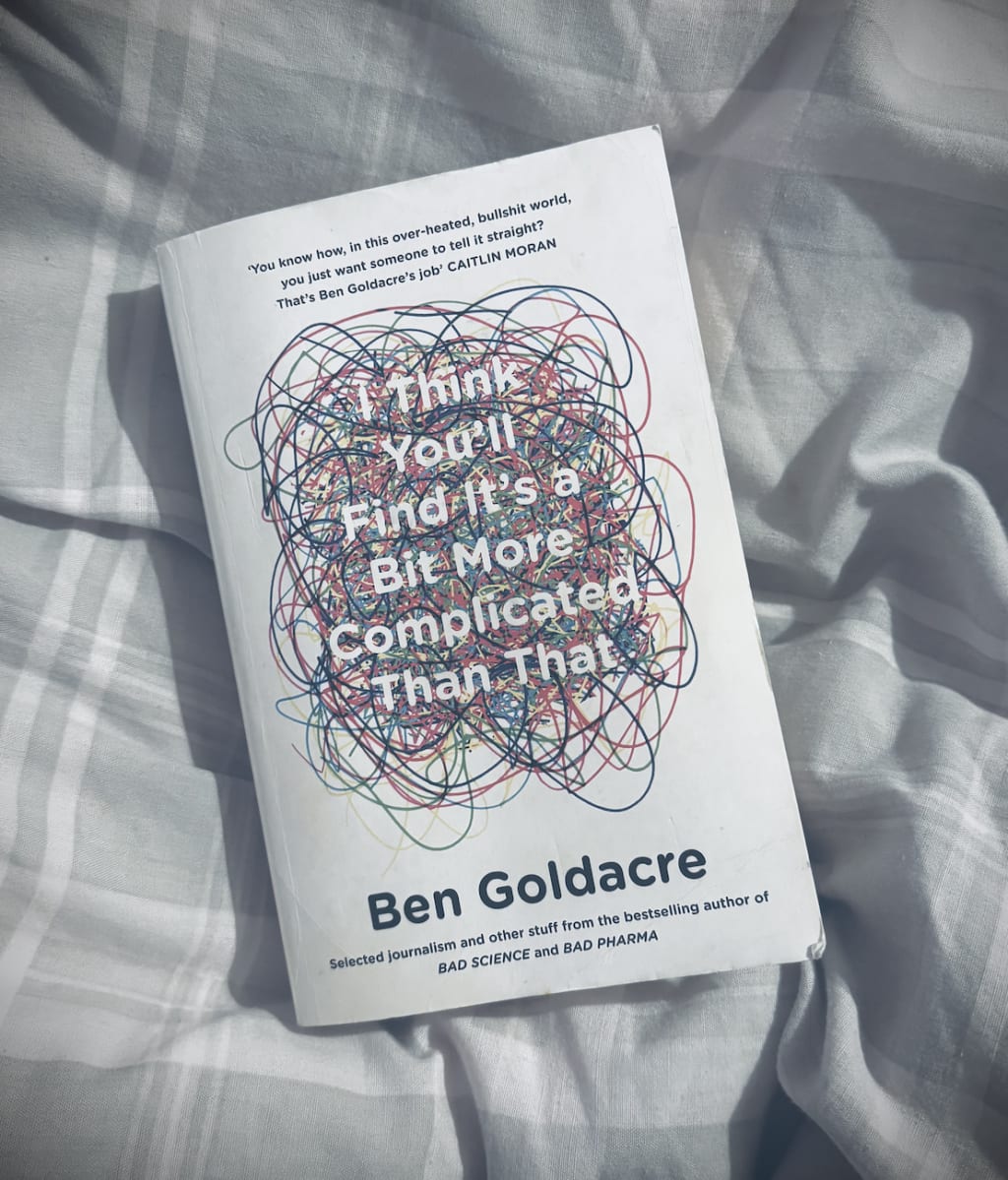
Again, used bookstores for random finds is probably your best bet when it comes to wanting to read books. Nobody has any money nowadays and well, bookshops like Waterstones and Foyles are great for gifting but when it comes to reading - I think there's more to be said about buying someone else's book. Sometimes there are notes in them, sometimes there are weird birthday cards with phone numbers in them (yes, I found that once) and of course, there's that Andy Warhol book where I was legitimately confused about what I had found. At the moment, I'm sitting around drinking coffee, so let's have a look at this weird compilation of journalism by a man who once wrote for the Guardian Newspaper.
Starting off taking down some shoddy claim made by a fellow doctor that the internet causes autism - this book details everything from bad science to silenced science. The person in question making the claim, Goldacre states, never actually released a paper to try and prove their point - but was almost vitriolic in the sense that they were correct, much like the RFK Jr situation. We have children debunking claims made by adults, some children as young as nine years' old - and we have adults trying to stop them. Ben Goldacre definitely knows what he's doing when it comes to this book. He's clearing everything up for the average reader.
Another point he makes in this book is to do with scare-mongering and other feelings-induced moments that data lends its hand to, especially when the data isn't nearly all true. He looks at the ideas concerning flouride in the water and what people have researched about them and the ideas around how some researchers believe smoking can ward off Alzheimer's disease. Both of these are often wrong or, at least, have some bias to them (the second one is oh so wrong though, please do not believe that smoking can cure anything). The idea that smoking can ward off Alzheimer's was found to be produced by scientists who were being paid by the companies who made the cigarettes. I can't say that any of us are surprised. But atop of this, it was actually found through research that smoking causes Alzheimer's disease instead.
The final piece in the first section of the book concerns how papers are often hidden behind vast pay walls, making science practically inaccessible to the normal public sphere. How would you even begin that argument without talking about the late, great Aaron Swartz? Yes, Ben Goldacre writes about the boy before his death and mentions how public access to this kind of information is probably our best bet to having a more informed public. But that doesn't suit the pocket of those involved in the dissemination of information. As someone who was growing up when Aaron Swartz was doing his activism against these ridiculous prices for journals and papers, I think Goldacre could be correct. Everyone wants to make money even when it comes at the detriment of public knowledge.
One of the parts I thoroughly enjoyed was the takedown Goldacre did of a claim that intense coffee drinking caused hallucinations. Now, I am fully aware that if you drink over your tolerance of coffee, you tend to experience feelings of impending doom because of your heart rate increasing so much, but hallucinations is a whole different thing. Goldacre looks at the reports of these and finds that 'hallucinations' probably isn't the best option to pick for what these people are prompted to describe. I normally have my own rule though: if it sounds a bit silly, then usually it is. As a seasoned coffee drinker who is normally told that I drink enough caffeine to kill a small country - I have yet to experience a hallucination because of it. I'm still giggling over the prospect.
Another takedown I enjoyed was the way in which Goldacre looks at published research in the media. Of course, we know that the media's main concern is people consuming it and thus, we can also assume that the data it publishes will be faulty at best. Goldacre states that it will be the publications with more shocking and often more worrying data that will get air-time by magazines and newspapers - even if the research is shoddy at best. But the more respectable research without shocking data will be buried and often, the majority of the media-consuming public will be none the wiser to it. Honestly, he makes a good point about the way in which the media uses statistics to scare people even if the research isn't reputable.
One article that interested me in this book was an article on prescription heroin. The research on the topic seems to suggest that methadone is the best way to reduce the intake of heroin by an addict who relies on the substance. However, Ben Goldacre would beg to differ seeing as in many cases, methadone has caused more deaths than heroin and that methadone generally has a bad track record for getting addicts off their substance of choice in the long-term. Goldacre also discusses why we stopped prescribing heroin to heroin addicts in order to ween them off the drug. He concludes that due to the data as not presenting methadone as less dangerous, it therefore has something to do with the morals and emotions of the doctors dealing with the patient towards prescribing an illicit drug. Going through the way in which metadone fails, the author definitely shows us that this is not an effective method for getting addicts to give up heroin but because of the hurt feelings of the doctors, it has to be prescribed. It is genuinely laughable how doctors let their own feelings get in the way of proper healthcare for an individual, but it's true.
Anyways, this is just a selection of what is available inside the book, I think I've spoken on the subject for long enough. If you're looking for something that's both informative and actually quite funny then I highly recommend that you pick this one up.
About the Creator
Annie Kapur
I am:
🙋🏽♀️ Annie
📚 Avid Reader
📝 Reviewer and Commentator
🎓 Post-Grad Millennial (M.A)
***
I have:
📖 280K+ reads on Vocal
🫶🏼 Love for reading & research
🦋/X @AnnieWithBooks
***
🏡 UK
Keep reading
More stories from Annie Kapur and writers in Geeks and other communities.
Book Review: "The Descent of Man" by Grayson Perry
Well, I'm back to reading random books. The Descent of Man is one of those books I have never heard of at all, and I even refrained from looking at the blurb. I got it as my free book on a 'buy three get one free' deal and though it's quite short, it has a lot to say about the state of masculinity. This book has been read and reviewed by quite a lot of people so I'm kind of wondering how I missed it when it first came out in 2016. But, as always, Penguin Nonfiction never seems to disappoint - so let's take a look at where Grayson Perry stands on the state of modern masculinity and the ways in which men can improve their relation to their own gender and hopefully, the way in which they interact with the opposite gender.
By Annie Kapur23 days ago in Geeks
Not Just For Clean Up: A History Of The MCU's Department of Damage Control
Initially an organisation that seemed to exist to help the heroes of the Marvel Cinematic Universe, from Phase Four onwards, the Department of Damage Control has shifted into a more antagonistic role. Most recently seen in the Wonder Man series, the current incarnation of Damage Control seems to target superpowered individuals, regardless of whether that person poses an active or intentional threat.
By Kristy Andersona day ago in Geeks


Comments
There are no comments for this story
Be the first to respond and start the conversation.