
How to develop education, this Bhutanese film poses a dilemma
Some people say that teaching is a particularly beautiful thing, because you can find a home for your extra love, but also to a certain extent to help those remote mountain children see hope, see the future, etc.

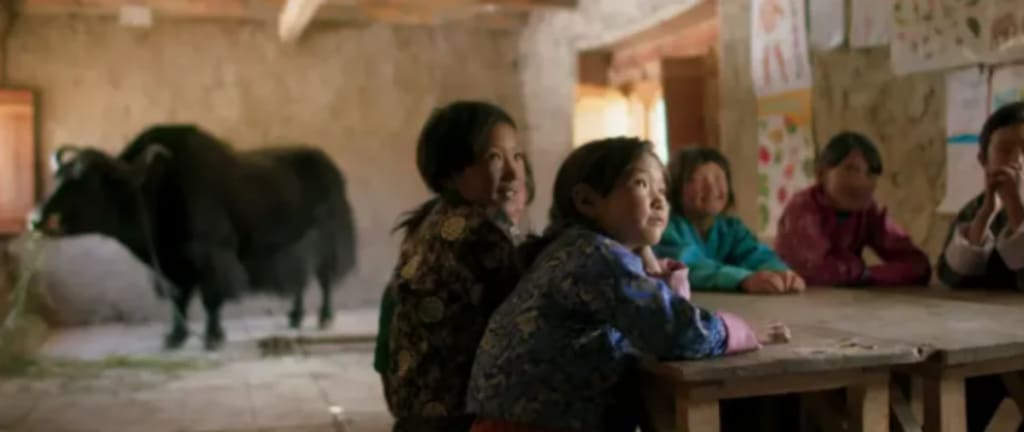
Some people say that teaching is particularly beautiful because it can find a home for their extra love, and it can also help the children in those remote mountainous areas see hope and a future to some extent. However, some people say that teaching is a very cruel thing because when children see the future, the future is far away from them.
The point of missionary work is to balance educational resources, but this balance is not systematic. The educational resources of a place are backward, and it does not depend on some teachers to completely change the face of local education. Teaching is naturally one option to change the face of local education, while another is to systematically accumulate and train local educational resources. This is the best way to solve the problem.
The film we recommend today is about teaching, but it doesn't take place in China, it's a foreign film. Of course, this film takes place in our neighboring country, Bhutan, a country that can be found on the map, but no one cares much about it. The film is "A Yak in the Classroom," a children's film or reality film from Bhutan.
Ugyen is a young man from Bhutan who, like all young people, is full of expectations and dreams for the future, but Ugyen's dreams are not in Bhutan, but in Australia, thousands of miles away. Ugyen is a teacher, but he truly hates his profession. Teachers are under the direct jurisdiction of the Ministry of Education in Bhutan, so Ugyen often visits the Ministry to put an end to his career. The Ministry of Education was very puzzled by Ugyen's request, but due to his several visits, they finally decided to let him teach in the most remote part of Bhutan, where he would only have to attend classes for a few months, without affecting his "dream" in any way.
Ugyen arrived at this remote elementary school in Lunana, a village with a population of only 100 people. It takes several days just to walk, and during that time, we have to go over the mountains, and the transportation is extremely inconvenient in the Lunana area, which is isolated but not a paradise. Ugin regretted his arrival in Lunana, but he decided to finish the semester because of the courtesy of the people here. Ugin's arrival gave Lunana fresh energy, and he learned the local folk songs here, which made his trip worthwhile for someone who likes to sing, but for a teacher who was just teaching, Ugin's trip was full of regrets.
After the time slipped away, there was not much time left for Ugin, and although everyone was sad to leave this time, for Ugin it might be goodbye forever. He does not give up his dream for Lunana and likewise does not throw away his future for the future of Luna's children. Everything is full of parting thoughts, but that is the nature of missionary work.
Young people are in the country with the highest happiness index in the world, but they don't feel that it is a meaningful thing at all, and this so-called happiness index is just a statement to put gold on their faces. This so-called happiness index is just a statement to their face and does not have practical significance. The film mentions this topic more than once, and each response is a direct irony.
The village chief of Lunana is puzzled by Ugin's choice since the happiness index is the highest, but why do young people go to foreign countries to find happiness, Ugin is also puzzled by the fact that since the happiness index is the highest, why does he, as a young man, have to engage in a profession he does not like, and so on. These direct or indirect irony let us see a status quo, iron needs to be hard, and their own story does not need others to identify.
Again, the theme of this film, teaching has always been a not very good topic of discussion, those who are bent on teaching they are wrong. Of course, they are, no one's enthusiasm should be let down, and this enthusiasm can indeed bring some local changes, but what happens afterward? Education is not a short-term thing, it requires a long-term investment, and this investment cannot be solved by teaching.
A case in point is Lunana, the most remote elementary school in Bhutan, where Ujjain is located. Teachers come and go, and come and go. Lunana indeed needs outside teachers to teach the children what the world outside the mountains is like, but it needs a stable, fluid, and cont, and sinuous education system to completely change the face of education in the region.
Ugin is just a paraprofessional, and paraprofessionals are like white horses passing by, existing for a very short period in this extremely backward area of education, but what Lunana lacks is not only a teacher but also an education system, what they lack is teacher for themselves. impress any paraprofessionals, but cannot change the fact that they do not belong to this place.
Lunana can be a pain in Ugine's heart, but it is only pain, this pain does not change the face of Lunana, want to completely change, and Lunana must train a group of teachers in the village themselves to carry out a long-term investment in education, this may be the optimal way.
*** Translated with www.DeepL.com/Translator (free version) ***
About the Creator
Phoenix
Victory won't come to me unless I go to it.
Book Review: "Modern Man in Search of a Soul" by Carl Jung
What happens when we strip human life of meaning? Well, according to Jung, everything begins to go wrong for us. From the moment we started to have control over nature, we start to descend in meaning and value. Rationalism may have brought us comfort in understanding, but it has also brought us less meaning in our soul. I'm not going to lie, if a book doesn't define what a 'soul' or a 'spirit' is, then I have no interest in the argument. The issue is that Jung takes us on a journey in which we start to understand what the soul is - or at least, what it is meant to consist of. So even though I don't agree with all of it, I understand where he is coming from when he talks about the subject of a 'soul'. Science can provide us with understanding but cannot answer the larger, more existential questions regarding ourselves.
By Annie Kapur3 days ago in Geeks
Super Bowl LX Recap: A Team Called Hawks
Sixty. The Super Bowl turned 60! Still amazes me that this was the sixtieth Super Bowl played in NFL history. It seems like yesterday that I watched Super Bowl XXVII, the first SB I ever watched. The QB who won Super Bowl XXVII has since called a few SBs, and will call next year's game, but that's another story. Super Bowl LX took place at Levi's Stadium in Santa Clara, California, the home stadium of the San Francisco 49ers. However, it was one of their division foes who represented the NFC, as the Seattle Seahawks faced off against the New England Patriots.
By Clyde E. Dawkins3 days ago in Unbalanced




Comments
There are no comments for this story
Be the first to respond and start the conversation.