
In Defense of Hamnet: Why Emotional Truth Matters More Than Historical Permission
A defense of one of the best movies of 2025.

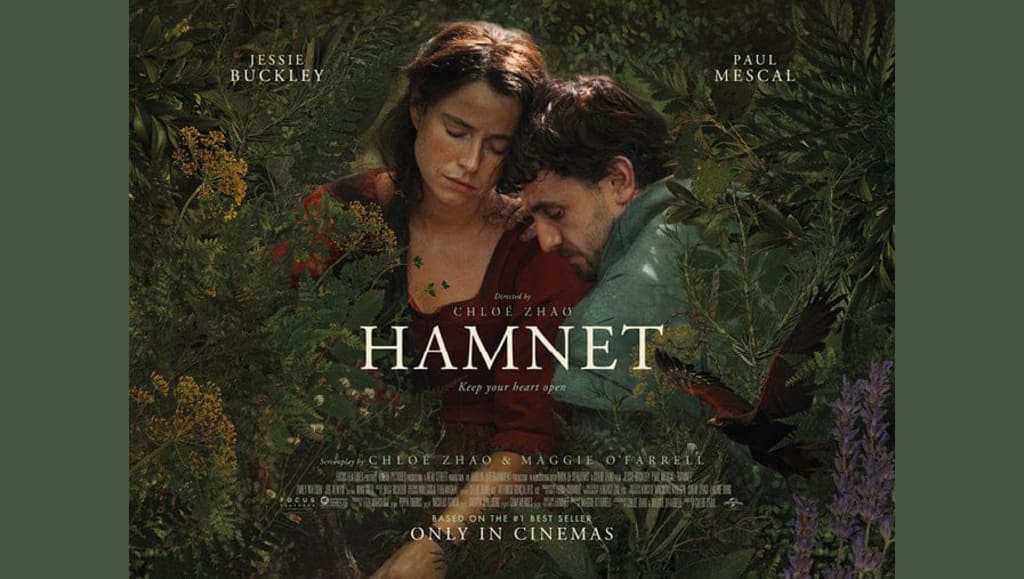
When Sir Ian McKellen recently dismissed Hamnet as “improbable,” suggesting that Shakespeare’s imagination “certainly didn’t just come from family life,” he was not merely critiquing a film. He was, perhaps unintentionally, applying the wrong standard to the kind of story Hamnet is trying to tell.
And that distinction — between historical truth and emotional truth — is where the entire debate actually lives.
McKellen’s criticism is understandable. He has spent a lifetime immersed in Shakespeare, in scholarship, in performance, in a tradition that treats the Bard’s work with near-sacred reverence. But reverence can become a form of gatekeeping when it insists that only one framework — the historical, the academic, the provable — is legitimate.
Hamnet is not working in that framework. It never claims to.
It is working in the tradition of poetic truth — a tradition that predates Shakespeare by nearly two thousand years.

Aristotle Already Solved This Argument
Long before Shakespeare ever picked up a pen, Aristotle made a crucial distinction in Poetics:
History tells us what did happen.
Poetry tells us what could happen — what feels universally true.
This is not a minor footnote. It is the philosophical foundation of narrative art.
By Aristotle’s definition, poetry (and by extension, cinema) is not inferior to history — it is broader. It does not claim factual accuracy. It claims human accuracy. It seeks not documentation, but resonance.
When Hamnet imagines the emotional aftershocks of a child’s death within Shakespeare’s marriage, it is not claiming causation. It is exploring possibility. It is asking: What might grief look like inside this family?
Not: What literally happened?
To demand that the film meet historical standards is to commit a category error. It is like criticizing a painting for not being a photograph.
The Plumber, the Paycheck, and Emotional Causality
A plumber is not a plumber because he is spiritually moved by pipes.
He is a plumber because he is paid to be one.
But why does he want the paycheck?
Maybe he wants stability.
Maybe he wants to support his family.
Maybe he wants to give his children a better life than he had.
There is no direct link between plumbing and love — yet the emotional motivation is still real. The job is not inspired by family in a literal sense, but in a human one.
That is emotional causality.
Shakespeare did not “write Hamlet because his son died.”
But grief, love, distance, guilt, and loss may still have shaped the emotional weather of his inner life.
To say that those experiences could not have mattered is far more presumptuous than suggesting they might have.

What Hamnet Is Actually Saying
McKellen also questioned the idea that Anne Hathaway (as portrayed in the film) did not understand what a play was or had never seen one. But this misreads the scene.
Anne is not overwhelmed because she is ignorant of theatre.
She is overwhelmed because she is seeing her husband’s grief — publicly, vulnerably, shared with strangers — when he had not shared it with her.
She realizes that the part of himself he withheld from her has been given to the world.
That is the source of her emotion.
This is not historical speculation.
It is emotional logic.
And it is supported, beautifully, by the silent communication between Paul Mescal and Jessie Buckley in the film’s final moments. Their shared looks do what language cannot. They show two people finally understanding each other through the strange translation of art.

Shakespeare the Human, Not the Marble Statue
We are often told that Shakespeare may not have been a good husband. That he may not have been kind. That he may not have been present.
All of that may be true.
But being flawed does not mean being unfeeling.
Being distant does not mean being untouched.
Being complicated does not mean being hollow.
Hamnet does not sanitize Shakespeare. It humanizes him.
And that is the film’s quiet power: it reminds us that even legends were once people who loved, failed, and lost.
Why This Criticism Feels Misplaced
The complaints about Hamnet do not read like responses to the film itself. They read like objections to its right to exist — as if emotional storytelling needs permission from scholarship.
But art does not ask permission.
It asks recognition.
And Hamnet recognizes something deeply human:
that love and grief do not need footnotes to be real.
It is not a claim about where Shakespeare’s imagination came from.
It is a meditation on where all imagination comes from.
From being alive.

About the Creator
Sean Patrick
Hello, my name is Sean Patrick He/Him, and I am a film critic and podcast host for the I Hate Critics Movie Review Podcast I am a voting member of the Critics Choice Association, the group behind the annual Critics Choice Awards.
Keep reading
More stories from Sean Patrick and writers in Geeks and other communities.
No Other Choice (2025)
It is only February, so other films may well surpass “No Other Choice”, but I think this is the best film I’ve seen so far this year. And that surprises me, because, it is a subtitled film and while I am pretentious enough to choose to watch foreign-language films, I was also very tired and that was an extra commitment from me. But more importantly, let me warn you, this film is gruesome and violent. There were times I had to turn away from the screen to avoid the worst of it (including some self-inflicted dentistry).
By Rachel Robbins5 days ago in Geeks
Britney Spears’s Back-Catalogue Sale Signals a Music Industry Turning Inward
The recent sale of Britney Spears’s back catalogue has become more than just another high-profile financial transaction. It stands as a revealing symbol of a music industry increasingly focused on recycling its past rather than building its future. As one of pop music’s most influential artists of the last three decades, Spears’s decision to sell the rights to her recorded music and publishing assets underscores a broader shift in how value is created and preserved in the modern entertainment economy. Catalog sales have surged in recent years, driven by investment firms eager to acquire reliable revenue streams from established hits. For companies facing uncertainty in touring income and volatile streaming payouts, owning proven music assets offers financial security. Spears’s catalogue, which includes global anthems such as …Baby One More Time and Toxic, represents a stable and predictable source of income through streaming platforms, advertising, and licensing deals. Yet the sheer scale of these transactions highlights an industry that appears increasingly dependent on yesterday’s successes. The move comes at a time when the music business is grappling with structural challenges. Streaming has transformed consumption habits but has also concentrated profits among a small group of top artists and rights holders. While platforms boast billions of users, the average musician earns little from digital plays alone. This imbalance has led to an environment where legacy catalogs—already famous and algorithm-friendly—are far more attractive to investors than untested new music. Spears’s sale also reflects changing priorities for artists themselves. After years of legal battles over control of her career and finances, monetizing her catalogue provides both financial independence and emotional closure. For performers who endured intense public scrutiny and rigid contracts in earlier eras, selling rights can be seen as reclaiming agency in an industry that historically favored record labels over creators. However, critics argue that the growing obsession with back catalogues is a sign of creative stagnation. Instead of funding emerging talent or experimenting with new sounds, corporations are pouring billions into music that has already proven profitable. This inward collapse risks narrowing the cultural space for innovation, as marketing budgets and radio exposure continue to prioritize familiar songs over fresh voices. There is also a cultural cost. Music has long functioned as a mirror of social change, reflecting new identities, struggles, and movements. When investment strategies dominate artistic strategy, music risks becoming a financial instrument first and an expressive medium second. The industry’s fixation on nostalgia may provide short-term returns but could weaken its long-term relevance to younger audiences seeking authenticity and originality. At the same time, the phenomenon reveals how music has become a financial asset class. Songs are now treated like real estate or stock portfolios, valued for their ability to generate recurring revenue rather than emotional connection alone. Spears’s catalogue sale joins a growing list of similar deals by iconic artists, reinforcing the idea that pop history is being consolidated into corporate ownership. Yet the implications go beyond business. For fans, these transactions can feel unsettling, as the emotional legacy of an artist becomes controlled by anonymous investment groups. Decisions about licensing, remixes, and branding are increasingly driven by profitability rather than artistic intent. The risk is that music once shaped by personal struggle and creative vision may be repackaged endlessly to suit advertising campaigns and film soundtracks. Britney Spears’s catalogue sale is therefore not just a financial headline—it is a cultural signal. It reveals an industry seeking safety in its own archive, wary of risk and uncertain about the future. Whether this trend represents a temporary phase or a lasting transformation will depend on whether record labels and investors eventually rediscover the value of nurturing new talent alongside preserving old hits. For now, the deal stands as a powerful reminder: the music industry may be moving forward technologically, but economically and creatively, it appears to be turning inward—relying on the past to secure its future.
By Fiaz Ahmed 4 days ago in Geeks




Comments
There are no comments for this story
Be the first to respond and start the conversation.