
New 'Walking Dead' Encounter App Brings Zombies to Life in Front of Your Eyes
The Walking Dead announced their official release of an augmented reality app called The Walking Dead Encounter.

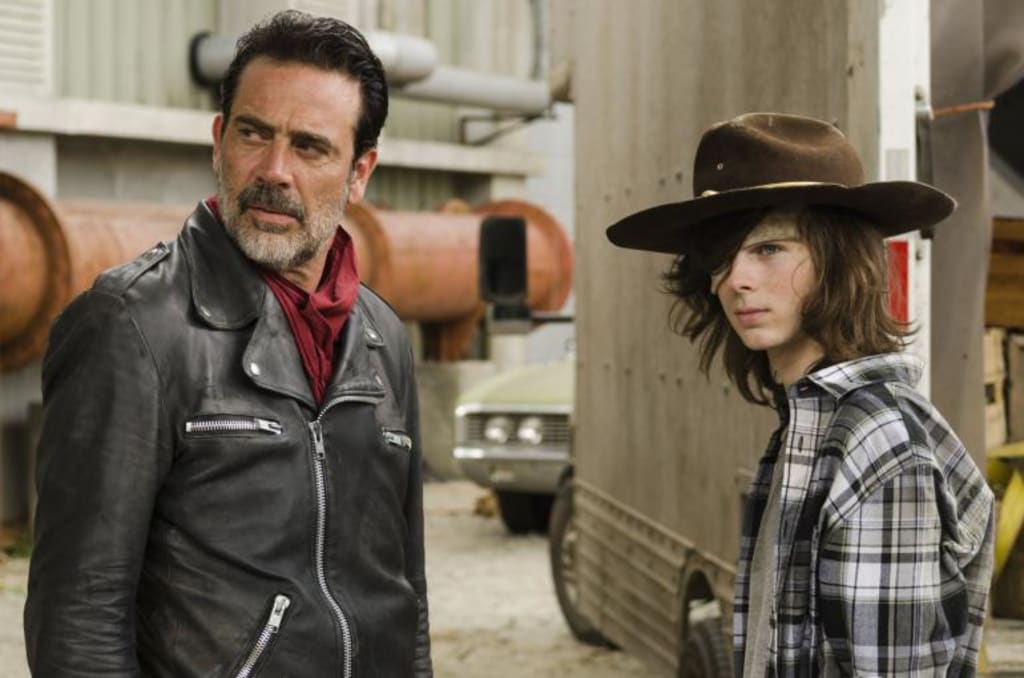
As part of a marketing campaign for The Walking Dead's eighth season, AMC, along with Mountain Dew, are announcing their official release of an augmented reality app called The Walking Dead Encounter. The app was given a soft launch earlier this year at San Diego Comic-Con, where fans were allowed to use the app and explore its minimal functions. At the same time, fans who used the app were asked to send their images across social media to tease the full launch.
As far as features go, the app only starts off with two zombies you can play around with. You can either use them in a virtual reality simulation where a random zombie pops up in your surroundings, leaving you to shake the undead off; or, you can just use the app to your liking, taking multiple various images with it in your everyday life. It's fairly fun at the moment, but the game is intended to pick up steam when the eighth season of The Walking Dead premieres in October.
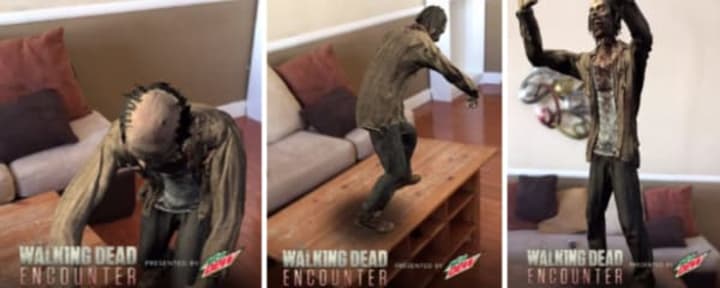
[Credit: AMC / Mountain Dew]
When the newest season does air, the app will introduce a new zombie with every passing episode. But if you're impatient and don't want to wait that long to fool around with more zombie fun, you can go out and buy various Mountain Dew products for promotional codes to unlock more zombies to explore the world with.
Will the new zombies be affiliated with Season 8 of The Walking Dead?
The details surrounding what kind of zombies will become available are unknown, but we can safely assume they'll somehow be linked with episodes of The Walking Dead. The series has become known for introducing various types of zombies, using incredible practical and special effects to make them really pop on screen. That said, we can probably count on this new promotion for The Walking Dead to introduce new types of zombies that'll appear in Season 8, rather than just using the old designs from past seasons. There is, however, one exception that most fans will agree with.
Back in Season 7, the show introduced us to a practically indestructible walker controlled by Jadis and her junkyard crew. The zombie was set on Rick Grimes, but he fortunately came out of the confrontation without too much damage. The reason that particular walker stood out more than others was because of its unique nature. There had been plenty of types before, but none like the spike covered creature seen then. With that being said, fans would most likely want to see a similar walker design on The Walking Dead Encounter app.

'The Walking Dead' [Credit: AMC]
The biggest question is, what kind of zombies will we see in this app? Perhaps a metal covered zombie like the ones guarding Negan's gate at the Sanctuary will be added, or maybe something none of us are expecting will be introduced. As with the fates of each character from week to week, nothing is certain. We'll just have to wait for each episode of The Walking Dead to air to unlock more zombies for The Walking Dead Encounter.
The Walking Dead returned for Season 8 on October 22, 2017.
The Walking Dead Encounter app is available for purchase on IOS and Android devices.
About the Creator
Allie Z.
I cover most entertainment related topics and am venturing into journalism.
Goodbye, Mr. Duvall
It is turning out to be an interesting year. I was in the middle of teaching a class when a pop-up appeared on the screen announcing the death of Mr. Robert Seldon Duvall (yes, that was his full name). I was in the middle of a discussion on the obsession we have with winning when it comes to sports (the Winter Olympics was a theme), and I felt as though things were coming full circle. We had already lost Gene Hackman last year, and along with that titan, it feels though one particular golden age has closed off to be replaced by...?
By Kendall Defoe about 13 hours ago in Geeks
tyra banks
Few figures in modern fashion and television have left a mark as lasting as Tyra Banks. Model, producer, entrepreneur, and cultural commentator, she has navigated multiple industries with a mix of ambition and reinvention. From breaking barriers on international runways to creating one of reality television’s most talked-about franchises, Banks has built a legacy that continues to evolve—especially as conversations resurface through projects like an ANTM documentary and renewed interest in the cultural impact of her work. Early Career and Modeling Breakthrough Before she became a household name, Tyra Banks was a teenage model in Los Angeles determined to challenge industry norms. In the early 1990s, she rose quickly in Paris and Milan, booking an impressive number of runway shows during her first European fashion season. She later became one of the few Black models to secure major contracts with brands such as Victoria’s Secret and Sports Illustrated. Her success was not only personal—it was symbolic. At a time when representation in high fashion was limited, Banks’ visibility signaled change. She spoke openly about body image, colorism, and the pressures young women face in the modeling world. That willingness to discuss difficult topics would later define her television career. The Birth of America’s Next Top Model In 2003, Banks launched America's Next Top Model, widely known as ANTM. The show aimed to discover aspiring models while offering viewers a behind-the-scenes look at fashion photography, runway training, and branding. As creator, host, and executive producer, Banks shaped the tone and direction of the series. Unlike traditional modeling competitions, ANTM blended fashion education with reality-TV drama. Weekly challenges ranged from runway walks to elaborate photo shoots designed to test adaptability. Banks introduced catchphrases, signature critiques, and elimination ceremonies that became part of pop culture. One of the show’s defining elements was its panel of judges. Among them was fashion photographer Nigel Barker, whose calm, professional critiques balanced Banks’ theatrical hosting style. Together with other rotating judges, the panel evaluated contestants not only on beauty but also on marketability and growth. Over more than twenty cycles, ANTM became a global brand, inspiring international adaptations and launching several modeling careers. It also sparked debates about how reality television portrays competition, mentorship, and self-esteem. Cultural Influence and Criticism As America’s Next Top Model gained popularity, it also attracted scrutiny. Critics questioned certain challenges and editing choices, arguing that some moments crossed ethical lines. In later years, clips resurfaced online, prompting fresh discussion about reality television standards in the early 2000s. This renewed conversation has fueled interest in projects described as an America’s Next Top Model documentary or Americas Next Top Model doc. Although there is no official, comprehensive ANTM documentary endorsed by Banks, retrospective discussions—through interviews, podcasts, and unofficial specials—have explored how the show shaped and reflected its era. The idea of an ANTM documentary appeals to fans and critics alike. For supporters, it would highlight the show’s role in diversifying fashion conversations and giving young women a platform. For skeptics, it could offer space for accountability and reflection. In many ways, the ongoing demand for an America’s Next Top Model documentary shows how deeply embedded the series remains in pop culture memory. Reinvention Beyond ANTM While ANTM defined much of her television career, Tyra Banks refused to be confined to one identity. She launched The Tyra Banks Show, a daytime talk show that earned two Daytime Emmy Awards. The program addressed topics ranging from beauty standards to personal transformation, reinforcing her interest in empowerment narratives. Banks also ventured into academia, teaching personal branding at Stanford University for a period and pursuing executive education at Harvard Business School. Her entrepreneurial interests expanded into cosmetics and entertainment production, reflecting her broader vision of “modelland”—a concept blending fantasy, fashion, and storytelling. Her willingness to pivot demonstrates a key aspect of her public persona: resilience. When cycles of ANTM ended and later rebooted, Banks adapted. She stepped away at times, returned as host, and remained closely associated with the franchise’s identity. The Legacy of ANTM in the Streaming Era In the age of streaming, many younger viewers have discovered ANTM for the first time. Episodes circulate on social platforms, prompting re-evaluation of moments that once seemed routine on reality TV. This digital afterlife has intensified calls for an America’s Next Top Model documentary that would contextualize the show within its historical moment. The broader reality-TV landscape has also changed. Contemporary competition shows often emphasize mental health resources and sensitivity training—standards shaped partly by lessons learned from earlier programs like ANTM. Whether celebrated or critiqued, the show undeniably influenced how fashion competitions are structured. Nigel Barker has, in various interviews, reflected on the educational intention behind the series, noting that it aimed to simulate real industry pressures. Those reflections contribute to ongoing dialogue about the balance between authenticity and entertainment. Representation and Industry Impact Tyra Banks’ influence extends beyond television formats. She consistently advocated for broader definitions of beauty. Long before “body positivity” became a mainstream term, she challenged narrow expectations in modeling. She spoke candidly about weight fluctuations and criticized tabloids for shaming women’s bodies. By placing contestants of diverse backgrounds on national television, ANTM introduced audiences to different expressions of femininity and identity. While the execution was not without flaws, the intent to widen representation marked an important shift in early-2000s media. An ANTM documentary—should one fully materialize—would likely explore this dual legacy: empowerment alongside controversy. That complexity mirrors Banks herself. She is both architect of a groundbreaking series and participant in a television culture that often prioritized drama over nuance. Looking Forward Today, Tyra Banks remains a recognizable figure in entertainment and business. Discussions about an Americas Next Top Model doc continue to surface in fan communities, underscoring the enduring fascination with the franchise. Whether through an official America’s Next Top Model documentary or through ongoing public conversations, the story of ANTM is still being written. Ultimately, Tyra Banks’ career illustrates how media figures evolve alongside the industries they help shape. From supermodel to television mogul, from mentor to subject of retrospective critique, she has occupied many roles. Her journey reflects broader changes in fashion, reality television, and cultural accountability. In revisiting ANTM and imagining a future America’s Next Top Model documentary, audiences are not only reconsidering a television show—they are examining a specific era of entertainment. And at the center of that conversation remains Tyra Banks: ambitious, controversial, and undeniably influential.
By Saboor Brohi about 9 hours ago in Geeks


Comments
There are no comments for this story
Be the first to respond and start the conversation.