
One World to Rule Them All
How Tolkien created the perfect fantasy world for millions of readers all over the world.

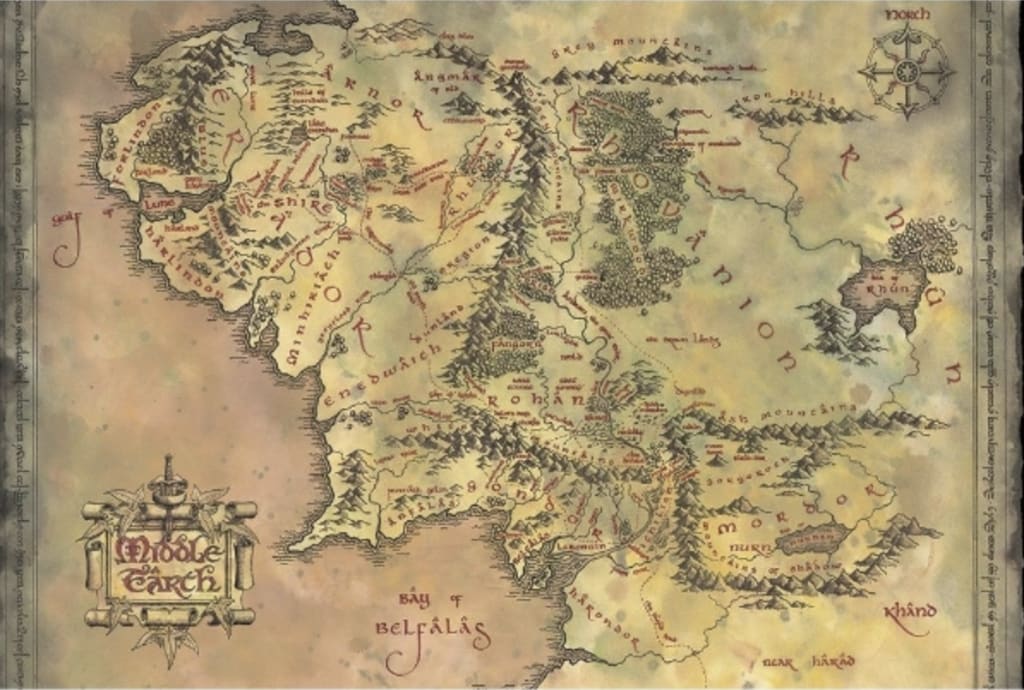
I remember first stumbling across the fantastical works of Tolkien when I was 8 years old. While other children in my class were reading the latest Jacqueline Wilson novels, I was riding through the plains of Rohan with the Rohirrim, I was defending the walls of Minas Tirith, I was part of the strongest fellowship ever created and I walked with them every step from the green meadows of Hobbiton, to the fiery slopes of Mount Doom.
Tolkien didn't just have an idea for a story. He didn't just create a couple of characters and a some villages and cities to serve a purpose in the narrative. He created an entire world, complete with different: languages, races, mythologies, species, culture, geographical features, songs, riddles and so much more. Every single, minute detail that flowed from his genius mind, has allowed millions of people over the last 100 years to be transported from our own reality into the fantasy world of Middle-Earth, due to the heart and soul Tolkien poured into his many works.
Here are the 5 main reasons that Tolkien created the perfect fantasy world.
1) He was a philologist who studied languages in oral and written histories. He created his first language in his teenage years.
Tolkien had a passion for constructing not only languages, but mythologies for his fictional works. He once said he believed languages and names came first and the story followed. He actually wanted to write the whole of the Lord of the Rings in Elvish, but decided to leave in as much as the readers could 'stomach'. He also believed that for a language to be convincing, it must include a history of not only its etymological development, but the history of its speakers too. For most of his languages, he developed the grammatical structure and phonics to demonstrate how the language would have sounded.
- There were 3 strands of Elvish language (early, middle and late) which branched off into at least 10 variations.
-'Mannish' languages: including the speech of Gondor, the Rohirrim and the Hobbits of the Shire. However, by the Third Age (when The Lord of the Rings was set) most of the people of the Western Lands in Middle-Earth spoke the Common Tongue as their native language.
- Dwarvish, although Dwarves mainly spoke in the Common Tongue, one of their languages 'Khuzdul' was never spoken amongst outsiders, the examples seen in The Lord of the Rings are kept in their original form and not translated.
-Entish: is described as similar to Elvish, as the Elves first taught the Ents how to speak. However, as their language developed it became more slow, sonorous and 'long-winded' and would have sounded like a woodwind instrument.
- Adûnaic or Númenórean: (the language of the Men of Númenor) which is said to be the language from which the Common Tongue is derived.
2) Tolkien was inspired by Old Norse myths and legends:
Many place names and ideas used by Tolkien are inspired from Norse legends and tradition. For example, in Norse mythology humans live on Midgard or Middle-Earth, hence Tolkien using this name for the land LOTR is set in. Additionally, Norse mythology describes the gods living in a land called Asgard (which is above Midgard) and is described much like Valinor, the Undying Lands of the Elves. Similarly, in the heroic sagas in Norse mythology, powerful swords had names that told their stories (e.g. Andúril, Glamdring, Sting etc.) and there were also rings forged by the dwarves on Muspelheim that symbolised power... sound familiar?
3) He created an entire mythology and history of the peoples of Middle-Earth:
Although Tolkien revised and changed parts of his works over the decades, he created a fully-formed historical account of Middle-Earth as a complete world, rather than just adding stories to revolve around the events of the Lord of the Rings.
- The Silmarillion, is a published tale of the origins of Middle-Earth, starting in the very First Age. Tolkien worked on this mythology for over 50 years.
- 'The History of Middle-Earth' consists of 12 volumes that cover the main events in Middle-Earth leading up to The Lord of the Rings. Including 'The War of the Ring' and 'Sauron Defeated' which we only see glimpses of in the books and movies.
4) Every single character Tolkien created is relatable:
Tolkien used classic themes of love, friendship and the ultimate battle of good versus evil that make the best pieces of literature so iconic and powerful. For example, Sam Gamgee's determination and unwavering support, even when his best friend has been corrupted by the ring. The iconic line of "I can't carry it for you, but I can carry you." Was a moment that resounded within all of us, who have experienced the turmoil of watching a friend going through a hardship you just couldn't control.
From the warmer, softer moments of Tom Bombadil singing through the forest, to Treebeard supporting Merry and Pippin and the forces of men joining together for one last battle against Sauron, to the darker moments of the heartbreak of fallen kin, longing for the return of loved ones and the sacrifices felt by every character, that make Tolkien's world relatable to each person who reads the books.
5) Tolkien's Legacy:
Not only were Tolkien's many stories (both set in and outside of Middle-Earth) popular during his lifetime; but the efforts, thoughts and passion that Tolkien felt have allowed his stories to be discovered by each passing generation.
Over his career, Tolkien kept tweaking and reworking his stories, mythologies and languages which meant that some of his narrative work was never fully finished. After his passing in 1973, his son Christopher took charge of piecing together scraps of his father's work into a more cohesive piece. During this time, more than 30 narrative works have been published to expand the already fantastical world Tolkien fans already knew.
Simply, J.R.R. Tolkien was truly a master of his craft and took creating whole worlds to the next level. He inspired other masters such as Terry Pratchett, J.K. Rowling and more to create whole worlds that readers can get lost in with every page. He allowed his readers to go on a journey with him, to experience Middle-Earth through the character's eyes so when the readers came to read the final page of The Return of the King, the ending of this perilous journey was not only for Sam and the rest of the Fellowship, but for the dedicated audience too.
"Well," he said, "I'm back."
About the Creator
T. Freya Taylor
Im Freya, archaeologist, teacher and proud Ravenclaw and officially a published author (check out ‘The Mummy’s Curse: Secrets and Senet!) I’m fuelled by my passion for ancient history, culture and mythology, especially ancient Egypt.
Keep reading
More stories from T. Freya Taylor and writers in Geeks and other communities.
Top 11 Hamilton Moments
When Disney+ dropped earlier this year, people were exposed to such a plethora of new material that hadn't been accessible anywhere before. The best of which (in my opinion) was the Broadway recording of Lin-Manuel Miranda's phenomenal hit, Hamilton.
By T. Freya Taylor5 years ago in Geeks
Not Just For Clean Up: A History Of The MCU's Department of Damage Control
Initially an organisation that seemed to exist to help the heroes of the Marvel Cinematic Universe, from Phase Four onwards, the Department of Damage Control has shifted into a more antagonistic role. Most recently seen in the Wonder Man series, the current incarnation of Damage Control seems to target superpowered individuals, regardless of whether that person poses an active or intentional threat.
By Kristy Anderson5 days ago in Geeks
Russia’s Extreme Winter Storms Are a Climate Wake-Up Call the Kremlin Is Ignoring
Russia has recently experienced increasingly extreme winter storms, raising concerns among climate scientists, environmental researchers, and global policy observers. Some analysts argue these severe weather patterns should serve as a climate warning for policymakers, while critics claim current responses remain focused on short-term economic priorities rather than long-term environmental planning.
By Aarif Lashari2 days ago in Geeks



Comments
There are no comments for this story
Be the first to respond and start the conversation.